🔄 More collisions
If particles collide more often, there are more chances for a successful collision every second.
Sign up to access the complete lesson and track your progress!
Unlock This CourseYou already know that some factors make reactions faster. Collision theory explains why. It is the idea behind every exam answer about rate.
According to collision theory, a chemical reaction can only happen when two things are true:
Many collisions do not lead to a reaction. The particles just bounce off each other, like two snooker balls. Only the collisions with enough energy are successful.
Key terms:

Like a shot on goal, a collision only counts if it has enough energy - that minimum is the activation energy
Remember, the minimum energy particles must have to react is called the activation energy. A collision with less energy than this does not cause a reaction. A collision with at least this much energy can.
Think of a football match. Passing the ball gently along the ground does not score a goal. Only a hard enough shot gets it into the net. In the same way, only a hard enough collision breaks the bonds in the reactants.
So there are two ways to make a reaction faster:
If particles collide more often, there are more chances for a successful collision every second.
If the particles move faster, a bigger share of collisions have at least the activation energy.
The rate of reaction goes up when either of these happens. Look for them in every answer.
In a solution, the reacting particles are spread out in the water. In a more concentrated solution there are more reacting particles in the same volume. They are packed closer together.
So the particles collide more often. The frequency of collisions increases, so the rate of reaction increases.
Notice that the particles are not moving any faster. Each collision has the same energy as before. There are just more of them every second.
Simple proportionality: if you double the concentration, there are twice as many particles in the same space, so there are about twice as many collisions each second. The rate roughly doubles.
Gas particles are far apart. If you raise the pressure, the same number of gas particles is squeezed into a smaller volume. They are closer together.
So the particles collide more often. The frequency of collisions increases, so the rate of reaction increases. This is the same idea as concentration, because squeezing a gas makes it more concentrated.
Pressure only matters for reactions where a gas is a reactant. It makes no real difference to reactions with only solids and liquids.
A gas is compressed so its volume halves. The same number of particles now has half the space, so there are twice as many particles in each cm3. Collisions become about twice as frequent, so the rate roughly doubles.
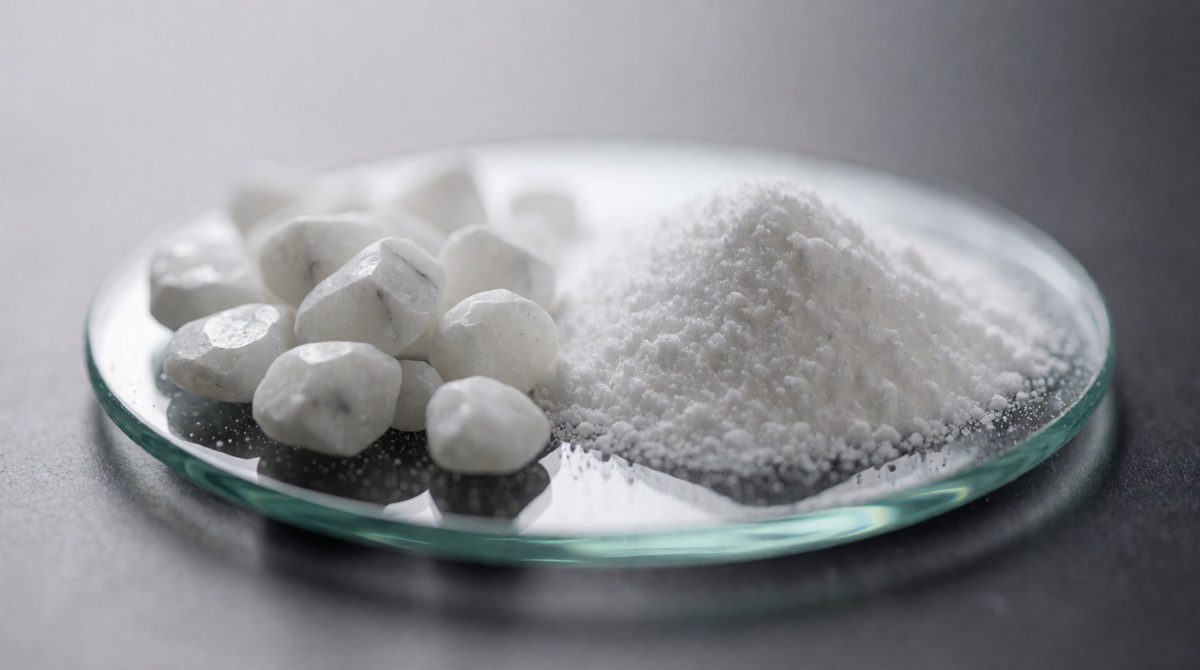
Chop it smaller and more particles are on the surface - so collisions happen more often and the reaction speeds up
In a reaction between a solid and a liquid or gas, the reaction happens at the surface of the solid. Particles inside a lump cannot be hit.
If you break a solid into smaller pieces, more of its particles are on the outside. There is more surface for the other reactant to hit. So the frequency of collisions increases and the rate of reaction increases.
Remember the surface area to volume ratio. Small pieces have a bigger surface area compared with their volume. Here are two cubes of the same solid:
The smaller cube has the bigger ratio. Cutting the 2 cm cube into eight 1 cm cubes gives the same mass, but twice the surface area to volume ratio. So smaller pieces react faster than one big lump.
Powdered zinc reacts faster with acid than one large lump of zinc of the same mass. Why? The powder has a much bigger surface area to volume ratio. More zinc particles are exposed, so acid particles collide with zinc more often.
Temperature is special because it does two things.
When you heat a mixture, the particles move faster. They meet each other more often, so the frequency of collisions increases.
Faster particles also have more energy. The collisions are more energetic, so more of them reach the activation energy and are successful.
Both effects make the rate of reaction increase.
1. Saying "more collisions" for temperature and stopping there. You must also say the collisions are more energetic.
2. Saying concentration makes particles move faster. It does not. It only makes collisions more frequent.
3. Saying surface area makes particles collide harder. It does not change the energy of collisions.
4. Saying collisions only happen at high temperature. Collisions always happen. The problem is that not enough of them have the activation energy.
5. Writing "more collisions" with no reason. Say why there are more collisions.
A student reacts magnesium ribbon with dilute hydrochloric acid. Explain, using collision theory, why the reaction is faster when the acid is warmed from 20 °C to 40 °C. [4 marks]
The particles move faster at the higher temperature, so they collide more often (the frequency of collisions increases). The particles also have more energy, so a greater proportion of collisions have at least the activation energy. More collisions are successful in each second, so the rate of reaction increases.
For an "explain" question about temperature, make two separate points: more frequent collisions and more energetic collisions. For concentration, pressure and surface area, the frequency point is enough.