🔥 Heating
The forward reaction happens. The white solid breaks down into ammonia gas and hydrogen chloride gas.
Sign up to access the complete lesson and track your progress!
Unlock This Course
Once ash is made it can't turn back into wood - but some reactions really can run both ways
Most reactions you have met so far go one way. Magnesium burns to make magnesium oxide, and you cannot turn the oxide back into magnesium just by leaving it alone. But some reactions are different. In these, the products can react with each other to make the original reactants again.
Think of a revolving door. People can walk through it in either direction. A reversible reaction is like that: particles can go forwards to make products, and backwards to make reactants.
Key terms:
We show a reversible reaction with a double arrow, ⇌, instead of a single arrow. For reactants A and B making products C and D, we write:
A + B ⇌ C + D
The two half arrows remind us that the reaction goes in both directions at the same time.
The direction can be changed by changing the conditions. For example, heating may push a reaction one way, and cooling may push it back the other way. The reaction is not stuck in one direction.
Key term:
Ammonium chloride is a white solid. When you heat it, it breaks down into two gases: ammonia and hydrogen chloride.
NH4Cl(s) ⇌ NH3(g) + HCl(g)
The forward reaction happens. The white solid breaks down into ammonia gas and hydrogen chloride gas.
The reverse reaction happens. The two gases meet in the cooler part of the tube and make white ammonium chloride solid again.
So the same chemicals can be turned into each other just by changing the temperature.
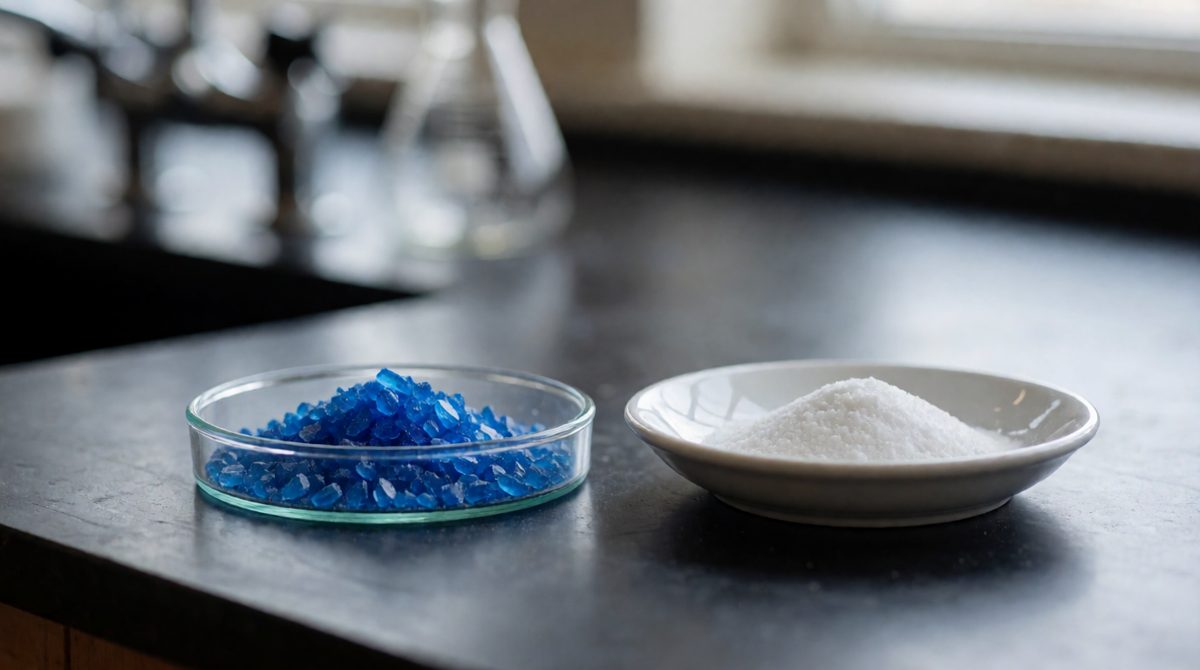
Drip water on white anhydrous copper sulfate and it turns blue again - the reverse reaction gives out heat
Hydrated copper sulfate is a blue solid. It contains water that is part of the crystal. When you heat it, the water is driven off and a white powder is left. This powder is called anhydrous copper sulfate, which means "without water".
hydrated copper sulfate (blue) ⇌ anhydrous copper sulfate (white) + water
Key terms:
You already know that exothermic reactions transfer energy to the surroundings, and endothermic reactions take it in. In a reversible reaction, the two directions are opposites:
If a reversible reaction is exothermic in one direction, it is endothermic in the opposite direction. The same amount of energy is transferred in each case.
Look at the copper sulfate example again:
The ammonium chloride reaction follows the same rule. Heating it to break it down is endothermic. The gases joining back together gives out the same amount of energy, so that direction is exothermic.
The key idea is "same amount". If the forward reaction takes in 50 units of energy, the reverse reaction gives out exactly 50 units. No energy is lost or made.
A reversible reaction A ⇌ B is endothermic in the forward direction and takes in 40 kJ. What is the energy change for the reverse reaction?
The reverse reaction is exothermic. It gives out the same amount of energy: 40 kJ.
Now imagine a reversible reaction in a sealed flask. Nothing can escape. At the start, there are only reactants, so the forward reaction is fast. As products build up, the reverse reaction starts and speeds up. Meanwhile the forward reaction slows down, because reactants are being used up.
After a while, the two rates become exactly the same. This is called equilibrium. At equilibrium, the forward reaction and the reverse reaction are still going on, but they cancel each other out. So the amounts of reactants and products stop changing.
Think of a shop with a queue. If people join the queue as fast as others are served, the queue stays the same length. People are still moving, but the length does not change.
Key terms:
Equilibrium is only reached when the apparatus stops the reactants and products escaping. If a product is a gas and the flask is open, the gas floats away. The reverse reaction then cannot happen, because there is nothing left to react. So the system never reaches equilibrium.
In an open test tube, some of the gases from ammonium chloride can escape from the top. Then the system is not closed, and equilibrium is not reached. To reach equilibrium, the chemicals must be sealed in.
1. Saying the reaction has stopped at equilibrium. It has not. Both reactions carry on at the same rate.
2. Saying there are equal amounts of reactants and products. Equilibrium means equal rates, not equal amounts.
3. Forgetting that equilibrium needs a closed system.
4. Using a single arrow for a reversible reaction. Use ⇌.
Hydrated copper sulfate is blue. When it is heated, it forms white anhydrous copper sulfate and water. The reaction is reversible.
(a) Write the word equation for the reaction, using the correct arrow. (2 marks)
(b) Water is added to the white solid. It turns blue and gets warm. Is this direction exothermic or endothermic? What does this tell you about heating the blue solid? (2 marks)
(c) Explain what is meant by equilibrium. (2 marks)
(a) hydrated copper sulfate ⇌ anhydrous copper sulfate + water (1 mark for the correct chemicals, 1 mark for the double arrow).
(b) It is exothermic, because the temperature rises (1 mark). So heating the blue solid is endothermic, and the same amount of energy is transferred (1 mark).
(c) Equilibrium is reached when the forward and reverse reactions happen at exactly the same rate (1 mark), in a closed system where nothing can escape (1 mark).
When asked about energy in the reverse reaction, say "the opposite type, and the same amount of energy".