➕ Increase a reactant
If the concentration of a reactant is increased, more products will be formed until equilibrium is reached again.
Everything in this lesson is for Higher tier students only. If you are sitting Foundation tier, you can skip it.
Sign up to access the complete lesson and track your progress!
Unlock This Course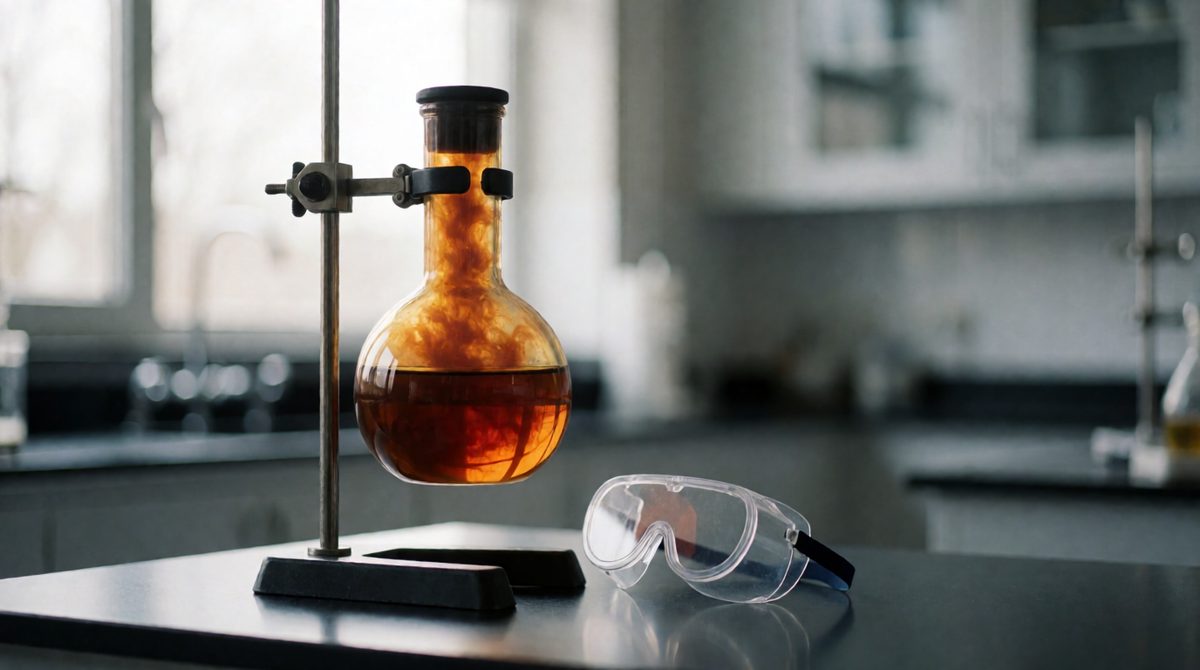
In this sealed flask the reaction goes both ways at once. At equilibrium the colour stops changing
In a reversible reaction at equilibrium, the amounts of reactants and products stay steady. But those amounts are not fixed for ever. The relative amounts of all the reactants and products at equilibrium depend on the conditions of the reaction.
So what happens if someone changes a condition? The system does not just sit there. It responds to counteract the change. That means it works against the change to try to cancel it out.
Key terms:
Le Chatelier's Principle lets us predict what will happen when we change a condition. You do not need to do any calculations. You only need to make a qualitative prediction. That means saying what will happen in words, such as "more product" or "less reactant".
A good way to think about it is a spring. If you push it down, it pushes back up. Equilibrium works in a similar way. If you disturb it, the mixture pushes back until it settles down again.
In this lesson we look at one condition: concentration. Temperature and pressure are covered in the next lesson.
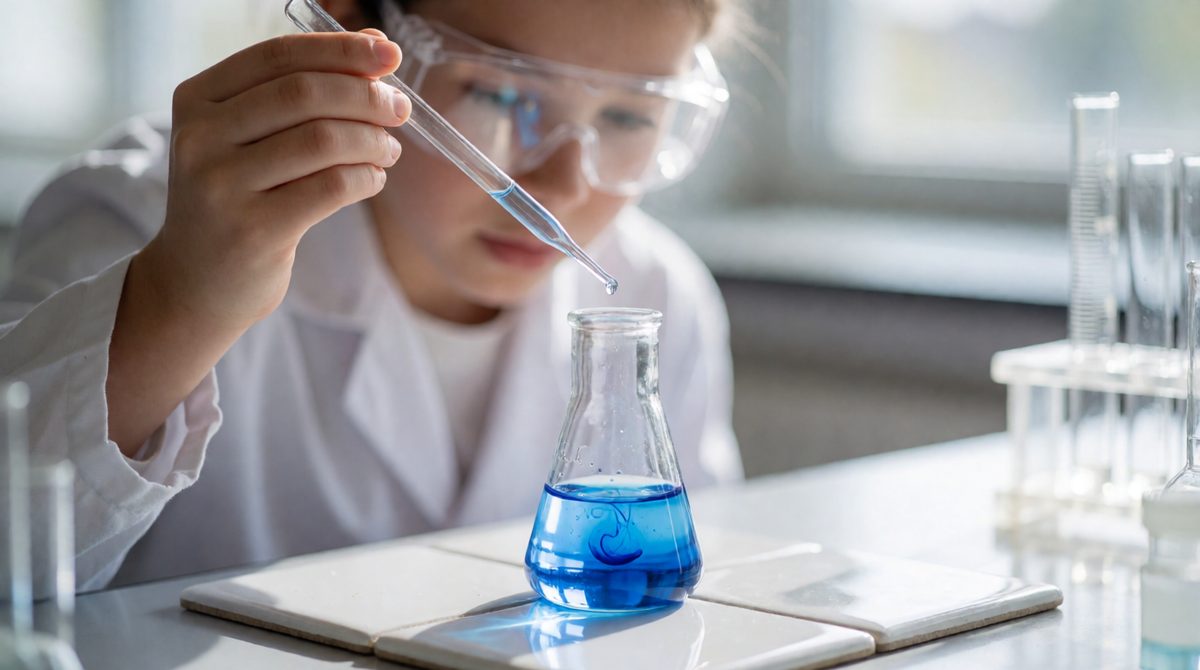
Add more reactant and the equilibrium shifts to use it up, so watch the colour change as more product forms
Take a reversible reaction that has reached equilibrium. Now change the concentration of one of the reactants or products. At that moment the system is no longer at equilibrium. The concentrations of all the substances then change until equilibrium is reached again.
There are two rules to learn. They both follow from Le Chatelier's Principle.
If the concentration of a reactant is increased, more products will be formed until equilibrium is reached again.
If the concentration of a product is decreased, more reactants will react until equilibrium is reached again.
Notice the pattern. The system always tries to undo the change you made. Too much reactant? It uses some up by making more product. Not enough product? It makes some more by reacting more reactant.
The same thinking works the other way round. The system always works against whatever you did.
Increase a reactant: more products formed.
Decrease a reactant: less product.
Increase a product: more reactants are formed as some product changes back.
Decrease a product: more reactants react, so more products are made.
Hydrogen and iodine gases react in a closed container to make hydrogen iodide. The reaction is reversible:
H2(g) + I2(g) ⇌ 2HI(g)
The mixture is at equilibrium. More hydrogen is added. What happens to the amount of hydrogen iodide?
Step 1: Hydrogen is a reactant, and its concentration has gone up.
Step 2: The system is no longer at equilibrium.
Step 3: To counteract the change, the system uses up some of the extra hydrogen. It reacts with iodine to form more hydrogen iodide.
Answer: the amount of hydrogen iodide increases until equilibrium is reached again.
Now some of the hydrogen iodide is removed from the same mixture. What happens?
Step 1: Hydrogen iodide is a product, and its concentration has gone down.
Step 2: To counteract the change, more reactants react to make more hydrogen iodide.
Answer: the amounts of hydrogen and iodine go down, and more hydrogen iodide is made until equilibrium is reached again.
In the exam you may be given a reaction, or a table of data, and asked to predict the effect of a change. Follow these steps:
A + B ⇌ C + D. At equilibrium the concentrations are: A 0.40, B 0.40, C 0.20, D 0.20 mol/dm3. More A is added and the concentration of A rises to 0.80 mol/dm3. What happens to C and D?
A is a reactant and its concentration has increased. The system counteracts this by using up some A. So more products are formed. The concentrations of C and D go up above 0.20 mol/dm3 and the concentration of B goes down below 0.40 mol/dm3, until equilibrium is reached again.
Notice that the concentration of A does not stay at 0.80. It falls back a bit as some A is used up. But it does not fall all the way back to 0.40.
1. Saying the equilibrium "stops" when you change a concentration. It does not stop. The reaction keeps going, and the amounts change until equilibrium is reached again.
2. Saying that the reaction only goes one way. Both the forward and reverse reactions carry on.
3. Forgetting to say which substance changed and whether it is a reactant or a product.
4. Mixing up the direction. Adding a reactant gives more products. Removing a product gives more products too.
Nitrogen dioxide and dinitrogen tetroxide are in equilibrium in a sealed container: 2NO2 ⇌ N2O4
(a) Some extra NO2 is added at equilibrium. Predict the effect on the amount of N2O4. Explain your answer. (2 marks)
(b) Some N2O4 is removed from the container. Predict the effect on the amount of NO2. (2 marks)
(a) The amount of N2O4 increases. NO2 is a reactant and its concentration has increased, so the system counteracts the change by forming more product until equilibrium is reached again.
(b) The amount of NO2 decreases. N2O4 is a product and its concentration has decreased, so more reactant reacts to form more N2O4 until equilibrium is reached again.
Use the words "counteract" and "until equilibrium is reached again". Always say whether the changed substance is a reactant or a product.