🔥 Forward reaction endothermic
Raising the temperature favours the forward reaction. The relative amount of products at equilibrium increases.
Everything in this lesson is for students sitting the Higher tier paper.
Sign up to access the complete lesson and track your progress!
Unlock This Course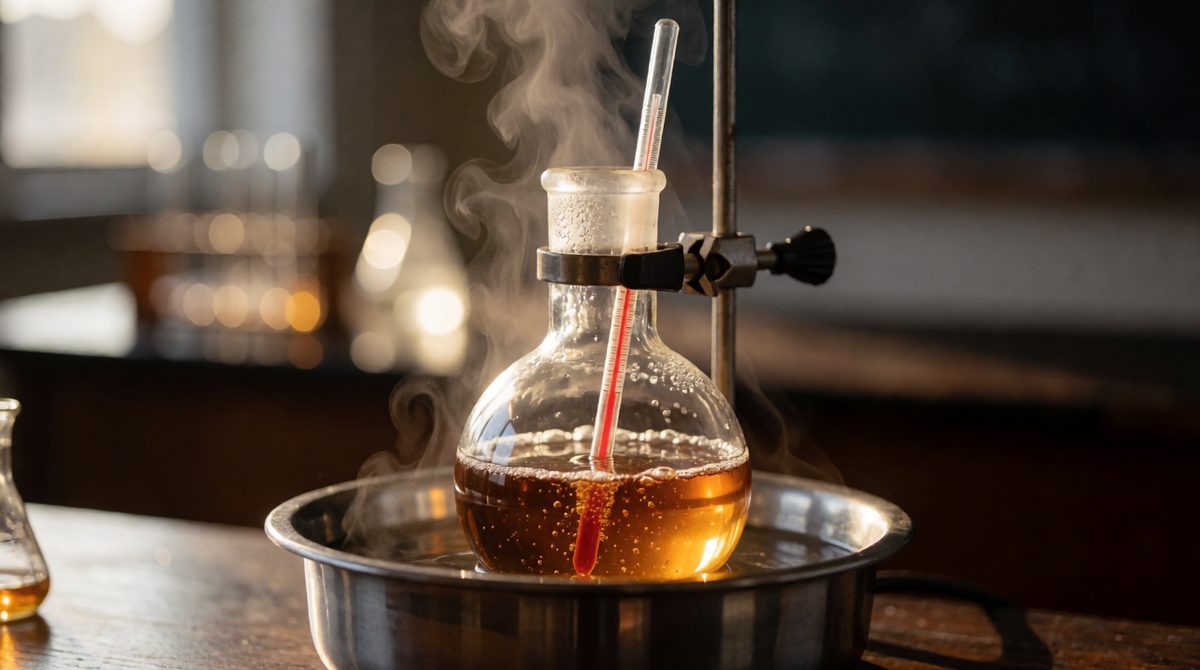
Cold pack or hot pack, it's all about heat flow - and in an equilibrium, heating up favours whichever direction takes heat in
Remember, the position of equilibrium moves to counteract any change you make. Temperature is one more thing you can change. Here the system fights back by using up or giving out heat energy.
In a reversible reaction, one direction is exothermic and the other is endothermic. The two directions always have equal and opposite energy changes. So heating or cooling the system helps one direction more than the other.
Key terms:
If the temperature is increased, the system tries to take in the extra heat. The endothermic direction takes in heat, so it is favoured.
Raising the temperature favours the forward reaction. The relative amount of products at equilibrium increases.
Raising the temperature favours the reverse reaction, which is endothermic. The relative amount of products at equilibrium decreases.
If the temperature is decreased, the system tries to give out heat to replace what was lost. The exothermic direction gives out heat, so it is favoured.
Cooling favours the reverse reaction, which is exothermic. The relative amount of products at equilibrium decreases.
Cooling favours the forward reaction. The relative amount of products at equilibrium increases.
Heat it up and the endothermic direction wins. Cool it down and the exothermic direction wins. Then ask: is that direction the one making products or reactants?
The reaction PCl5(g) ⇌ PCl3(g) + Cl2(g) is endothermic in the forward direction. What happens to the relative amount of products if the temperature is increased?
Step 1: the forward reaction is endothermic.
Step 2: raising the temperature favours the endothermic direction, which is the forward reaction.
Step 3: the relative amount of products at equilibrium increases.
If the same system is cooled, the exothermic reverse reaction is favoured, so the relative amount of products decreases.
You may be given data and asked to predict what a temperature change does. It might be an energy change or a table of results. Look for the sign of the energy change in the forward direction. A positive energy change, or "takes in energy", means endothermic. A negative one, or "releases energy", means exothermic.
Or you may be given results at different temperatures. If the amount of product rises as the temperature rises, the forward reaction must be endothermic. If it falls, the forward reaction must be exothermic.
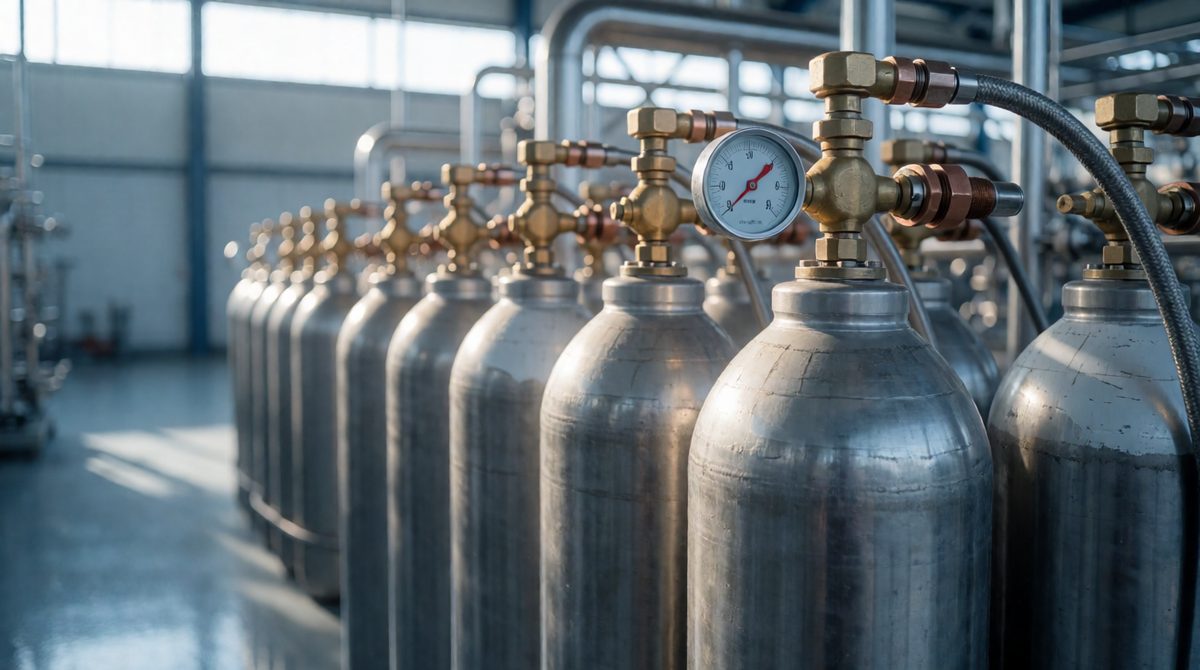
These sealed gas cylinders are under serious pressure - raise the pressure on a gas equilibrium and it shifts to the side with fewer molecules
Pressure only matters for gaseous reactions at equilibrium. Gas particles bump into the walls of their container, and that is what makes pressure. More gas molecules means more pressure. So the system fights a pressure change by changing the number of gas molecules.
Key terms:
The equilibrium position shifts towards the side with the smaller number of molecules. This lowers the pressure again.
The equilibrium position shifts towards the side with the larger number of molecules. This raises the pressure again.
The symbol equation tells you the numbers. Count the gas molecules on each side using the balancing numbers.
2SO2(g) + O2(g) ⇌ 2SO3(g)
Left side: 2 + 1 = 3 molecules. Right side: 2 molecules.
If the pressure is increased, the equilibrium shifts towards the right, the smaller number of molecules. The relative amount of products increases.
If the pressure is decreased, the equilibrium shifts towards the left, the larger number of molecules. The relative amount of products decreases.
PCl5(g) ⇌ PCl3(g) + Cl2(g)
Left side: 1 molecule. Right side: 1 + 1 = 2 molecules.
Increasing the pressure shifts the equilibrium to the left, the side with fewer molecules. The relative amount of products decreases.
N2(g) + O2(g) ⇌ 2NO(g)
Left side: 1 + 1 = 2 molecules. Right side: 2 molecules.
Both sides have the same number of molecules, so the equilibrium position does not shift when the pressure changes.
If you are given an equation with state symbols, count only the gases. Anything marked (s), (l) or (aq) does not count. If you are given results, check whether the product amount rises or falls as pressure rises. A rising product amount means the products side has fewer gas molecules.
1. Mixing up "favours the endothermic direction" with "favours the forward reaction". Always check which direction is endothermic first.
2. Forgetting the balancing numbers. In 2SO2 there are 2 molecules, not 1.
3. Counting solids and liquids when working out pressure effects. Only gases count.
4. Saying pressure shifts equilibrium towards the side with the "bigger" molecules. It is the number of molecules that matters, not their size.
The reaction below is exothermic in the forward direction and reaches equilibrium in a closed container.
2SO2(g) + O2(g) ⇌ 2SO3(g)
Predict and explain the effect on the relative amount of SO3 at equilibrium of (a) increasing the temperature and (b) increasing the pressure. [4 marks]
(a) The forward reaction is exothermic, so the reverse reaction is endothermic. Increasing the temperature favours the endothermic reverse reaction, so the relative amount of SO3 decreases.
(b) The left side has 3 gas molecules and the right side has 2. Increasing the pressure shifts the equilibrium towards the side with the smaller number of molecules, which is the right. So the relative amount of SO3 increases.
Write the direction in words every time: "favours the endothermic reaction" or "shifts towards the side with fewer molecules". Then say what that does to the products. That gets the marks.