⚗ Catalytic cracking
The large hydrocarbons are heated until they are a gas. The vapour is then passed over a hot catalyst, such as zeolite. The catalyst helps the molecules break apart.
Sign up to access the complete lesson and track your progress!
Unlock This Course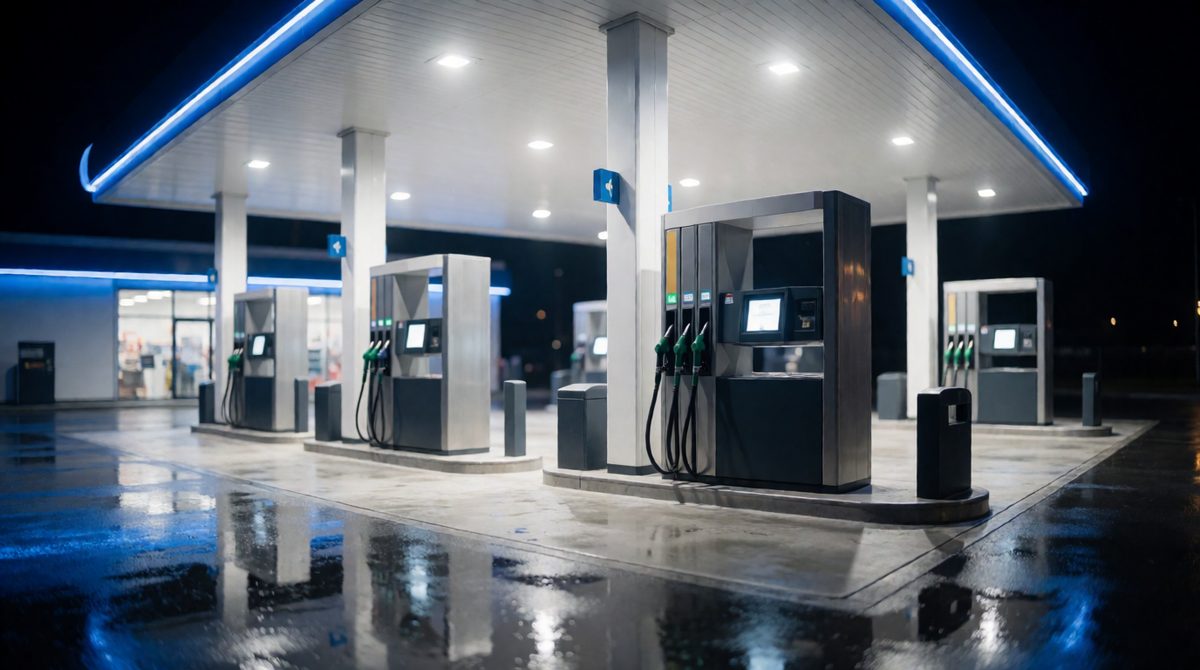
Petrol is in huge demand, so refineries crack long, less useful molecules into smaller ones that fill pumps like these
Fractional distillation gives us fractions with lots of different molecule sizes. The trouble is that we do not need the same amount of each one. There is a high demand for fuels with small molecules, such as petrol and kerosene. There is far less demand for the large molecules in thick fractions like heavy fuel oil.
Large hydrocarbons are thick, hard to set alight and burn badly. Small hydrocarbons flow easily and burn well. So the industry breaks the large molecules into smaller, more useful ones. This is called cracking.
Key terms:
In cracking, a big molecule is split up when it is heated. There are two main methods. You should be able to describe the conditions for each in general terms.
The large hydrocarbons are heated until they are a gas. The vapour is then passed over a hot catalyst, such as zeolite. The catalyst helps the molecules break apart.
The large hydrocarbons are heated to a gas and mixed with steam. The mixture is then heated to a very high temperature. There is no catalyst.
Both methods use heat to break the strong covalent bonds in the long carbon chains. That is why the temperatures are high.
The products of cracking are always a mixture. They include:
Alkenes are not just waste. They are used to make polymers, such as plastics. They are also the starting materials for making many other chemicals.
Used as fuels. They help to meet the high demand for petrol and other small-molecule fuels.
Used to make polymers and as starting materials for many other chemicals.
Modern life depends on hydrocarbons. We use them as fuels for transport and heating, and as the raw materials for plastics and many other everyday products. Cracking helps to make sure we get the right mix of these products from every barrel of crude oil.
A cracking equation has one large hydrocarbon on the left and two or more smaller molecules on the right. The rules are the same as for any equation: the number of each type of atom must be the same on both sides.
Here is a cracking reaction. The alkene made is ethene, C2H4.
C10H22 → C8H18 + C2H4
Count the atoms. Carbon is 10 on the left and 8 + 2 = 10 on the right. Hydrogen is 22 on the left and 18 + 4 = 22 on the right. It is balanced.
Balance: C14H30 → C8H18 + __ C2H4
Step 1: carbon. 14 − 8 = 6 carbon atoms left over. Each C2H4 has 2 carbon atoms, so we need 6 ÷ 2 = 3 of them.
Step 2: check hydrogen. 18 + (3 × 4) = 18 + 12 = 30. It matches.
Answer: C14H30 → C8H18 + 3C2H4
A good trick: the products must have the same total number of carbon atoms and the same total number of hydrogen atoms as the starting hydrocarbon. Work out the carbon first, then check the hydrogen.
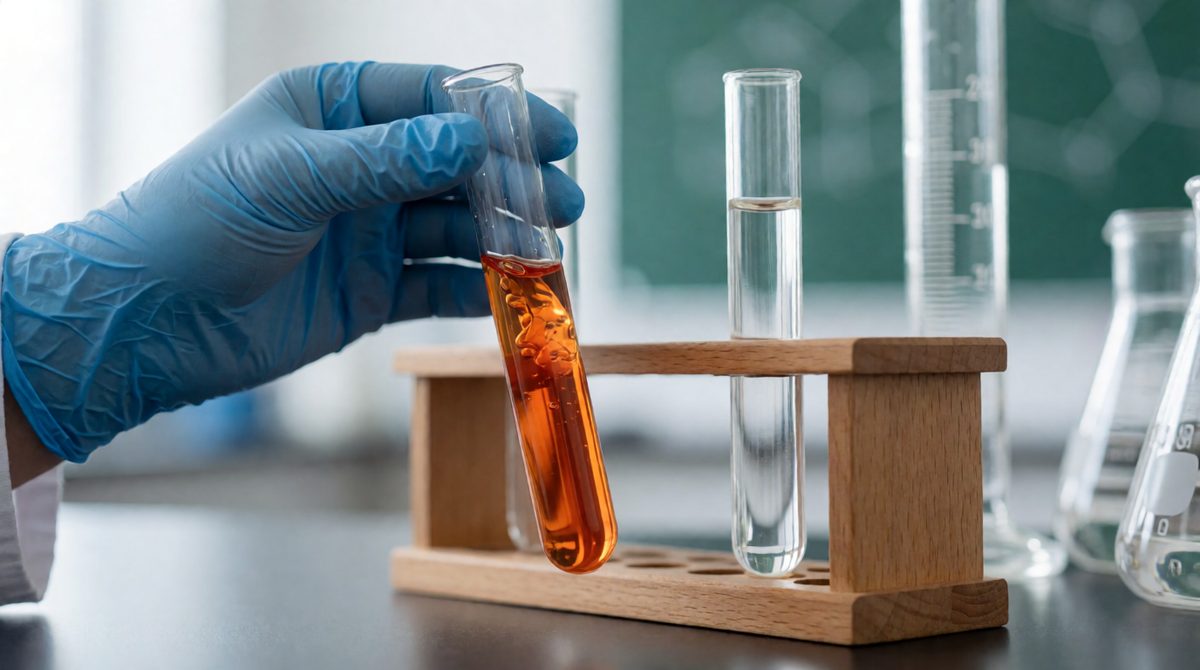
Orange-brown bromine water turning colourless means an alkene is in there - the classic test for a C=C bond
Alkenes are more reactive than alkanes. We use this to tell them apart. The test uses bromine water, which is orange-brown.
Do not say the bromine water goes "clear" or "white". Say it goes colourless. Also, an alkane does not decolourise bromine water: it stays orange. Finally, cracking is not the same as fractional distillation. Distillation separates molecules that are already there, using boiling points. Cracking is a chemical reaction that makes new, smaller molecules.
A hydrocarbon with the formula C12H26 is cracked. One product is C6H14. The other product is ethene, C2H4.
(a) Balance the equation: C12H26 → C6H14 + __ C2H4 (2 marks)
(b) Describe a test to show that ethene is made, and give the result. (2 marks)
(c) Give one reason why oil companies crack large hydrocarbons. (1 mark)
(a) Carbon: 12 − 6 = 6, and 6 ÷ 2 = 3. So the number is 3. Check hydrogen: 14 + 12 = 26. C12H26 → C6H14 + 3C2H4
(b) Shake the gas with bromine water. If ethene is present, the bromine water changes from orange-brown to colourless.
(c) There is a high demand for small molecules as fuels, and cracking makes more of them. (Or: it makes alkenes, which are used to make polymers.)
In a cracking equation, count carbon first, then check hydrogen. Always write the colour change for bromine water in full: orange-brown to colourless.