Alkenes, Alcohols and Carboxylic Acids » Reactions of Alkenes
What you'll learn this session
Study time: 30 minutes
AQA spec: 4.7.2.2
- Why alkenes burn with smoky flames
- How hydrogen, water (steam) and halogens add across the C=C double bond
- The conditions and products of each addition reaction
- How to draw the products for the first four alkenes
🔒 Unlock Full Course Content
Sign up to access the complete lesson and track your progress!
Unlock This CourseThe C=C double bond decides everything
Alkenes are hydrocarbons with the functional group C=C. The functional group is the part of the molecule that decides how it reacts. Every alkene has the same C=C bond, so every alkene reacts in the same ways. Learn the reactions of ethene and you can predict the reactions of propene, butene and pentene too.
Key terms:
- Addition reaction: a reaction where atoms are added across the C=C double bond, so the double bond becomes a single bond.
- Functional group: the part of a molecule that decides its reactions. For alkenes it is C=C.
Burning alkenes
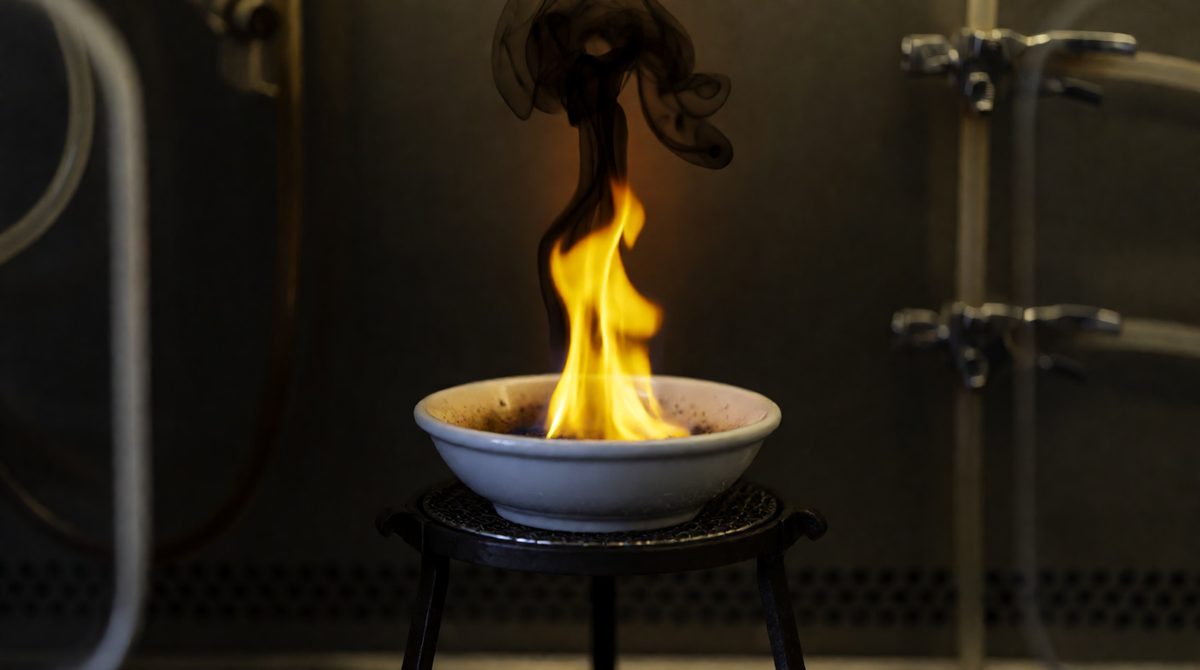
That sooty, smoky flame is incomplete combustion - alkenes often don't get enough oxygen to burn cleanly in air
Alkenes burn in oxygen in the same way as other hydrocarbons. With plenty of air they make carbon dioxide and water. But in air they tend to burn with smoky flames. This is because of incomplete combustion: there is not enough oxygen to burn all the carbon, so tiny bits of unburnt carbon (soot) are left in the flame.
Remember
In air there is often not enough oxygen to burn all the carbon, so the flame is smoky.
Addition reactions
The C=C double bond is the reactive part of an alkene. In an addition reaction, one of the two bonds in the double bond breaks. Each carbon atom then picks up a new atom. The double bond becomes a single bond, and only one product is made. Nothing is lost, so the product is a bigger molecule than the alkene you started with.
Alkenes do this with three types of reactant: hydrogen, water and the halogens.
⚛ Hydrogen
Alkene + hydrogen makes an alkane. Needs a nickel catalyst and heat.
💧 Water
Alkene + steam makes an alcohol. Needs a catalyst, high temperature and high pressure.
⚖ Halogens
Alkene + halogen makes a compound with two halogen atoms. Happens at room temperature.
Adding hydrogen
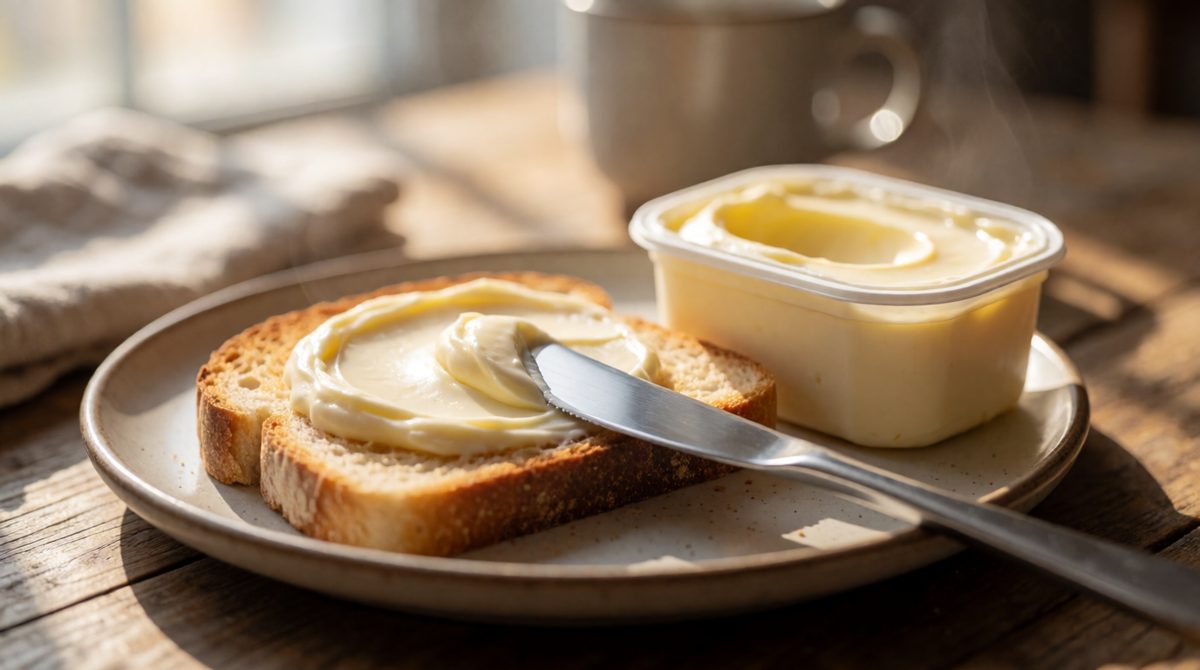
Margarine is made by adding hydrogen across C=C double bonds with a hot nickel catalyst
An alkene reacts with hydrogen to make an alkane. The reaction needs a nickel catalyst and the mixture is heated. The double bond becomes a single bond, so the molecule becomes saturated.
Ethene + hydrogen → ethane
C2H4 + H2 → C2H6
Propene gives propane (C3H6 + H2 → C3H8). Butene gives butane (C4H8 + H2 → C4H10).
Adding water
An alkene reacts with water, as steam, to make an alcohol. The conditions are a high temperature, high pressure and an acid catalyst (phosphoric acid). One H atom goes onto one carbon and an OH group goes onto the other.
Ethene + steam → ethanol
C2H4 + H2O → C2H5OH
The alcohol has the functional group –OH. You will meet alcohols properly in the next lessons.
Adding halogens
Halogens such as chlorine, bromine and iodine add across the double bond very easily. This happens at room temperature with no catalyst. Each carbon of the old double bond gets one halogen atom.
Ethene + bromine → dibromoethane
C2H4 + Br2 → C2H4Br2
Chlorine and iodine work in the same way, giving dichloroethane and diiodoethane. Orange-brown bromine water turns colourless when it reacts. This is the test for alkenes you met earlier.
Drawing the products
You must be able to draw fully displayed formulae for the first four alkenes (ethene, propene, butene and pentene) and their products. A fully displayed formula shows every atom and every bond. Follow these steps:
- Draw the alkene with every atom and bond, including the C=C.
- Change the C=C into a single C–C bond.
- Put one new atom (or group) on each of the two carbon atoms that were joined by the double bond.
- Check every carbon has exactly four bonds.
For ethene, each carbon has two H atoms. After adding hydrogen, each carbon has three H atoms and one C–C bond, so you have ethane. After adding chlorine, each carbon has two H atoms, one Cl and the C–C bond, so you have dichloroethane. After adding water, one carbon gets an H and the other gets an OH, so you have ethanol.
The same method works for longer alkenes. The new atoms go onto the two carbons of the double bond and the rest of the molecule stays as it is. Adding bromine to propene gives CH3CHBrCH2Br, which is dibromopropane. In your drawing, the CH3 group must show all three C–H bonds.
Displayed formulae, bond by bond
Ethene: H–C(H)=C(H)–H, so each carbon has two H atoms and the double bond between them.
Ethane (with hydrogen): H–C(H)(H)–C(H)(H)–H. Every bond is single.
Ethanol (with steam): H–C(H)(H)–C(H)(H)–O–H. The O is joined to one carbon and to an H.
Dichloroethane, dibromoethane, diiodoethane: H–C(H)(X)–C(H)(X)–H, where X is Cl, Br or I.
Propene is CH3–CH=CH2. Draw every C–H bond. Its products are CH3–CH2–CH3 (propane) and CH3–CHX–CH2X with a halogen. With steam, the OH goes on one end carbon or on the middle carbon, and the H goes on the other. Butene and pentene follow exactly the same pattern.
Worked example
Draw the product of ethene reacting with iodine. Start with H2C=CH2. Change the double bond to a single bond. Put one I on each carbon. The product is C2H4I2. In the displayed formula, each carbon has two H atoms, one I atom and one bond to the other carbon, which makes four bonds each.
Common mistakes
1. Leaving the double bond in the product. After addition there must be only single bonds. 2. Drawing a carbon with five bonds, or only three. Count to four every time. 3. Putting both halogen atoms on one carbon. Chlorine, bromine and iodine are diatomic (Cl2, Br2, I2), so one atom goes on each carbon. 4. Forgetting the conditions: nickel catalyst for hydrogen, steam with high temperature and pressure for water, room temperature for halogens.
Exam-style question
Propene (C3H6) reacts with hydrogen. (a) Name the catalyst needed. (b) Give the name and formula of the product. (c) Explain why this is called an addition reaction.
Model answer
(a) Nickel. (b) Propane, C3H8. (c) Hydrogen atoms are added across the carbon-carbon double bond, so the double bond becomes a single bond and only one product is made.
Exam tip
Always write the conditions with the reaction. Marks are often given for the catalyst, the steam or the temperature, as well as for the product.