⚛ With sodium
Sodium fizzes in an alcohol and hydrogen gas is given off. The reaction is gentler than sodium with water.
Sign up to access the complete lesson and track your progress!
Unlock This CourseAlcohols are a family of compounds that all contain the functional group -OH. This one group gives every alcohol its typical reactions. Alcohols form a homologous series, so each one is one CH2 bigger than the one before.
The first four members are methanol, ethanol, propanol and butanol. Notice that every name ends in -ol. That ending is how you recognise an alcohol from its name.
| Alcohol | Carbon atoms | Formula |
|---|---|---|
| Methanol | 1 | CH3OH |
| Ethanol | 2 | CH3CH2OH |
| Propanol | 3 | CH3CH2CH2OH |
| Butanol | 4 | CH3CH2CH2CH2OH |
You can also write ethanol as C2H5OH. In a displayed formula, the -OH group is drawn as an oxygen atom joined to a hydrogen atom, and the oxygen is joined to a carbon atom.
Key terms:
To recognise an alcohol, look for the -OH group on a carbon chain. Look for a name that ends in -ol, too.
You only need to know the names of the first four alcohols.
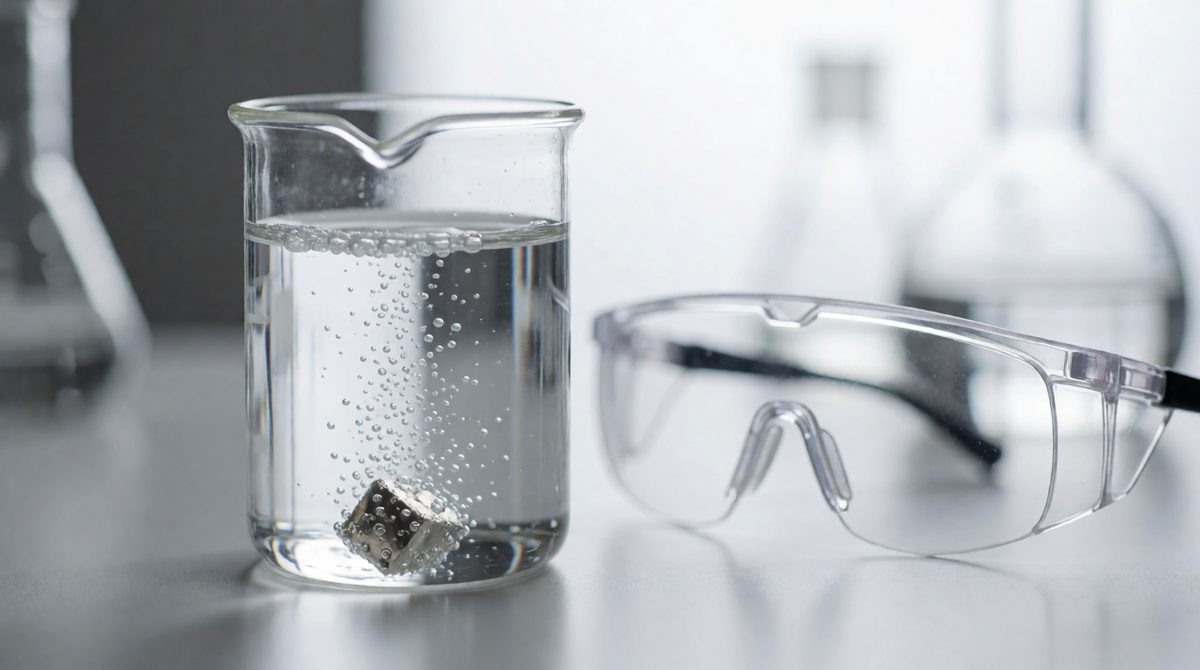
Fizzing sodium in ethanol gives off hydrogen - gentler than sodium in water, but the same idea
Sodium fizzes in an alcohol and hydrogen gas is given off. The reaction is gentler than sodium with water.
Methanol, ethanol and propanol mix completely with water to give a clear solution. Butanol is less soluble because its carbon chain is longer.
Alcohols burn well. Complete combustion gives carbon dioxide and water.
Alcohols are oxidised to carboxylic acids. For example, ethanol becomes ethanoic acid.
When an alcohol burns in plenty of air, it makes carbon dioxide and water. The reaction gives out heat.
Ethanol + oxygen → carbon dioxide + water
C2H5OH + 3O2 → 2CO2 + 3H2O
These are the combustion equations for the other three:
You only need to write balanced equations for the combustion of alcohols. For the other reactions, a description is enough.
Balance the equation for burning propanol.
Start with C3H7OH + O2 → CO2 + H2O.
1. Carbon: 3 carbon atoms, so 3CO2.
2. Hydrogen: C3H7OH has 8 hydrogen atoms, so 4H2O.
3. Oxygen on the right: 6 + 4 = 10. The alcohol already has 1, so oxygen gas must supply 9. That is 4.5O2.
4. Double everything to remove the half: 2C3H7OH + 9O2 → 6CO2 + 8H2O.
An oxidising agent adds oxygen to a molecule. When an alcohol reacts with an oxidising agent, it is oxidised and a carboxylic acid is made. This is why wine left open to the air can turn sour: the ethanol is slowly oxidised to ethanoic acid, the acid in vinegar.
Ethanol → ethanoic acid
You will meet carboxylic acids in the next lesson.
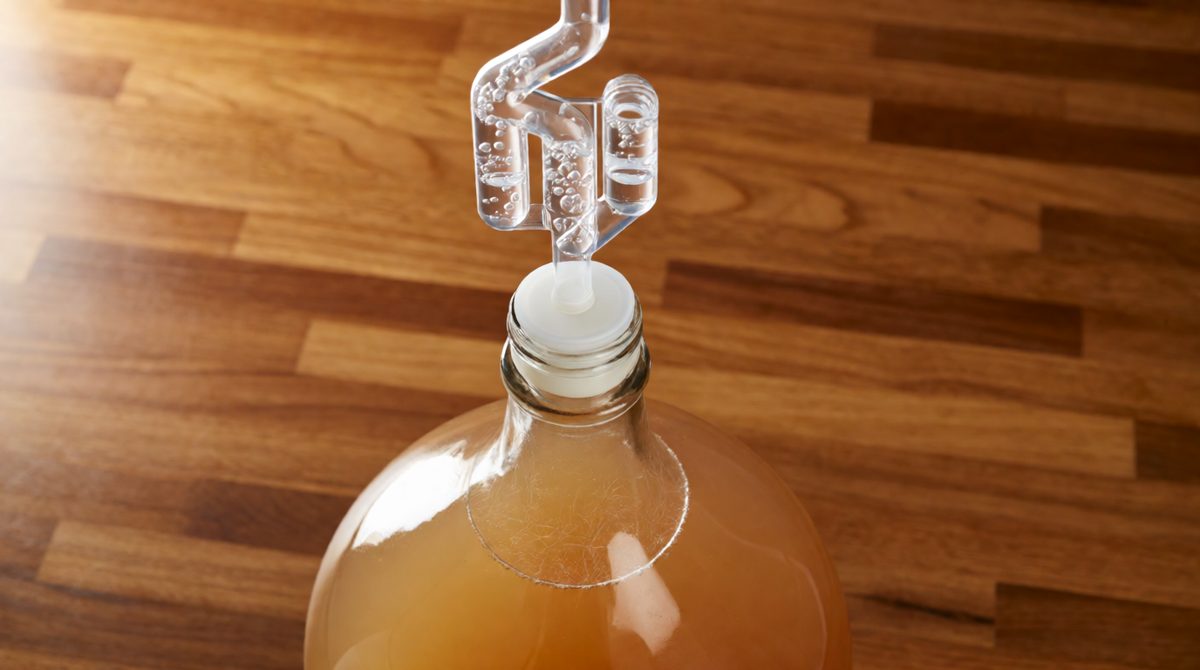
Those bubbles are yeast hard at work: glucose → ethanol + carbon dioxide, in warm conditions with no air
Fermentation makes an aqueous solution of ethanol from a sugar solution, using yeast. Yeast is a living organism. It contains enzymes that turn sugar into ethanol and carbon dioxide.
Glucose → ethanol + carbon dioxide
C6H12O6 → 2C2H5OH + 2CO2
You need to know the conditions for fermentation:
If it is too cold, the yeast works too slowly. If it is too hot, the enzymes are damaged and fermentation stops.
The result is a weak solution of ethanol in water. Ethanol can be separated from water by fractional distillation.
Key terms:
1. Forgetting the oxygen already in the alcohol when balancing combustion equations.
2. Saying fermentation needs oxygen. It must be kept air-free.
3. Giving a temperature that is too high. Yeast works best at about 30 °C to 40 °C.
4. Calling any compound with a long name an alcohol. Look for -OH and an -ol ending.
Ethanol can be made by fermentation. (a) Name the substance added to the sugar solution. (b) Give two conditions needed. (c) Describe what you would see when sodium is added to ethanol. (d) Write the balanced equation for the complete combustion of ethanol.
(a) Yeast.
(b) A temperature of about 30 °C to 40 °C; no oxygen (anaerobic).
(c) The sodium fizzes (bubbles of hydrogen gas are given off).
(d) C2H5OH + 3O2 → 2CO2 + 3H2O
If a question asks you to describe a reaction of an alcohol, say what you would see: fizzing for sodium and a clear solution for the smaller alcohols in water. For an oxidising agent, say the alcohol is oxidised to a carboxylic acid.