🔄 Before
Each monomer has a C=C double bond. There are many separate monomer molecules.
Sign up to access the complete lesson and track your progress!
Unlock This Course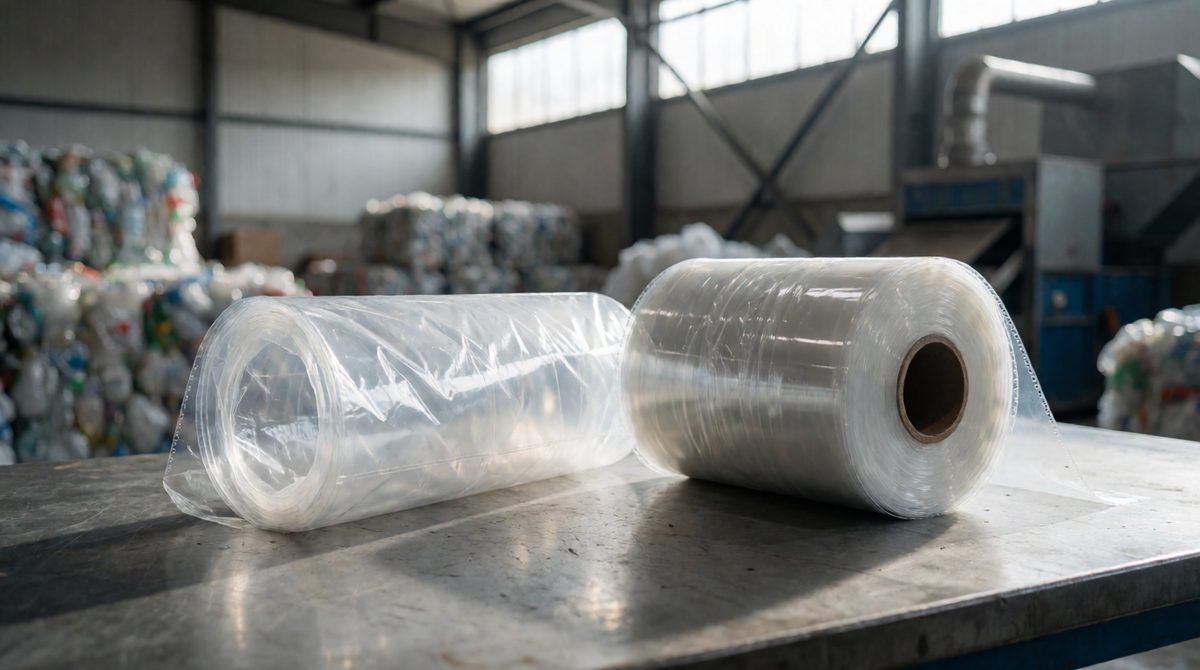
These bags are poly(ethene): long chains of thousands of ethene monomers joined end to end
You already know that alkenes have a C=C double bond, and that this bond makes them reactive. In this lesson we use that reactivity to build something huge: a plastic.
In addition polymerisation, many small molecules join together to form one very large molecule. The small molecules are called monomers. The very large molecule is called a polymer. The name helps: "mono" means one, and "poly" means many.
Key terms:
Alkenes make good monomers because each one has a C=C bond. Poly(ethene) is made from ethene. Poly(propene) is made from propene. The name of the polymer is just "poly" followed by the monomer name in brackets.
In the reaction, one of the two bonds in each C=C double bond opens up. Each monomer then uses the freed bond to join to the next monomer, like people in a line holding hands. The result is a long chain of carbon atoms joined by single bonds.
Each monomer has a C=C double bond. There are many separate monomer molecules.
The double bonds have become single bonds. There is one long polymer chain.
The word equation is simple: many ethene molecules make poly(ethene). In symbols, we write n for "a very large number":
n CH2=CH2 → (–CH2–CH2–)n
The brackets show the repeating unit. The small n after the bracket means the unit repeats n times. The bonds at each end of the bracket carry on into the next unit, so the chain keeps going.
Only one product forms. No other small molecule is made. This is why it is called addition polymerisation: the monomers are simply added together. So the repeating unit has the same atoms as the monomer. Count them for ethene: the monomer has 2 carbon atoms and 4 hydrogen atoms, and so does the repeating unit.
Monomer and repeating unit have the same atoms. Only the bonding changes: C=C becomes a C–C single bond in the chain.
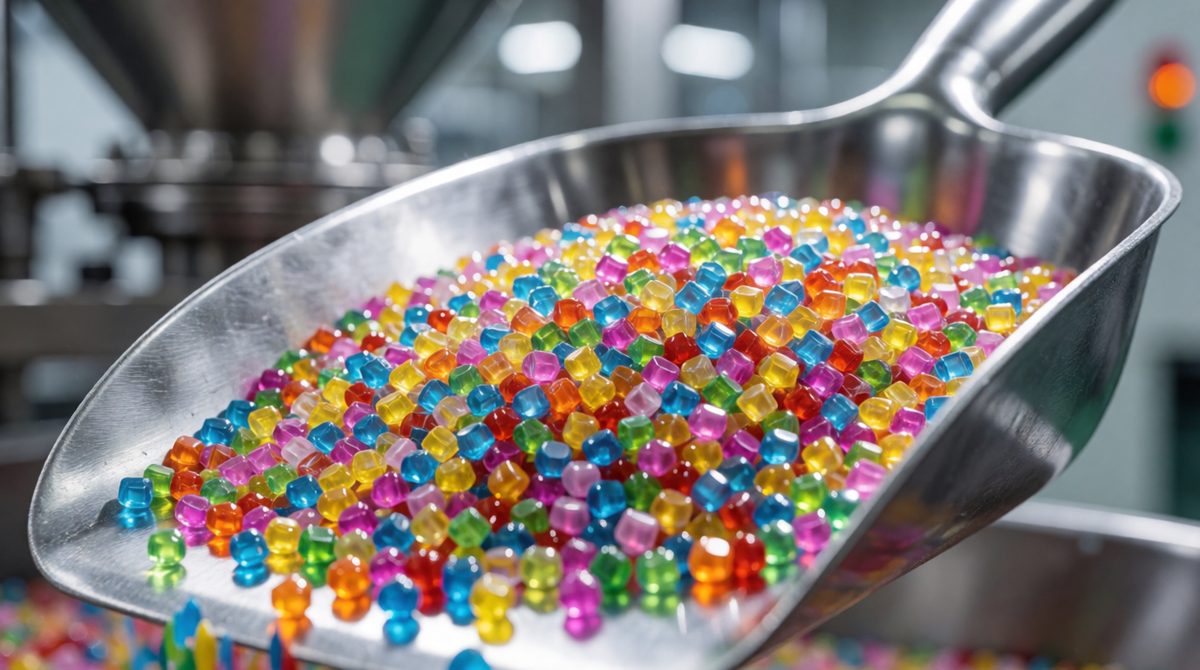
Plastic pellets like these are made by opening up C=C bonds so monomers link into long polymer chains
You can draw any addition polymer if you follow the same steps. Look at the monomer and find the C=C bond. Keep the two carbon atoms of the C=C in the middle of the repeating unit, and keep everything attached to them.
Monomer: ethene, CH2=CH2. Each carbon has two hydrogens. The repeating unit is (–CH2–CH2–)n
Monomer: propene, CH3–CH=CH2. The CH3 group stays attached. The repeating unit is (–CH(CH3)–CH2–)n
In a drawing, the carbon chain runs along the middle. The CH3 group in poly(propene) hangs off the chain as a side group. It is still on the same carbon atom as it was in the monomer.
Chloroethene has the formula CH2=CHCl. Draw its polymer.
Step 1: the C=C stays in the middle, with H, H on one carbon and H, Cl on the other.
Step 2: change C=C to C–C.
Step 3: add the bonds sticking out and the brackets, then n.
Answer: (–CH2–CHCl–)n. The polymer is called poly(chloroethene). Count the atoms: the monomer has 2 C, 3 H and 1 Cl, and so does the repeating unit.
You can also work backwards. Look at the polymer and find one repeating unit. The main chain in an addition polymer is made only of carbon atoms. So take one section with two carbon atoms in the chain, then follow these steps.
You can also find the monomer from the name: poly(propene) must come from propene.
A polymer has the repeating unit (–CH2–CH(CH3)–)n.
Take the two chain carbons. One has 2 H. The other has an H and a CH3. Put the double bond back: CH2=CH(CH3).
This is propene, so the polymer is poly(propene).
An exam may show you a diagram and ask whether it is a monomer or a polymer. Use these clues.
It has a C=C double bond. It is a small molecule. There are no brackets and no n.
It has brackets, with bonds going through them, and an n. The carbon chain has only single bonds.
A molecule can only be a monomer for addition polymerisation if it contains the functional group C=C.
1. Leaving the C=C in the polymer. The chain in the repeating unit has only single bonds.
2. Forgetting the bonds that stick out through the brackets. Without them the diagram shows one small molecule, not a chain.
3. Moving side groups. Atoms stay on the carbon atoms they were attached to.
4. Forgetting n.
5. Saying a small molecule is made as well. Only the polymer forms.
Propene, CH3–CH=CH2, is used to make poly(propene). (a) Explain why propene can be used as a monomer. (b) Draw the repeating unit of poly(propene). (c) Explain why the repeating unit has the same atoms as propene. [4 marks]
(a) Propene has a C=C double bond, so many molecules can join together by addition polymerisation. (b) (–CH(CH3)–CH2–)n, drawn with a bond sticking out from each end of the brackets through to the next unit. (c) No other molecule is formed in the reaction, so all of the atoms in the monomers end up in the polymer.
When you draw a repeating unit, always check the atom count against the monomer. If the numbers differ, you have made a mistake.