⚛ Addition polymerisation
Uses a double bond. No small molecule is lost. The polymer is the only product.
Everything in this lesson is for students sitting the Higher tier papers. Foundation tier students do not need it.
Sign up to access the complete lesson and track your progress!
Unlock This Course
Polyester fibres like these are condensation polymers - every time two monomers link up, a small water molecule is kicked out
In the last polymer lesson, the monomers had a C=C double bond and simply added on to each other. Nothing was lost. Condensation polymerisation is different. Here the monomers each have two functional groups, one at each end. When two monomers react, they join together and usually lose a small molecule, such as water.
Because a small molecule is lost each time, these reactions are called condensation reactions. Making a long chain this way is called condensation polymerisation.
Key terms:
Think of each monomer as a short rope with a hook at each end. One hook can catch one neighbour and the other hook can catch another neighbour. That is how a long chain forms.
If a monomer had only one functional group, it could join to just one neighbour and the chain would stop. So each monomer needs a functional group at both ends.
Uses a double bond. No small molecule is lost. The polymer is the only product.
Monomers have two functional groups. A small molecule such as water is lost at every join. There are two products.
The simplest condensation polymers come from two different monomers. Each monomer has two of the same functional group.
An -OH group reacts with a -COOH group to make an ester link, and a molecule of water is lost. Because both monomers have two groups, the reaction can happen at both ends of each molecule. Ethanediol joins to hexanedioic acid, which joins to another ethanediol, and so on. The result is a polyester.
The chain alternates between the two monomers. The repeating unit contains one piece from each:
-O-CH2-CH2-O-CO-(CH2)4-CO-
In words: ethanediol + hexanedioic acid → polyester + water
You can draw this with blocks. Use one type of block for each monomer's carbon chain, with its two functional groups as the ends. When two blocks join, show a small molecule (water) leaving.
Question: One molecule of ethanediol joins to one molecule of hexanedioic acid. How many molecules of water are lost?
Answer: One. Each time an -OH group and a -COOH group react to make a link, one molecule of water is lost. One join means one water molecule. A chain made by 100 separate reactions loses 100 water molecules.
An amino acid is a molecule with two different functional groups: an amino group (-NH2) at one end and a carboxylic acid group (-COOH) at the other.
The simplest is glycine: H2N-CH2-COOH.
This time only one monomer is needed, because it already has both kinds of group. The -NH2 of one glycine reacts with the -COOH of the next one. A molecule of water is lost and the two molecules join. The same thing happens again and again, so amino acids react by condensation polymerisation to produce a polypeptide.
The repeating unit in poly(glycine) is: -NH-CH2-CO-
Key terms:
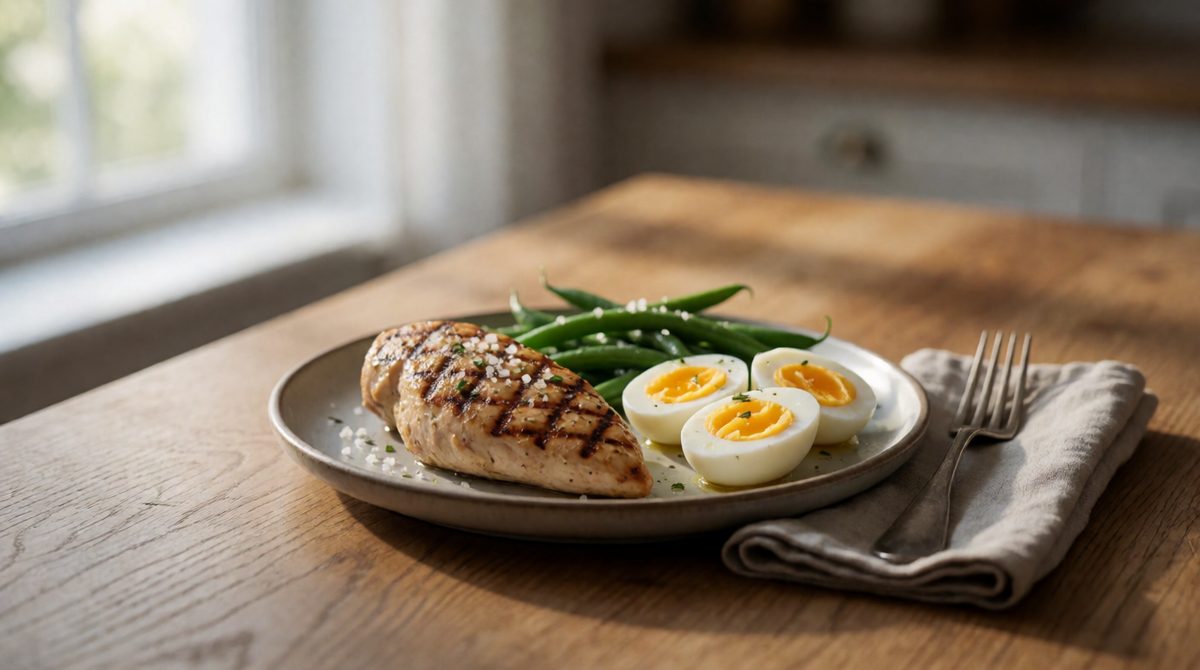
Eggs, beans and chicken are packed with protein - long chains of amino acids joined in a set order
Glycine is only one of many amino acids. Different amino acids can be combined in the same chain. Chains like this are proteins. The order of the amino acids makes each protein different.
Every amino acid has -NH2 and -COOH, so any amino acid can join to any other.
The rest of each amino acid differs, which is why proteins can be so varied.
1. Saying water is made in addition polymerisation. It is not. Water is lost only in condensation polymerisation.
2. Forgetting the water. A condensation polymer equation always has a small molecule as a second product.
3. Drawing a monomer with only one functional group. It must have two or the chain cannot grow.
4. Mixing up the two types. Amino acids have two different groups. Ethanediol and hexanedioic acid each have two of the same group.
Glycine is H2NCH2COOH. Explain how glycine forms a polypeptide. [3 marks]
Each glycine molecule has two functional groups, an -NH2 group and a -COOH group. The -NH2 group of one molecule reacts with the -COOH group of another, and a small molecule (water) is lost. This happens many times, joining the molecules into a long chain called a polypeptide. This is condensation polymerisation.
When a question asks you to explain condensation polymerisation, always mention both parts: two functional groups on each monomer, and a small molecule being lost.