↕ Group number
For Groups 1 to 7, the group number is the number of outer electrons. Fluorine is 2,7, so it has 7 outer electrons and is in Group 7.
Sign up to access the complete lesson and track your progress!
Unlock This Course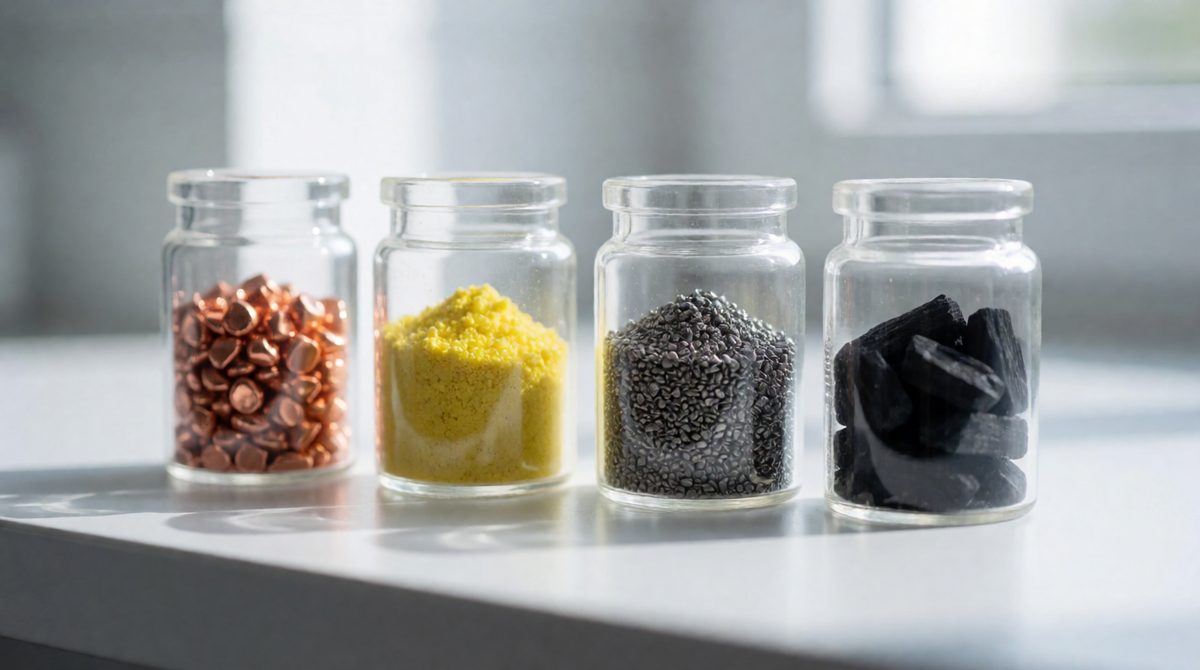
From the hydrogen in this water to the iron in this nail, every element has its place in the table, ordered by atomic number
The modern periodic table puts every element in order of its atomic (proton) number. Hydrogen has atomic number 1, so it comes first. Helium has atomic number 2, so it comes next, and so on. Each element has one more proton than the element before it.
The elements are also arranged so that elements with similar properties are in the same column. These columns are called groups. The rows across the table are called periods.
So there are two ideas working together:
Key terms:
Something is periodic if it repeats at regular intervals, like the days of the week. If you go through the elements in order of atomic number, similar properties keep coming back at regular intervals.
For example, lithium (atomic number 3), sodium (11) and potassium (19) are all soft, very reactive metals. Each one starts a new row. The same pattern of properties then repeats along the next row. That is why the table is called a periodic table: similar properties occur at regular intervals.
Breaking the list into rows at the right places is what lines up similar elements in the same column.
The spec says you must be able to explain how the position of an element is related to the arrangement of electrons in its atoms, and so to its atomic number. Here is the chain of reasoning:
For Groups 1 to 7, the group number is the number of outer electrons. Fluorine is 2,7, so it has 7 outer electrons and is in Group 7.
The period number is the number of occupied shells. Fluorine has electrons in 2 shells, so it is in Period 2.
Look down Group 2 to see the pattern:
Each one has 2 outer electrons, so they are all in Group 2. Each step down the group adds one more shell, so each one is in the next period down.
Group 0 is the exception to the "group number = outer electrons" rule. Its elements have full outer shells. You will meet them in Group 0: The Noble Gases. The block of transition metals between Groups 2 and 3 is covered in Transition Metals.
Question: Phosphorus has atomic number 15. Use this to find its group and period.
Step 1: Atomic number 15 means 15 protons, so 15 electrons.
Step 2: Fill the shells: 2 in the first, 8 in the second, 5 left for the third. Electronic structure = 2,8,5.
Step 3: 5 outer electrons, so Group 5.
Step 4: 3 occupied shells, so Period 3.
Question: An element is in Period 2 and Group 4. Write its electronic structure and give its atomic number.
Period 2 means 2 shells. Group 4 means 4 outer electrons. The first shell is full with 2, so the structure is 2,4. That is 6 electrons, so the atomic number is 6. This element is carbon.
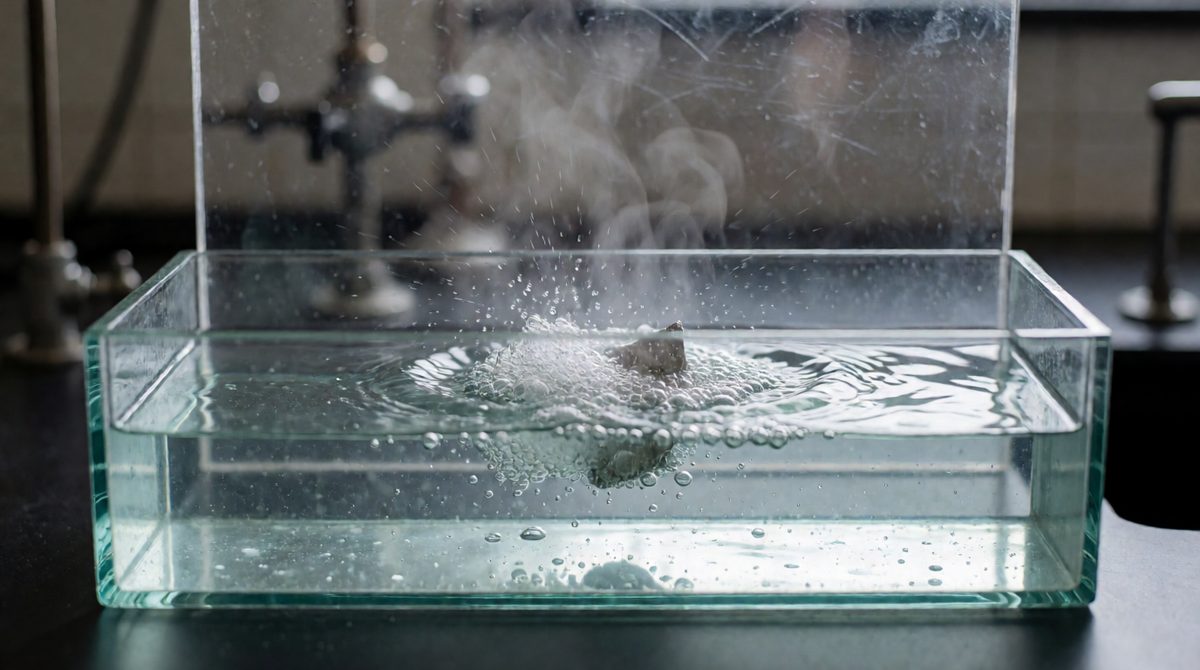
Lithium, sodium and potassium all sit in Group 1 with one outer electron, so they all fizz in water in the same way
Elements in the same group have the same number of electrons in their outer shell. This is what gives them similar chemical properties.
Why? When atoms react, it is the outer electrons that get involved. The inner shells stay as they are. So atoms with the same number of outer electrons tend to react in the same kinds of ways.
Compare this with a period. Moving along a period, the number of outer electrons changes from one element to the next. So elements next to each other in a row usually behave quite differently. Magnesium (2,8,2) and chlorine (2,8,7) are both in Period 3, but one is a shiny metal and the other is a toxic green gas.
The spec also wants you to predict possible reactions and probable reactivity of elements from their position. This is really useful in exams, because you may be asked about an element you have never studied.
If one element in a group reacts with something, the others in that group will probably react in the same way and make the same type of product.
Reactivity changes steadily as you go down a group. If you know the trend, you can predict whether an element lower down will react more or less vigorously.
Information: Magnesium reacts with dilute hydrochloric acid to form magnesium chloride and hydrogen. In Group 2, reactivity increases down the group. Strontium is further down Group 2 than magnesium.
Prediction: Strontium is in the same group, so it has the same number of outer electrons (2). It should also react with dilute hydrochloric acid to form strontium chloride and hydrogen.
Strontium is further down the group, so it should react more vigorously than magnesium.
You will see exactly how reactivity changes in particular groups, and the reasons why, in the lessons on Group 1 and Group 7.
Saying the table is ordered by mass. The modern table is ordered by atomic (proton) number, not by mass.
Mixing up groups and periods. Groups go down (columns). Periods go across (rows).
Saying elements in the same period are similar. It is elements in the same group that are similar.
Giving half an explanation. "They are in the same group" is not enough. Say they have the same number of outer electrons, and that this gives them similar chemical properties.
Oxygen has the electronic structure 2,6. Element X has the electronic structure 2,8,6.
(a) Give the group and period of element X. [2 marks]
(b) Explain why element X has similar chemical properties to oxygen. [2 marks]
(a) Group 6 (it has 6 outer electrons). Period 3 (it has 3 occupied shells).
(b) X and oxygen both have 6 electrons in their outer shell, so they are in the same group. Elements with the same number of outer electrons have similar chemical properties.
For any "position" question, write out the electronic structure first. The last number gives the group (for Groups 1 to 7) and the count of numbers gives the period.