📄 Stationary phase
The paper stays still. Some substances stick to it quite well, so they do not travel far.
Sign up to access the complete lesson and track your progress!
Unlock This Course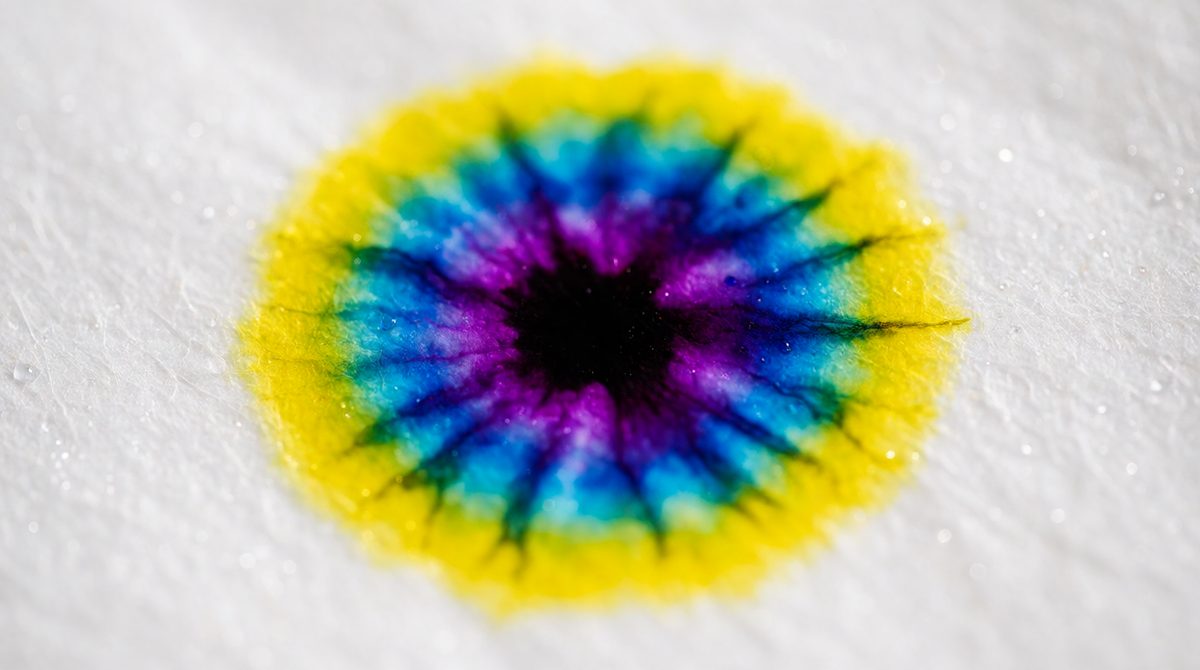
Black ink splitting into colours on wet paper? That's chromatography separating the dyes in the mixture
Have you ever seen a black felt-tip pen leak onto wet paper? The black ink spreads out and splits into different colours. That is chromatography in action.
Chromatography is a way to separate mixtures. It can also give information that helps us identify substances. It works because different substances in a mixture are carried along at different speeds.
Key terms:
A small spot of the mixture is placed on a line near the bottom of a piece of chromatography paper. This starting line is called the origin. The bottom edge of the paper is then placed in a solvent. The solvent soaks up the paper and carries the substances in the mixture with it.
The paper stays still. Some substances stick to it quite well, so they do not travel far.
The solvent moves up the paper. Some substances dissolve in it very well, so they are carried a long way.
Separation depends on how the substances are distributed between the two phases. A substance that spends more time in the mobile phase moves further up the paper. A substance that spends more time stuck to the stationary phase stays closer to the origin. Because each substance has its own balance between the two phases, the mixture splits into separate spots.
A chromatogram can show whether a substance is pure.
One solvent is not always enough to be sure. The compounds in a mixture may separate into different spots in one solvent, but stay together in another. So a result with one solvent could be misleading. A pure compound, however, will produce a single spot in all solvents. That is why chemists often test with more than one solvent.
Two spots from one starting spot means the sample was a mixture of at least two substances. One spot may mean the sample is pure, so check with another solvent.
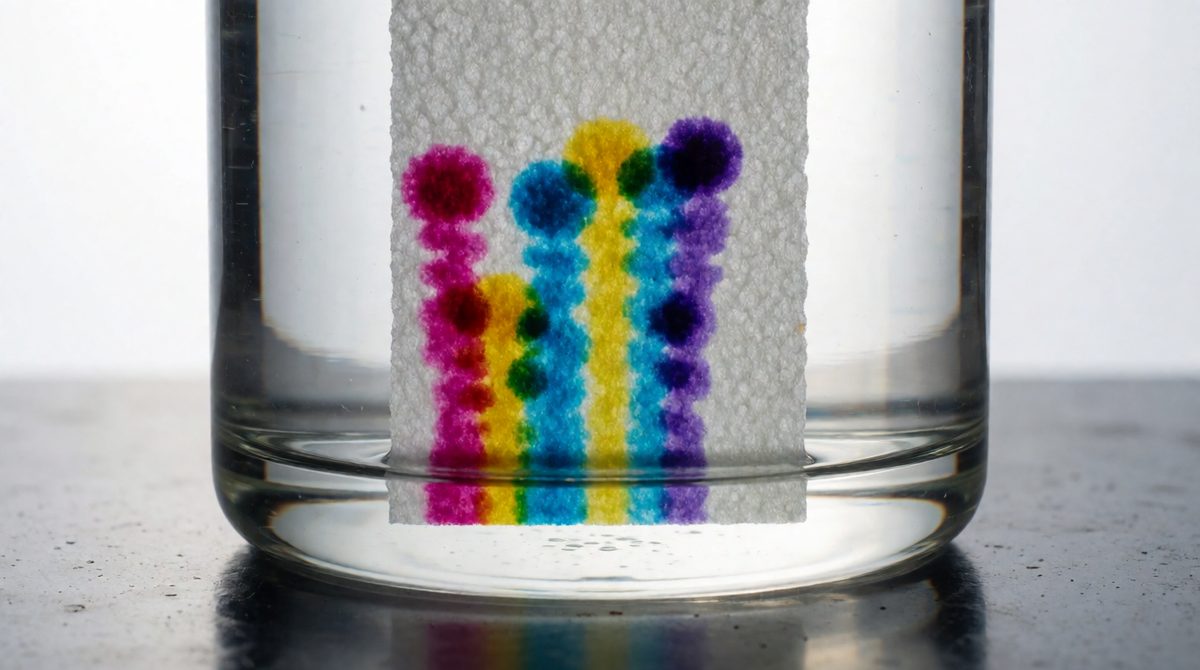
Each colourful spot has climbed its own distance - divide that by how far the solvent went to get its Rf value
The distance a spot travels depends on the substance and on the solvent. To compare results fairly, we calculate the Rf value.
Rf = distance moved by substance ÷ distance moved by solvent
An Rf value is a ratio, so it is always between 0 and 1. A spot that stays on the origin has an Rf of 0. A spot that moves with the solvent has an Rf of 1.
A yellow spot moves 3.0 cm. The solvent moves 6.0 cm.
Rf = 3.0 ÷ 6.0 = 0.50
A blue spot moves 4.2 cm. The solvent moves 7.5 cm.
Rf = 4.2 ÷ 7.5 = 0.56
Both distances have 2 significant figures, so give the answer to 2 significant figures: 0.56.
A substance has an Rf of 0.40 and the solvent moved 8.0 cm. Rearrange the equation: distance moved by substance = Rf × distance moved by solvent = 0.40 × 8.0 = 3.2 cm.
Different compounds have different Rf values in different solvents. So an Rf value can help to identify a compound. If you know the Rf values of some substances in a particular solvent, you can compare them with your unknown.
Run known substances next to the unknown on the same paper. Spots that travel the same distance and have the same Rf value may be the same substance.
Compare your calculated Rf value with a table of data. It only works if the table used the same solvent as your experiment.
Example: a table says compound X has an Rf of 0.45 in a certain solvent. Your unknown spot has an Rf of 0.45 in that solvent. It could be compound X. An Rf of 0.80 would rule it out.
Two different compounds can sometimes have the same Rf value in one solvent. This is why a match is used as evidence to help identify a substance, not as absolute proof.
1. Measuring to the edge of a spot instead of its centre.
2. Measuring the solvent distance from the bottom of the paper instead of from the origin line.
3. Putting units on an Rf value, or getting a value above 1.
4. Comparing Rf values from different solvents. They are only comparable if the solvent is the same.
5. Saying one spot proves a substance is pure, when only one solvent was used.
A student runs a chromatogram of a green ink. It forms two spots. Spot A moves 2.4 cm and spot B moves 5.6 cm. The solvent front moves 8.0 cm. (a) Is the ink pure? (b) Calculate the Rf value of spot B. (c) Spot A has an Rf of 0.30 in this solvent. A table says a dye called Y has an Rf of 0.30 in this solvent. What can the student say?
(a) No. It is a mixture because it separated into two spots.
(b) Rf = 5.6 ÷ 8.0 = 0.70
(c) Spot A could be dye Y, because the Rf values match in the same solvent. The student could check by running dye Y beside it, or by using another solvent.
Always show the equation and your numbers, and give your answer to a sensible number of significant figures. Method marks are easy to pick up.