🔥 The test
A burning splint held at the open end of a test tube of the gas.
Sign up to access the complete lesson and track your progress!
Unlock This CourseMany gases are colourless, so you cannot tell what a gas is just by looking at it. Chemists use simple tests that give a clear result you can see or hear. Each test below works because the gas does something that the other gases do not.
In your exam you will often be given a reaction that makes a gas, such as a metal reacting with an acid. You then need to say which test you would use and what you would see. There are four tests to learn. For each one you need the test, the gas and the positive result.
Key terms:
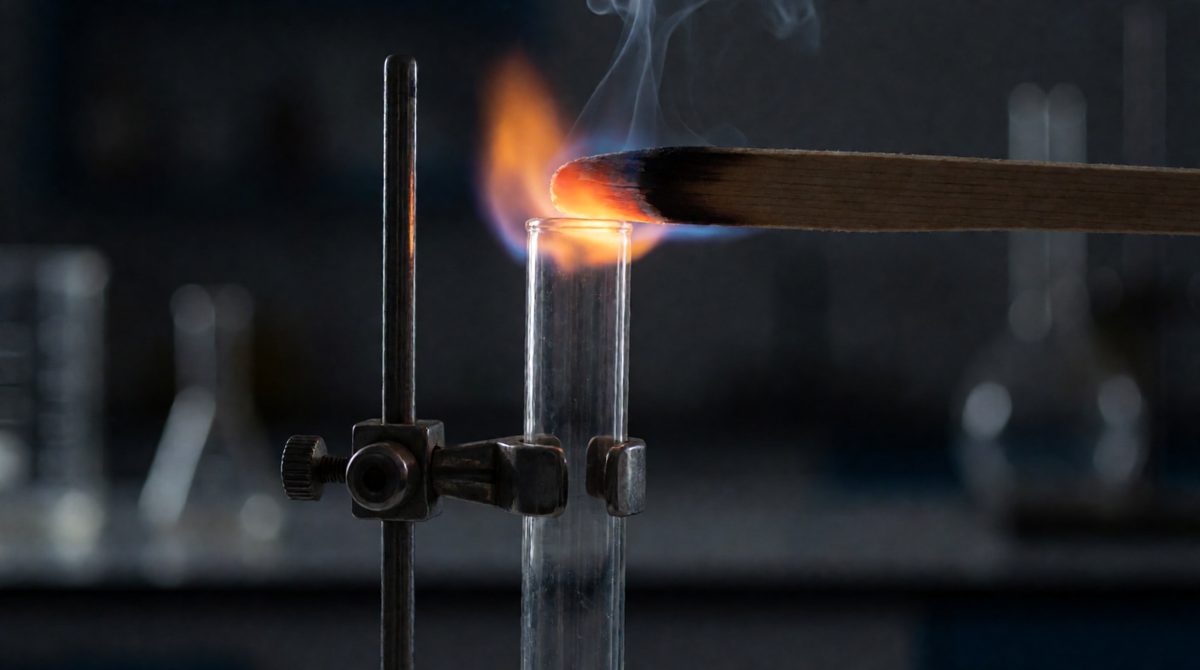
Pop! A burning splint at the mouth of the tube means hydrogen is there
Collect the gas in a test tube. Hold a burning splint at the open end of the test tube.
If the gas is hydrogen, it burns rapidly with a pop sound. Many people call this a squeaky pop.
A burning splint held at the open end of a test tube of the gas.
The gas burns rapidly with a pop sound.
Notice that the splint is burning here. You need a flame to set the hydrogen alight. Do not mix this up with the oxygen test.
For oxygen you use a glowing splint. Light a splint, then blow out the flame so the end still glows red. Insert the glowing splint into a test tube of the gas.
If the gas is oxygen, the splint relights. Of these four gases, oxygen is the one that does this.
A glowing splint inserted into a test tube of the gas.
The splint relights.
Remember it like this. Hydrogen: burning splint held at the open end, gives a pop. Oxygen: glowing splint put inside the tube, relights.
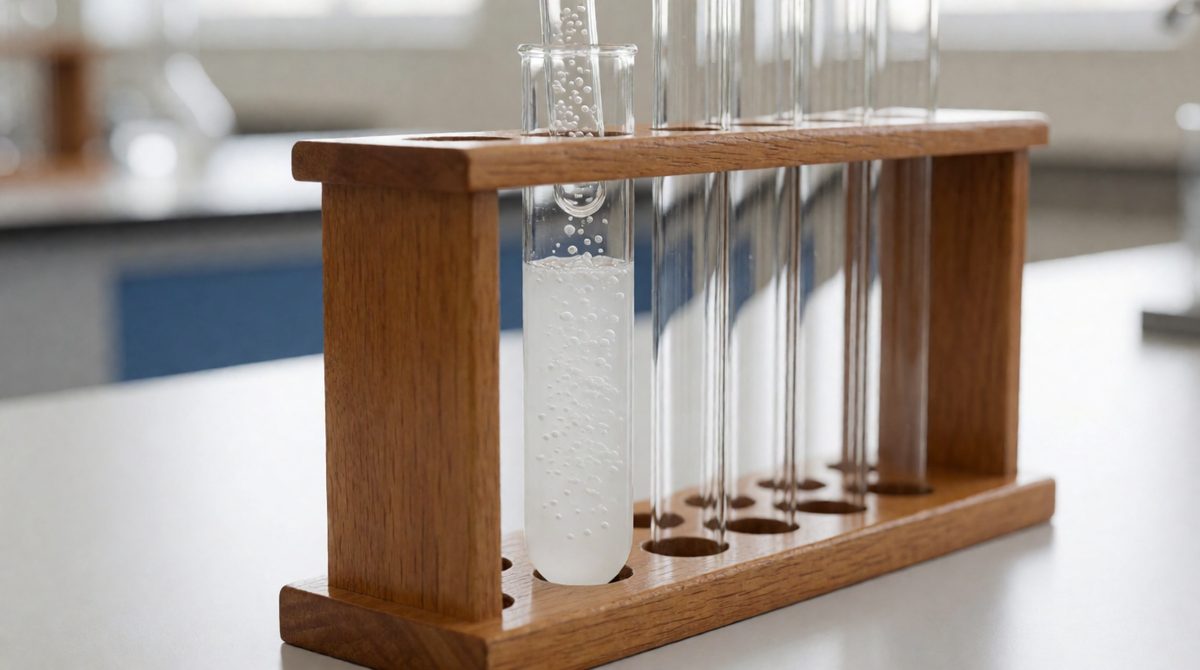
Gas bubbling through this limewater is turning it milky - the giveaway sign of carbon dioxide
This test uses limewater, which is an aqueous solution of calcium hydroxide. Limewater starts off colourless.
Shake the gas with limewater, or bubble the gas through limewater. If the gas is carbon dioxide, the limewater turns milky. You can also say it turns cloudy.
Shake the gas with limewater, or bubble it through limewater.
The limewater turns milky (cloudy).
In an exam, say the limewater turns milky or cloudy. Those are the words the spec uses, so they are the safest choice.
This test uses litmus paper. The paper must be damp. Put damp litmus paper into the chlorine gas.
The litmus paper is bleached and turns white. Chlorine does not just change the colour of the paper. It removes the colour completely.
Put damp litmus paper into the gas.
The litmus paper is bleached and turns white.
Learn this summary. Cover the result and see if you can say it from memory.
Test: burning splint at the open end of the tube.
Result: burns rapidly with a pop.
Test: glowing splint inserted into the tube.
Result: splint relights.
Test: shake with or bubble through limewater.
Result: limewater turns milky (cloudy).
Test: damp litmus paper put into the gas.
Result: the paper is bleached and turns white.
Always give the test and the result. A result on its own, such as "it pops", will not earn full marks.
A student adds a metal to an acid and a colourless gas is made. The student collects the gas in a test tube. A burning splint is held at the open end of the tube and there is a pop. The gas is hydrogen.
Now the student collects a different colourless gas from another reaction. A glowing splint is put into the tube and it relights. This gas is oxygen.
Finally the student bubbles a third gas through a colourless solution and the solution turns milky. The solution was limewater, so the gas is carbon dioxide.
Each time, the student matched the result to the test. You can do the same in the exam: read the result, then name the gas.
Sometimes a question names the gas and asks for the test. Then pick the matching test:
Other times the question gives the result and asks for the gas. Then match the result: a pop is hydrogen, a relit splint is oxygen, milky limewater is carbon dioxide and bleached litmus paper is chlorine.
1. Mixing up the splints. Hydrogen needs a burning splint and oxygen needs a glowing splint.
2. Writing that the limewater "goes white" instead of "milky" or "cloudy".
3. Using dry litmus paper for chlorine. The paper must be damp.
4. Saying the litmus paper "turns red" or "turns blue". For chlorine it is bleached white.
5. Giving only the result and forgetting the test.
Describe how you would test a colourless gas to show that it is carbon dioxide. State the result you would see. [2 marks]
Shake the gas with limewater (or bubble the gas through limewater) [1 mark]. The limewater turns milky (cloudy) [1 mark].
Two marks usually means two points: the test and the result. Write both, and use the exact words from this lesson.