🍇 Calcium
Calcium compounds give an orange-red flame.
Sign up to access the complete lesson and track your progress!
Unlock This CourseChemists often have a white powder or a colourless solution and need to know what is in it. You cannot tell by looking. So chemists use simple tests that give a clear, visible result. The flame test is one of the quickest. It helps to identify some metal ions, which are also called cations because they are positively charged.
Remember, ions are charged particles. Metal atoms lose electrons to form positive ions, and these ions are found in many compounds.
Key terms:
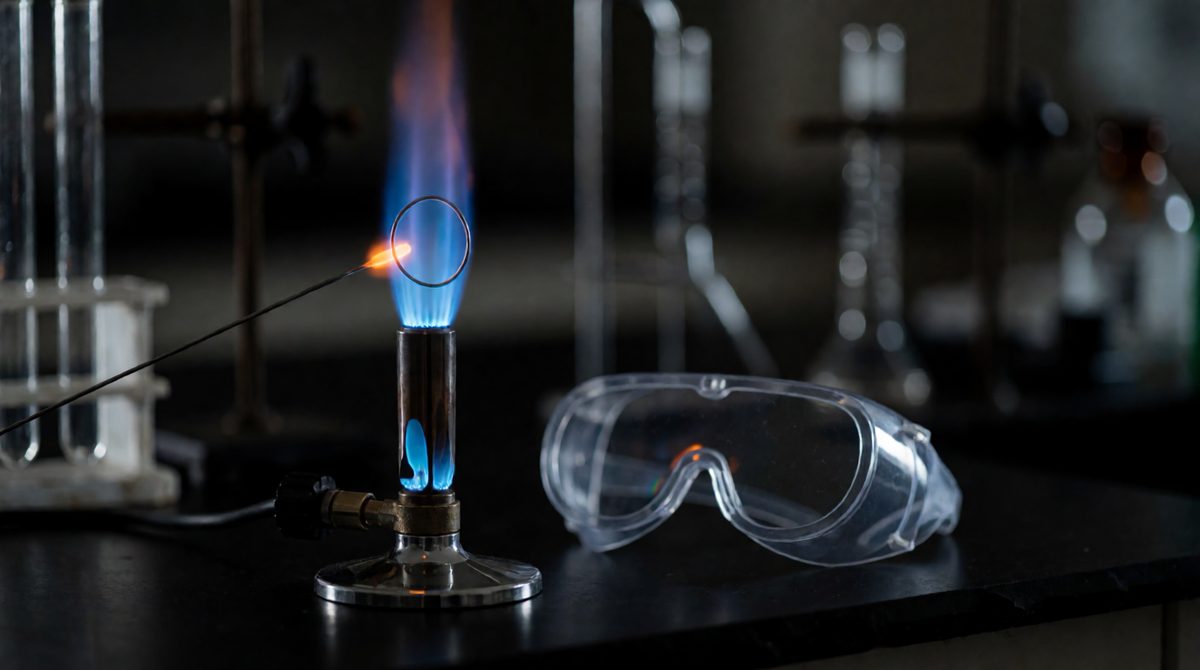
Dip a clean wire loop in the sample, hold it in the blue Bunsen flame and watch the colour
You only need a few simple things. Wear safety goggles, because you are working with a flame.
1. Light a Bunsen burner and turn it to the blue flame, which is hot and clear.
2. Clean a flame test wire (a loop of nichrome wire) by dipping it in dilute hydrochloric acid, then holding it in the flame. Repeat until it gives no colour.
3. Dip the clean loop into the compound being tested. A solid or a solution both work.
4. Hold the loop in the edge of the blue flame.
5. Look carefully at the colour of the flame and write it down.
6. Clean the wire again before you test the next sample.
Cleaning the wire is very important. If you skip it, traces of the last sample stay on the wire and give a false colour.

Fireworks get their colours the same way flame tests do - copper compounds glow green and lithium burns crimson
Each of these metals gives a distinctive colour. It is the metal ion in the compound that gives the colour, so different compounds of the same metal give the same colour.
Lithium compounds give a crimson flame. This is a deep red.
Sodium compounds give a yellow flame.
Potassium compounds give a lilac flame. This is a pale purple.
Calcium compounds give an orange-red flame.
Copper compounds give a green flame.
Two of the colours are close to each other, so take care.
Use the exact words from the list. In an exam, "red" on its own is not enough to tell lithium from calcium.
Sometimes a sample contains more than one metal ion. Then the colours can overlap, and some flame colours can be masked. You may see one colour and miss another.
Sodium is a common problem. Its yellow is very bright, and sodium compounds are found almost everywhere, even as small traces on dirty equipment. A strong yellow can cover up a weaker colour, such as the lilac of potassium. You would then wrongly think there is only sodium present.
If you only see one colour, there could still be another ion hiding behind it.
Clean the wire well and use a pure sample. Remember that one colour does not prove that no other ion is present.
Other metals give flame colours too, but the spec says these are not required knowledge. You only need the five above.
You should be able to identify species from test results. In a flame test question, match the colour to the metal ion.
A student tests three white powders. Powder A gives a crimson flame. Powder B gives a green flame. Powder C gives a lilac flame.
Match each colour to the list: crimson is lithium, green is copper and lilac is potassium. So A contains lithium ions, B contains copper ions and C contains potassium ions.
A student tests a sample and sees a bright yellow flame. They say it contains sodium ions only. Is this a safe conclusion?
Not quite. The sample does contain sodium ions. But yellow can mask other colours, so other metal ions might also be present.
1. Saying "red" for both lithium and calcium. Use crimson and orange-red.
2. Forgetting to clean the wire, which gives a false colour.
3. Saying the flame test finds non-metal ions. It identifies metal ions only.
4. Thinking a yellow flame proves that no other ion is present.
5. Saying the colour comes from the whole compound. It is the metal ion that gives it.
A student carries out flame tests on two compounds. Compound X gives an orange-red flame. Compound Y gives a yellow flame.
(a) Name the metal ion in each compound. (2 marks)
(b) Describe how the student should carry out a flame test. (3 marks)
(c) A third sample contains potassium ions and sodium ions. Explain why the student might not see a lilac flame. (2 marks)
(a) X contains calcium ions. Y contains sodium ions.
(b) Clean a flame test wire by dipping it in dilute hydrochloric acid and holding it in the flame. Dip the clean wire into the sample. Hold it in the blue Bunsen flame and note the colour.
(c) The strong yellow flame from the sodium ions masks the lilac colour of potassium, so the lilac cannot be seen.
Learn the five colours as exact words: crimson, yellow, lilac, orange-red and green. Examiners expect these words.