⚪ Aluminium ions
The white precipitate of aluminium hydroxide dissolves in excess sodium hydroxide solution. You end up with a colourless solution.
Sign up to access the complete lesson and track your progress!
Unlock This CourseFlame tests only work for some metal ions. Many metal ions give no flame colour at all. Sodium hydroxide solution gives a second test for metal ions (cations). You add it to a solution of the unknown compound and look at what happens.
When sodium hydroxide solution is added, the hydroxide ions (OH-) join with the metal ions. This makes a metal hydroxide. These metal hydroxides are insoluble, so they appear as a solid in the liquid. The solid is called a precipitate.
Key terms:
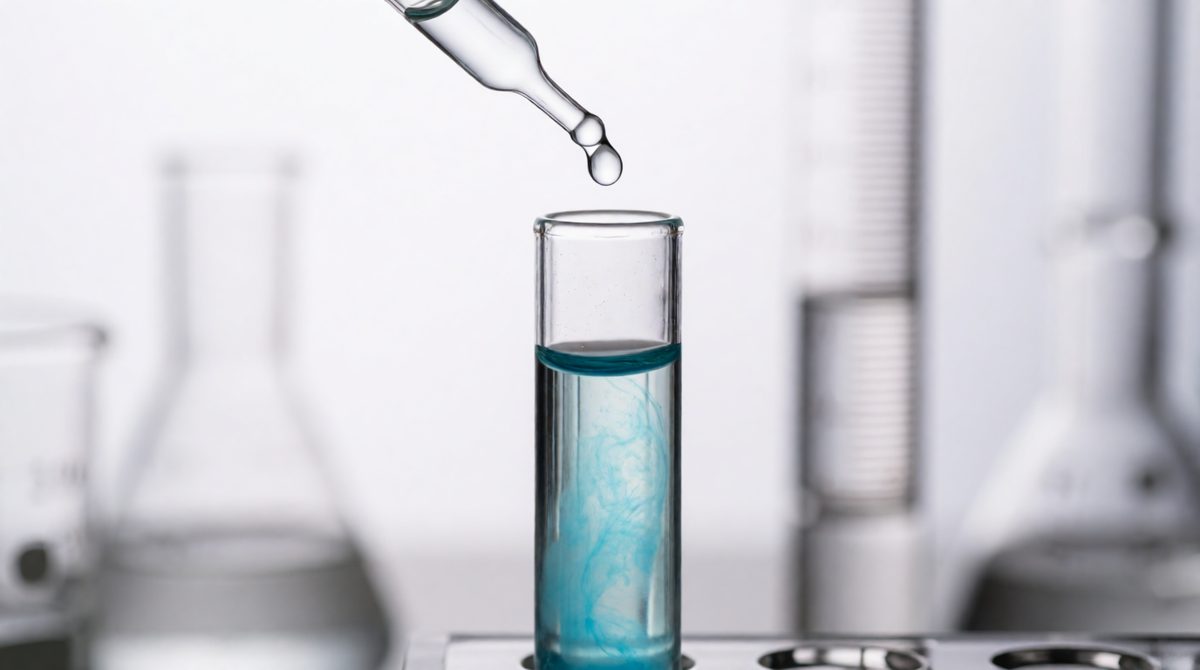
A few drops of sodium hydroxide and a coloured precipitate forms - its colour tells you which metal ion is present
1. Put a small amount of the solution being tested into a test tube.
2. Add a few drops of sodium hydroxide solution.
3. Look at the colour of any precipitate that forms and write it down.
4. If the precipitate is white, keep adding sodium hydroxide solution until it is in excess.
5. Shake the tube gently and see if the precipitate stays or disappears.
Wear safety goggles. Sodium hydroxide solution is corrosive and can harm your eyes and skin.
Solutions of aluminium, calcium and magnesium ions all form a white precipitate with sodium hydroxide solution. So the first drops do not tell the three apart. The excess step does part of the job:
The white precipitate of aluminium hydroxide dissolves in excess sodium hydroxide solution. You end up with a colourless solution.
The white precipitate stays when more sodium hydroxide is added. It does not dissolve in excess.
Only the aluminium hydroxide precipitate dissolves in excess. This test cannot separate calcium from magnesium, because they behave in the same way. A flame test can help here. Remember, calcium gives an orange-red flame colour.
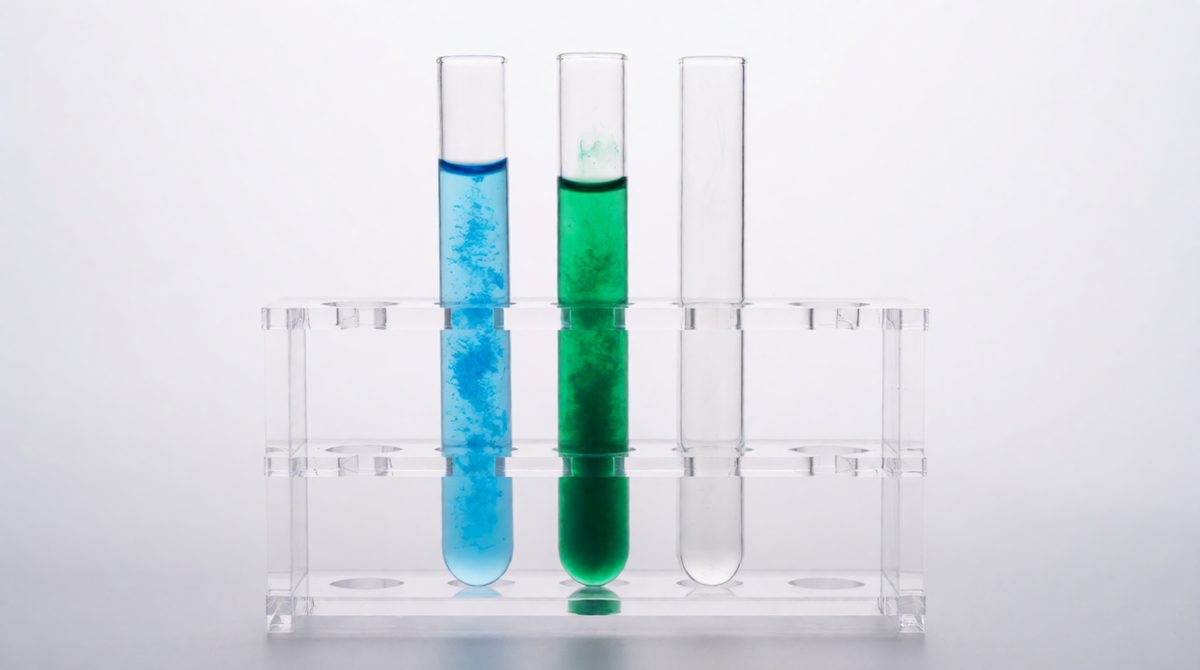
Blue, green, brown: copper(II), iron(II) and iron(III) hydroxide precipitates, all lined up
Copper(II), iron(II) and iron(III) ions form coloured precipitates. The colour tells you which ion is present.
A blue precipitate of copper(II) hydroxide.
A green precipitate of iron(II) hydroxide.
A brown precipitate of iron(III) hydroxide.
Aluminium, Al3+: white precipitate, dissolves in excess.
Calcium, Ca2+: white precipitate, stays in excess.
Magnesium, Mg2+: white precipitate, stays in excess.
Copper(II), Cu2+: blue precipitate.
Iron(II), Fe2+: green precipitate.
Iron(III), Fe3+: brown precipitate.
You should be able to write balanced equations for the reactions that make the insoluble hydroxides. The metal salt solution reacts with sodium hydroxide to make the metal hydroxide and a sodium salt. Add the state symbols: (aq) for dissolved and (s) for the solid.
Copper(II) sulfate solution with sodium hydroxide solution:
CuSO4(aq) + 2NaOH(aq) → Cu(OH)2(s) + Na2SO4(aq)
Check: 1 Cu, 1 S, 6 O, 2 Na and 2 H on each side. It is balanced.
Magnesium chloride solution with sodium hydroxide solution:
MgCl2(aq) + 2NaOH(aq) → Mg(OH)2(s) + 2NaCl(aq)
Check: 1 Mg, 2 Cl, 2 Na, 2 O and 2 H on each side. It is balanced.
The number of hydroxide groups in the formula equals the charge on the metal ion, so iron(III) and aluminium make Fe(OH)3 and Al(OH)3.
Ionic equations show just the metal ion joining with hydroxide ions. The number of OH- ions equals the charge on the metal ion:
Cu2+(aq) + 2OH-(aq) → Cu(OH)2(s)
Mg2+(aq) + 2OH-(aq) → Mg(OH)2(s)
Ca2+(aq) + 2OH-(aq) → Ca(OH)2(s)
Fe2+(aq) + 2OH-(aq) → Fe(OH)2(s)
Fe3+(aq) + 3OH-(aq) → Fe(OH)3(s)
Al3+(aq) + 3OH-(aq) → Al(OH)3(s)
You are not expected to write an equation for what happens when the aluminium hydroxide dissolves in excess. That makes sodium aluminate, which you do not need to write equations for.
Saying that calcium hydroxide dissolves in excess. Only aluminium hydroxide does. Mixing up the two iron ions: iron(II) is green and iron(III) is brown. Forgetting to add excess to a white precipitate, which is the only way to spot aluminium. Using the wrong number of hydroxide ions in the equation: always match the charge on the metal ion.
A student has three colourless solutions, X, Y and Z. Each contains one metal ion. She adds a few drops of sodium hydroxide solution to each and gets a white precipitate every time. She then adds excess sodium hydroxide solution. The precipitate in X dissolves. The precipitates in Y and Z do not. (a) Which metal ion is in X? (b) Aluminium chloride solution reacts with sodium hydroxide solution. Write a balanced equation for the first reaction in X. (c) What further test could tell Y from Z, if they are calcium and magnesium?
(a) Aluminium ions, because only aluminium hydroxide dissolves in excess sodium hydroxide solution.
(b) AlCl3(aq) + 3NaOH(aq) → Al(OH)3(s) + 3NaCl(aq)
(c) A flame test. Calcium gives an orange-red flame and magnesium gives no flame colour.
If the question says a precipitate is white, always ask what happens in excess. That one detail separates aluminium from calcium and magnesium.