Identifying Ions » Tests for Carbonates, Halides and Sulfates
What you'll learn this session
Study time: 30 minutes
AQA spec: 4.8.3.3, 4.8.3.4, 4.8.3.5
- How to test for carbonates using acid and limewater
- How to test for chloride, bromide and iodide ions using silver nitrate
- How to test for sulfate ions using barium chloride
- Which colour of precipitate tells you which ion is present
🔒 Unlock Full Course Content
Sign up to access the complete lesson and track your progress!
Unlock This CourseTesting for negative ions
In the last lesson you used sodium hydroxide to find out which metal ion is in a compound. Now we look at the other half of an ionic compound: the negative ion. Three important negative ions each have a simple test. Carbonate ions, halide ions and sulfate ions.
The halide and sulfate tests work on ions in solution. If you have a solid, you dissolve it in water first. For carbonates, you can add the acid straight to the solid.
Key terms:
- Carbonate ion: CO32-, found in compounds such as calcium carbonate.
- Halide ion: a negative ion made from a halogen, such as chloride, bromide or iodide.
- Sulfate ion: SO42-, found in compounds such as sodium sulfate.
Test for carbonates
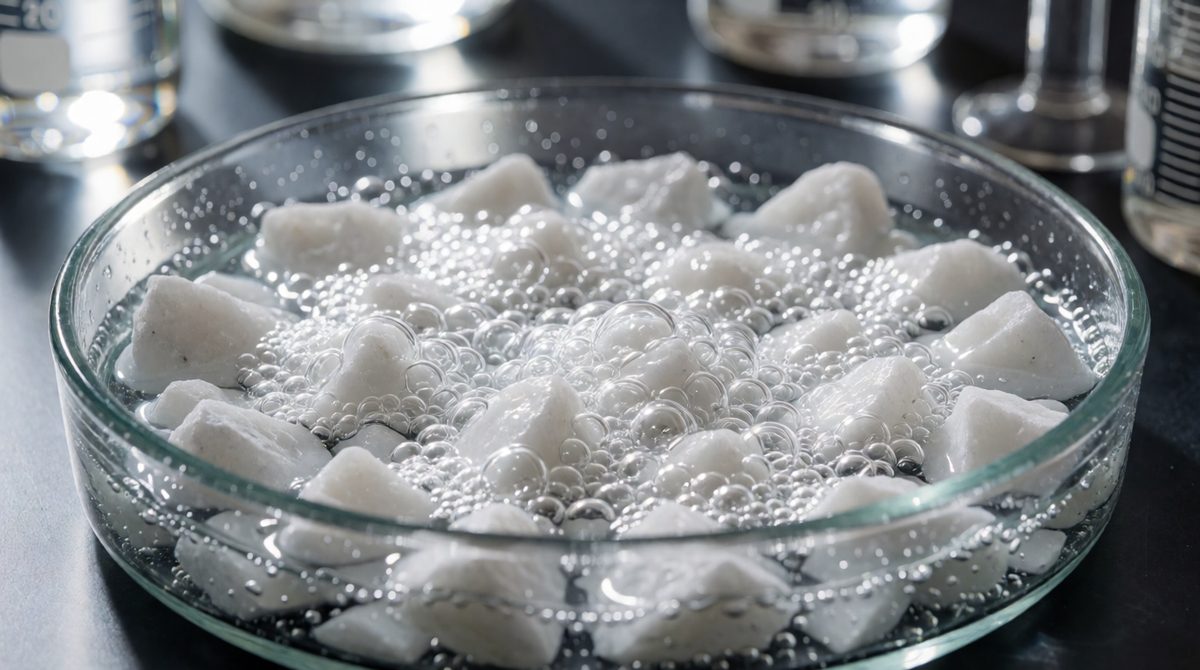
Fizzing when acid hits a carbonate means carbon dioxide - bubble it through limewater to be sure
Carbonates react with dilute acids to form carbon dioxide gas. So the test is easy to spot: you see bubbles.
- Add a few drops of dilute hydrochloric acid to the sample.
- If it fizzes, a gas is being made.
- Bubble the gas through limewater.
- If the limewater turns milky (cloudy), the gas is carbon dioxide, so the sample contains carbonate ions.
Here is an example in words:
calcium carbonate + hydrochloric acid → calcium chloride + water + carbon dioxide
Fizzing alone is not enough. Other substances, such as some metals, also fizz in acid. The limewater turning milky is what proves it is carbon dioxide.
Test for halides
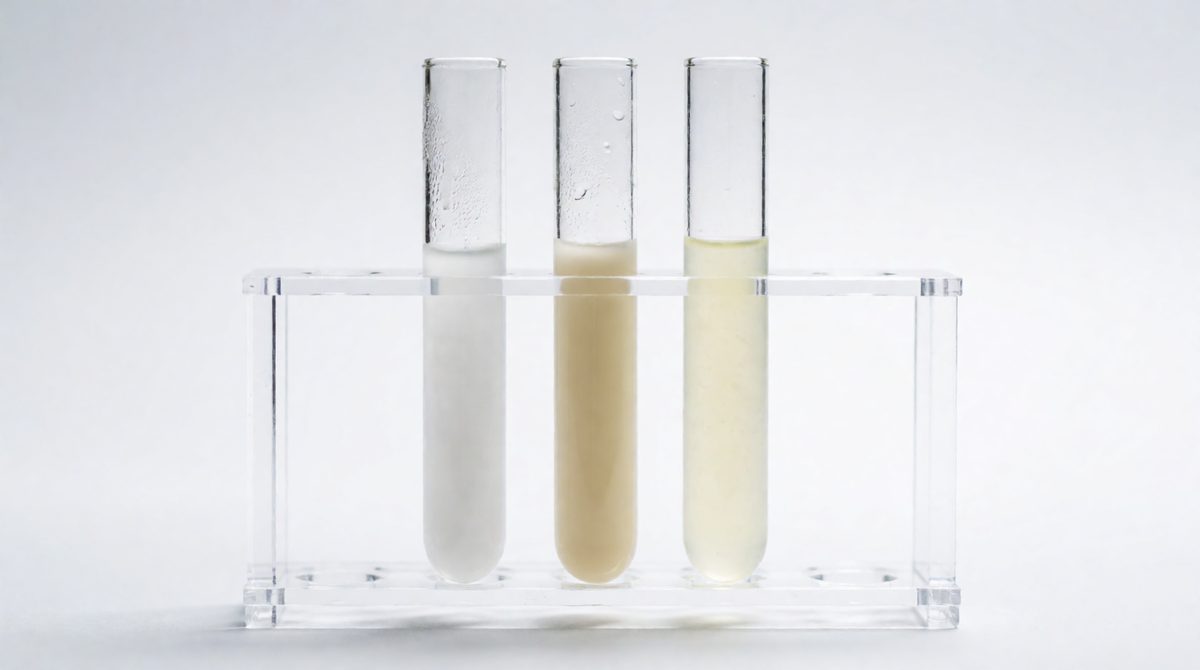
Silver nitrate shows the halide: white for chloride, cream for bromide, yellow for iodide
Halide ions in solution produce precipitates with silver nitrate solution in the presence of dilute nitric acid. The colour of the precipitate tells you which halide you have.
- Add dilute nitric acid to the solution.
- Add a few drops of silver nitrate solution.
- Look at the colour of the precipitate.
Chloride
Chloride ions give a white precipitate of silver chloride.
Bromide
Bromide ions give a cream precipitate of silver bromide.
Iodide
Iodide ions give a yellow precipitate of silver iodide.
Example in words:
sodium chloride + silver nitrate → silver chloride + sodium nitrate
The silver halide is the solid that does not dissolve, so it is the precipitate. A good way to remember the order is that the colours get deeper as you go down the group: white, cream, yellow.
Why add nitric acid first?
Other ions, such as carbonate ions, could also make a precipitate with silver nitrate and mix up your result. Adding dilute nitric acid first removes them. Use nitric acid, not hydrochloric acid. Hydrochloric acid contains chloride ions and would give a white precipitate by itself.
Test for sulfates
Sulfate ions in solution produce a white precipitate with barium chloride solution in the presence of dilute hydrochloric acid.
- Add dilute hydrochloric acid to the solution.
- Add a few drops of barium chloride solution.
- A white precipitate means sulfate ions are present.
The white precipitate is barium sulfate. Example in words:
sodium sulfate + barium chloride → barium sulfate + sodium chloride
Why add hydrochloric acid first?
Carbonate ions would also make a white precipitate with barium chloride. The acid reacts with any carbonate and gets rid of it, so a white precipitate can only mean sulfate.
All three tests together
⚛ Carbonate
Add dilute acid. Fizzing, and the gas turns limewater milky.
⚗ Halide
Add dilute nitric acid, then silver nitrate. White, cream or yellow precipitate.
⚖ Sulfate
Add dilute hydrochloric acid, then barium chloride. White precipitate.
Worked example
A student adds dilute nitric acid and then silver nitrate solution to a colourless solution. A cream precipitate forms. The cream colour means silver bromide, so the solution contains bromide ions.
Common mistakes
1. Using hydrochloric acid in the halide test. It adds chloride ions and spoils the result. 2. Saying the sulfate precipitate is cream or yellow. It is always white. 3. Mixing up the two white precipitates. Chloride gives white with silver nitrate; sulfate gives white with barium chloride. The reagent used tells you which ion it is. 4. Saying a fizz proves carbonate without testing the gas with limewater.
Exam-style question
A student has two colourless solutions, A and B. One contains sodium iodide and the other contains sodium sulfate. Describe the tests the student could do to tell them apart and the results they would see. (4 marks)
Model answer
Add dilute nitric acid and then silver nitrate solution to a sample of each solution. The solution containing iodide ions gives a yellow precipitate (silver iodide). Add dilute hydrochloric acid and then barium chloride solution to a fresh sample of each solution. The solution containing sulfate ions gives a white precipitate (barium sulfate).
Exam tip
Always name the acid, the reagent and the colour of the precipitate. Writing "it goes cloudy" will not get the mark.