⚛ Positive ions (metals)
Lithium, sodium, potassium, calcium and copper (flame tests). Aluminium, calcium, magnesium, copper(II), iron(II) and iron(III) (sodium hydroxide solution).
Sign up to access the complete lesson and track your progress!
Unlock This CourseIn this practical you are given an unknown single ionic compound. It contains one positive ion and one negative ion. Your job is to work out which two ions it contains, using the tests from the last three lessons. You do not learn any new test here. You learn how to put the tests together into a sensible plan.
The ions you can be asked about are the ones from the flame tests through to the sulfate test:
Lithium, sodium, potassium, calcium and copper (flame tests). Aluminium, calcium, magnesium, copper(II), iron(II) and iron(III) (sodium hydroxide solution).
Carbonate, chloride, bromide, iodide and sulfate.
This practical covers two apparatus and techniques skills. The first is the safe use of a Bunsen burner. The second is the use of the right test reagents and techniques to identify unknown samples, including gas tests, flame tests and precipitation reactions.
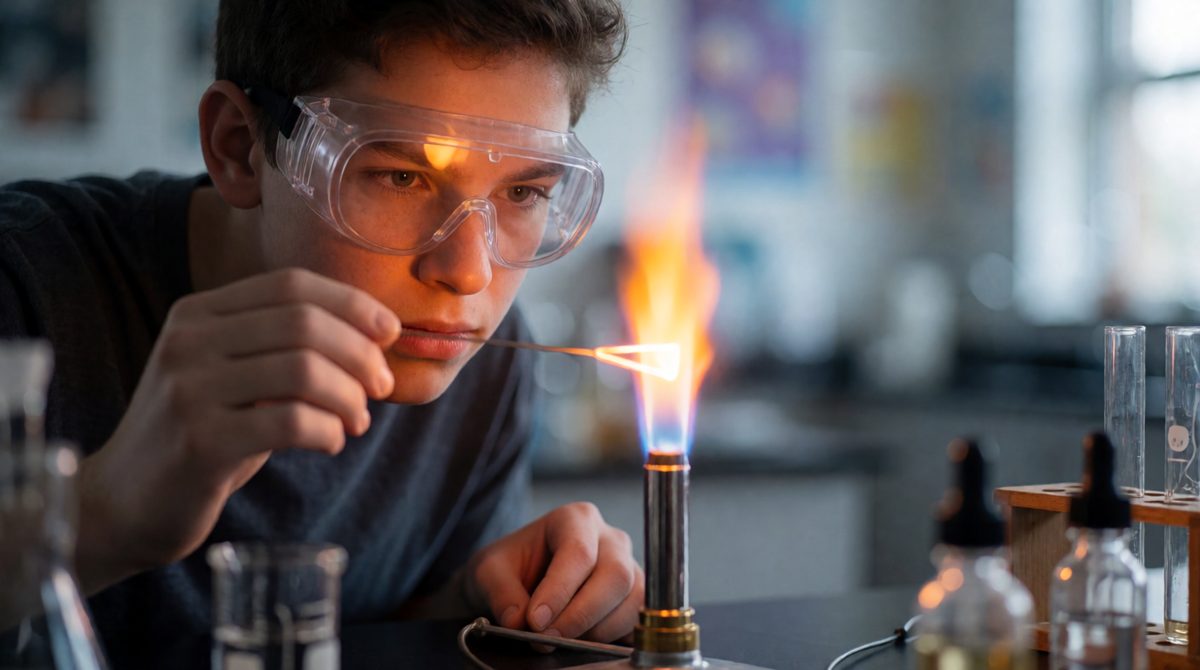
Start with a flame test - an orange-red flame like this points to calcium ions in your mystery compound
If the solid does not dissolve in water, do the flame test and the acid and limewater test on the solid itself, because those do not need a solution.
Use a clean test tube for each test, so that one test cannot spoil the next. Record every result in a table as you go.
You can do the tests in any order, but a good plan saves time and stops mistakes.
A student is given a white solid, compound A, and records these results.
Flame test: lilac. Sodium hydroxide solution: no precipitate. Dilute hydrochloric acid: fizzing, and the gas turned limewater milky.
The lilac flame shows a potassium ion. The fizzing and milky limewater show a carbonate ion. Compound A is potassium carbonate.
Compound B is a white solid. Its solution gives a white precipitate with sodium hydroxide solution, which dissolves when more is added. With nitric acid then silver nitrate it gives a cream precipitate.
A white precipitate that dissolves in excess sodium hydroxide shows an aluminium ion. A cream precipitate with silver nitrate shows a bromide ion. Compound B is aluminium bromide.
Compound C is a blue solid. It gives a green flame. Its solution gives a blue precipitate with sodium hydroxide solution, and a white precipitate with hydrochloric acid then barium chloride.
The green flame and blue precipitate both show a copper(II) ion. The white precipitate shows a sulfate ion. Compound C is copper(II) sulfate.
Set it on a heat-proof mat. Use the yellow safety flame when you are not heating, and the blue flame for flame tests. Keep hair and loose clothing away.
Wear safety glasses. Sodium hydroxide solution can irritate the skin and harm the eyes. Wash off any spills with plenty of water.
Silver nitrate stains skin and barium chloride is harmful. Use only a few drops and do not get them on your skin.
1. Using a dirty flame test wire, which gives the wrong colour. 2. Using hydrochloric acid in the silver nitrate test. 3. Adding only a few drops of sodium hydroxide and not testing in excess, so you cannot tell aluminium from calcium or magnesium. 4. Using the same test tube for different tests. 5. Writing "clear" when you mean "colourless". A solution can be clear and still coloured. 6. Writing "nothing" without saying what you looked for, such as "no precipitate".
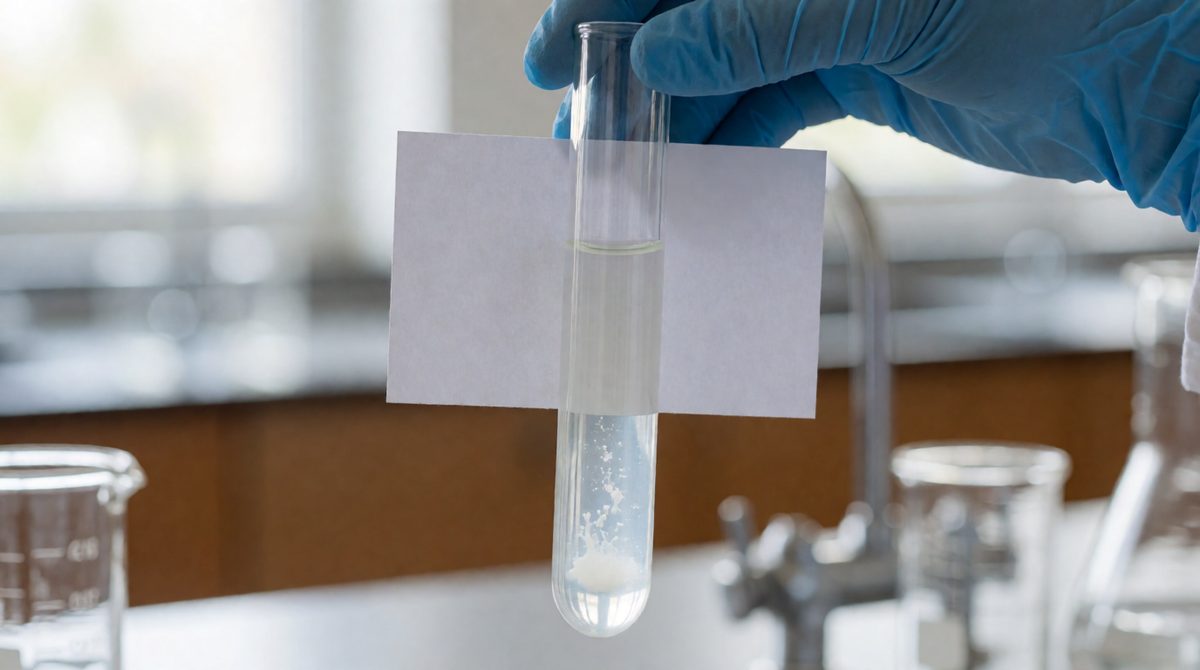
Hold the tube against white card so a pale precipitate shows up clearly, and repeat any unclear test
A good scientist repeats a test if the result is unclear. A pale precipitate can be hard to see, so hold the test tube against a white background. If you are unsure, compare your result with a known sample tested the same way. Use equal small amounts each time so that the tests can be compared.
A student is given a white solid, Z. The student carries out tests on Z.
Flame test: orange-red flame. Z dissolved in water, then sodium hydroxide solution added: white precipitate that does not dissolve in excess. Z solution with dilute nitric acid then silver nitrate solution: white precipitate.
(a) Name the compound Z. (2 marks) (b) Describe how the student should carry out the flame test safely and correctly. (3 marks) (c) The student wants to test another sample for a sulfate ion. Name the two reagents needed. (2 marks)
(a) Calcium chloride. The orange-red flame and the white precipitate that does not dissolve in excess sodium hydroxide show a calcium ion. The white precipitate with silver nitrate shows a chloride ion. (2 marks)
(b) Wear safety glasses. Clean the wire, dip it in the sample, and hold it in the blue part of the Bunsen burner flame. Observe and record the colour. (3 marks)
(c) Dilute hydrochloric acid and barium chloride solution. (2 marks)
In "identify the compound" questions, name both ions and give the test result that proves each one. Examiners give a mark for each ion and a mark for each piece of evidence.