🌋 The first gases
At the start of this period the atmosphere may have been like the atmospheres of Mars and Venus today. These are mainly carbon dioxide, with little or no oxygen gas.
Sign up to access the complete lesson and track your progress!
Unlock This Course
Take a deep breath! The air is about 80% nitrogen and 20% oxygen, plus a little carbon dioxide and water vapour
The atmosphere is the layer of gases around the Earth. You breathe it in every second. For about 200 million years, the proportions of the different gases in it have been much the same as they are today. That makes it very stable.
Today's atmosphere is made of:
So nearly all of the air is just two gases. Nitrogen is the biggest part. The "other gases" together make up only a tiny fraction.
Key terms:
The spec asks you to use ratios, fractions and percentages. The gases in air fit these three ways of writing a proportion:
Nitrogen is about four-fifths of the air. Oxygen is about one-fifth.
Nitrogen is about 80%. Oxygen is about 20%.
Nitrogen : oxygen is about 4 : 1.
A sample of air has a volume of 500 cm3. Roughly how much of it is oxygen?
Oxygen is about 20%, which is one-fifth.
500 ÷ 5 = 100 cm3.
Check with a percentage: 20% of 500 = 0.20 × 500 = 100 cm3. Both ways agree.
The nitrogen is about four-fifths, so about 400 cm3.
Notice that 80% + 20% = 100%. In real air the two do not quite add up to the whole, because of the small amounts of other gases. That is why the spec says "about" and "approximately".
The Earth is about 4.6 billion years old. Its early atmosphere was very different from today's. Theories about what was in it and how it formed have changed and developed over time.
The evidence is limited because of the huge time scale of 4.6 billion years. Nobody was there to measure it, and very little from that time has survived. Scientists have to work out what probably happened.
Key terms:
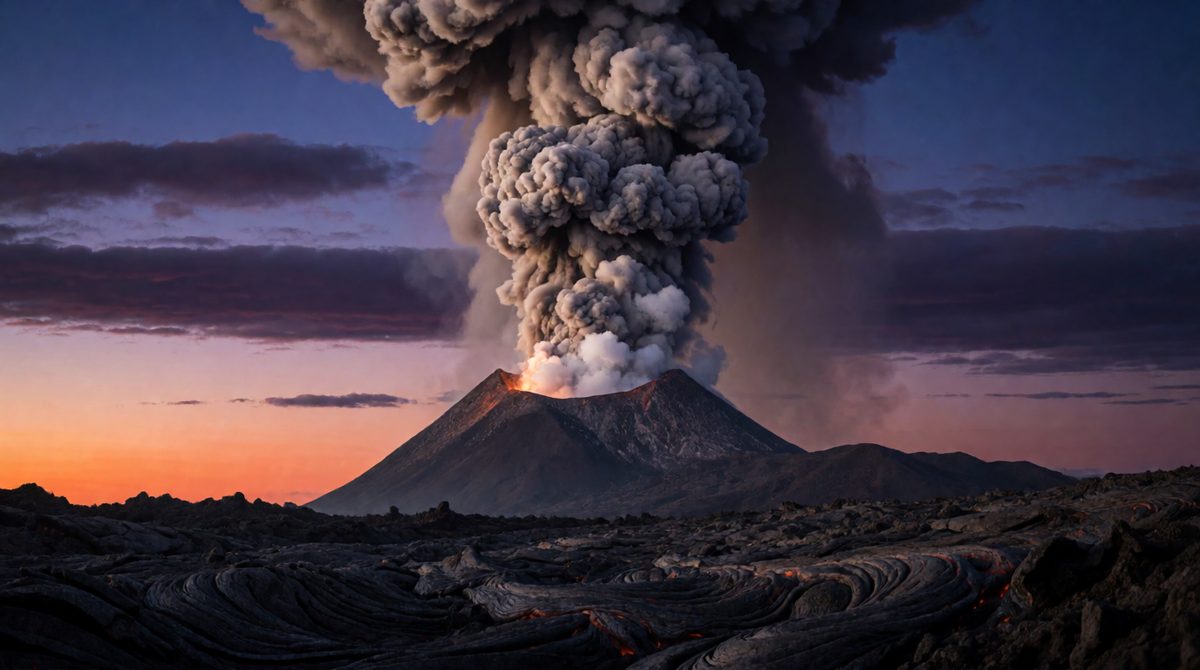
Billions of years ago, volcanoes like this pumped out the carbon dioxide and water vapour that made the early atmosphere and oceans
One theory suggests that during the first billion years of the Earth's existence there was intense volcanic activity. The volcanoes released gases that formed the early atmosphere. They also released water vapour.
At the start of this period the atmosphere may have been like the atmospheres of Mars and Venus today. These are mainly carbon dioxide, with little or no oxygen gas.
As the Earth cooled, the water vapour condensed. It fell as liquid water and formed the oceans.
Volcanoes also produced nitrogen. This gradually built up in the atmosphere. There may also have been small proportions of methane and ammonia.
Gases that may have been present: mainly carbon dioxide, plus water vapour and nitrogen, with small proportions of methane and ammonia. Oxygen: little or none.
Notice what has changed. Today nitrogen is about four-fifths of the air and oxygen about one-fifth. In the early atmosphere there was little or no oxygen. How this change happened is covered in the next lesson, How Oxygen Increased and Carbon Dioxide Decreased.
You may be given information and asked to interpret evidence or evaluate different theories about the early atmosphere. You only need to know the volcanic theory above. Here is how to tackle these questions.
A scientist says: "The early atmosphere was mainly carbon dioxide." Another scientist points out that Mars and Venus today have atmospheres that are mainly carbon dioxide with little oxygen.
The evidence from Mars and Venus supports the idea, because it shows that an atmosphere like this can exist on rocky planets. But it does not prove it, because these are different planets and not the early Earth.
1. Saying air is "mostly oxygen". It is only about one-fifth oxygen. Nitrogen is the biggest part.
2. Writing that the early atmosphere "was" definitely a certain mixture. The spec says it "may have been", so use words like "may" and "one theory suggests".
3. Saying the early atmosphere had lots of oxygen. It had little or none.
4. Mixing up condense (gas to liquid) with evaporate (liquid to gas).
1. Air contains about 20% oxygen. A sealed container holds 2000 cm3 of air. Calculate the volume of oxygen in it. (2 marks)
2. One theory says that volcanoes produced the gases in the early atmosphere. Describe how the oceans formed according to this theory. (2 marks)
3. Suggest why scientists cannot be certain what the early atmosphere was like. (1 mark)
1. 20% of 2000 = 0.20 × 2000 (1 mark) = 400 cm3 (1 mark).
2. Volcanoes released water vapour (1 mark). The water vapour condensed as the Earth cooled to form the oceans (1 mark).
3. The evidence is limited because it happened such a long time ago, about 4.6 billion years (1 mark).
For "evaluate" questions, give a point for the theory and a point against it or a limit on the evidence. Use "may have" and "suggests", not "proves".