💧 Testing pH
Put a small amount of each sample in a clean test tube or spotting tile. Add universal indicator and match the colour to the pH chart, or use a pH probe and read the number. Rinse the probe with distilled water between samples.
Sign up to access the complete lesson and track your progress!
Unlock This CourseIn this practical you analyse water samples from different sources, then purify one of them. You will use three skills: measuring pH, finding out how much is dissolved in the water, and distilling.
Your samples might be rain water, water from a pond, and salt water. Each one has different things in it, so each gives different results.
Key terms:
A sample is only useful if it is representative. If you scoop water from the very edge of a pond, you might collect extra mud or leaves. Take water from more than one place, and label each bottle clearly with where it came from.
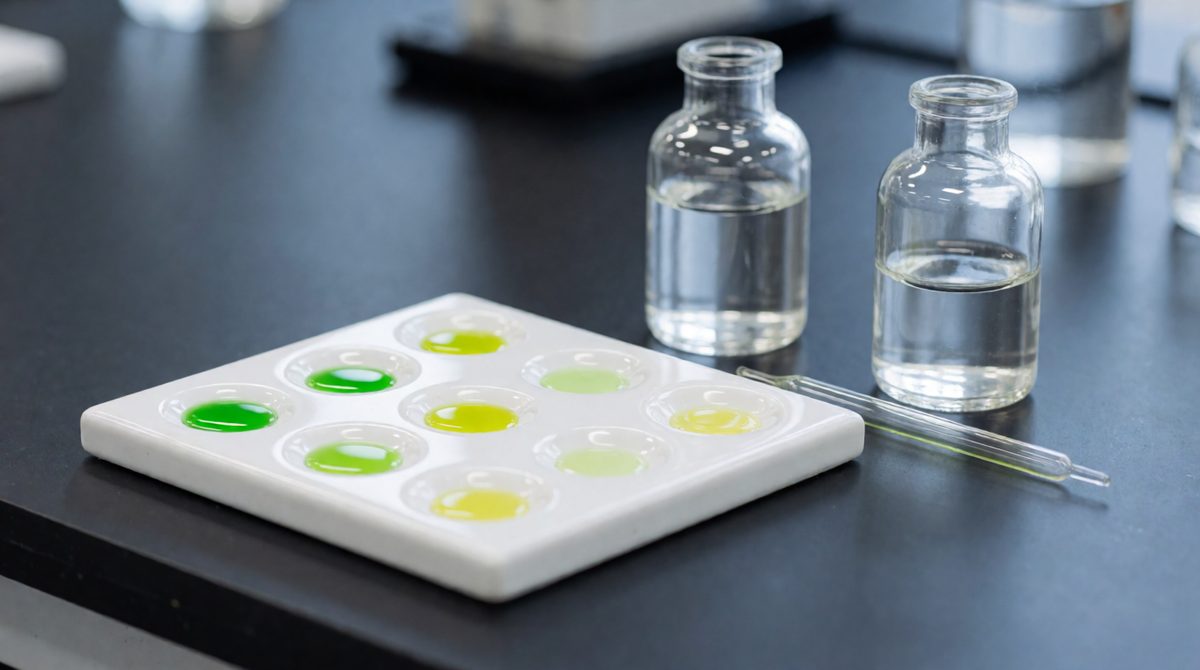
Universal indicator turns colour to show each water sample's pH - green means neutral, around pH 7
Put a small amount of each sample in a clean test tube or spotting tile. Add universal indicator and match the colour to the pH chart, or use a pH probe and read the number. Rinse the probe with distilled water between samples.
Find out how much solid is dissolved in a measured volume of each sample. The method is below.
The mass of the solid is the final mass minus the mass of the empty basin.
Compare your results. Pure water has a pH of 7. A sample with a pH below 7 is acidic and above 7 is alkaline. A sample with more dissolved solid has more dissolved in it.
An empty basin has a mass of 42.10 g. After evaporating 20 cm3 of sea water, the basin and solid have a mass of 42.80 g.
Mass of dissolved solid = 42.80 - 42.10 = 0.70 g
These numbers are an example. Rain water would be expected to leave far less solid than sea water.
Keep the volume the same for every sample. This is the control variable, so the results are a fair test.
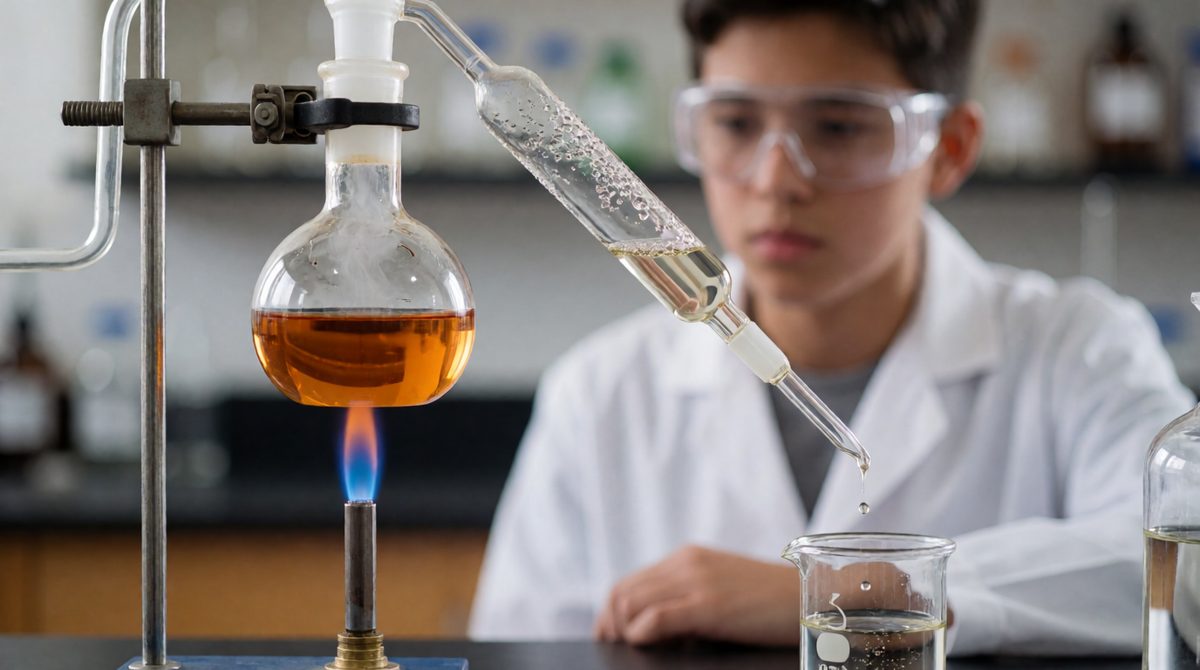
Steam rises off the salty water and cools in the condenser, leaving the dissolved salt behind in the flask
Water with dissolved solids can be purified by distillation. The water boils and turns to steam. The dissolved solids do not boil off, so they stay behind. The steam is cooled and turns back into liquid water.
Then test the distillate. Evaporate a small amount in a clean basin: if it is pure, no solid is left behind. You can also check its pH, which should be close to 7.
Hot glass looks like cold glass. Let equipment cool before you touch it. Tie back long hair and turn a Bunsen burner to the yellow flame when it is not in use.
Wear eye protection. Hot water can spit out of the basin if it is heated too hard.
Never taste or drink any sample or the distillate. Lab glassware is not clean enough to drink from.
Heating too strongly, so the solid spits out of the basin and the mass is too low. Weighing the basin while it is still hot, which gives a wrong reading. Using different volumes for different samples. Letting the flask boil dry. Putting the condenser water in at the top, so it does not fill the jacket.
You could improve the results by repeating each measurement and finding a mean, heating until the mass stops changing, and collecting samples from more than one spot. A pH probe is more precise than universal indicator colours.
A student has a sample of sea water. Describe how the student can get pure water from the sample, and how to show that the water is pure. (4 marks)
Heat the sea water in a flask so that it boils. The steam passes into a condenser, where it cools and turns back into liquid water. Collect the liquid in a beaker. To show it is pure, evaporate a small amount of the collected water. No solid is left behind. (You could also say that pure water boils at 100 °C at normal pressure.)
When asked about distillation, name the two changes of state: boiling (evaporating) then condensing. Many students forget to say that the solids stay behind in the flask.