💲 A rising price
Signals demand is strong, gives firms an incentive to make more, and rations the good to those willing and able to pay.
Sign up to access the complete lesson and track your progress!
Unlock This Course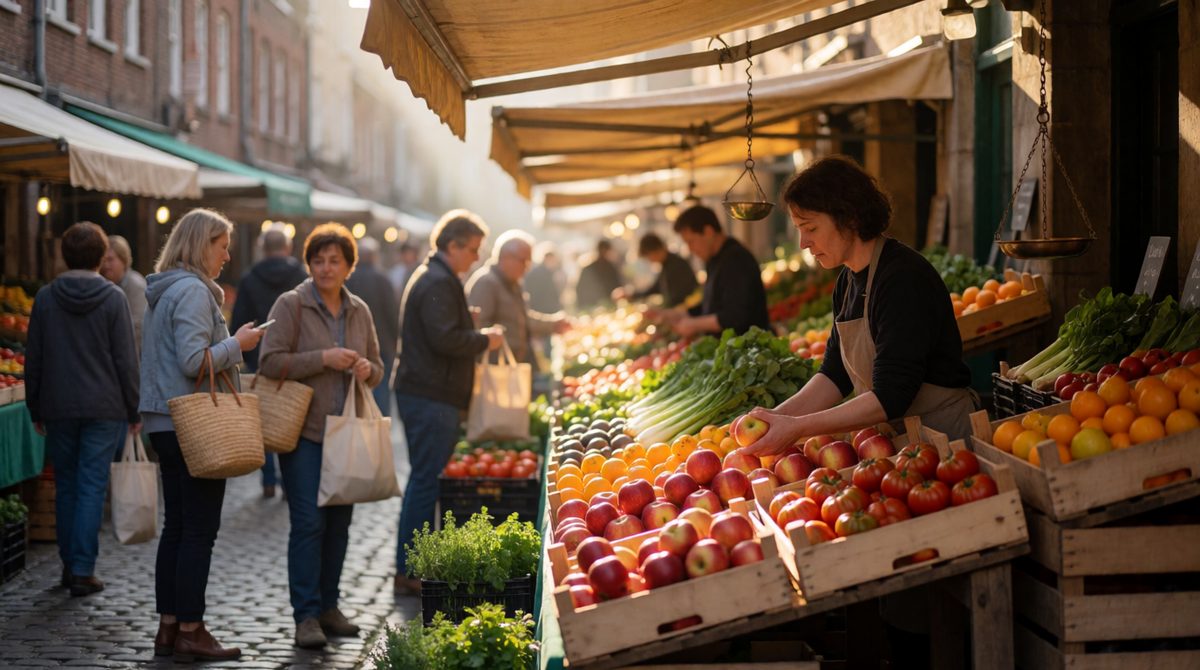
Nobody planned this stall's stock - prices signal what buyers want, and sellers respond
Think about how a large city gets fed. Nobody in charge plans how much bread, rice or fruit each street needs. Yet shops are usually stocked each morning. How?
In a market, the answer is prices. Buyers and sellers act in their own interests, and prices change as they do. Those changing prices steer resources towards the things people want. Remember from What, How and For Whom to Produce that every economy must answer three questions. This lesson shows how markets answer them without anyone giving orders.
Key terms:
The price mechanism works because price does three jobs at once.
A rising price signals that a good is wanted. A falling price signals that it is not wanted as much.
Higher prices and profits encourage firms to produce more. Lower prices and losses encourage them to produce less or stop.
When a good is scarce, a higher price puts off some buyers, so the good goes to those willing and able to pay.
Consumers vote with their money. If more people want a good, demand increases and its price tends to rise. That price rise is a signal to producers.
It is also an incentive. A higher price means a higher profit on each item sold. Profit attracts producers into that market, so more of the good is made. Resources move towards the goods consumers want most.
The reverse also happens. If a good goes out of fashion, demand falls, the price falls and profits shrink. Some firms switch to making something else, and resources move away.
Firms in a market want to keep costs low so that profit is as high as possible. So they choose the cheapest combination of factors of production that can make the good.
The prices of the factors guide this choice. If wages rise, workers become expensive, so a firm may use more machines. If machines become cheaper, the firm may switch to them. If labour is cheap, the firm may use more workers.
No one tells the firm what to do. Its own search for lower costs and higher profit does the job.
In a market, goods go to those who are willing and able to pay the price. This is where rationing comes in. Remember effective demand: wanting something is not enough, you also need the money to buy it.
If a good is scarce, its price rises. The higher price puts off some buyers, and the limited supply goes to those who will pay. People with more income can buy more. People with less income can buy less.
Signals demand is strong, gives firms an incentive to make more, and rations the good to those willing and able to pay.
Signals demand is weaker, gives firms less incentive to produce, and makes the good easier to afford.

When a product becomes fashionable, demand rises, prices go up and firms rush to make more - the price mechanism in action
Here is a made-up example. In the country of Zentria, a firm makes foldable electric scooters. Social media makes them fashionable.
Nobody planned this. The price mechanism did it.
In the exam, draw a demand and supply diagram. Put Price on the vertical axis and Quantity on the horizontal axis. Draw a downward sloping demand curve labelled D and an upward sloping supply curve labelled S. Then draw a second demand curve to the right of the first and label it D1. Mark the old price P1 and the new, higher price P2 on the vertical axis, and the quantities Q1 and Q2 on the horizontal axis. A higher price and a larger quantity show that the market has responded to the extra demand.
Saying that the government decides what is produced in a market. It does not: prices and profits do. Another slip is writing only that price rises, without saying what that does. Always link price to a signal, an incentive or rationing, and then say which question it answers.
In the country of Orvale, a new fruit drink becomes very fashionable. Demand rises sharply and the price of the drink goes up. Many new firms start making it.
(a) Define the price mechanism. [2 marks]
(b) Explain why the higher price encourages firms to produce more of the drink. [3 marks]
(c) Analyse how the price mechanism helps to decide for whom the drink is produced. [4 marks]
(a) The price mechanism is the way the interaction of demand and supply decides prices (1), which then allocates resources between different uses (1).
(b) A higher price means more revenue for each unit sold (1). With costs unchanged, profit per unit is higher (1), so firms have an incentive to produce more and new firms enter the market (1).
(c) The higher price rations the drink (1). Some people cannot afford it or are not willing to pay that price, so they buy less or none (1). The drink goes to those who are willing and able to pay (1). So people with more income are more likely to get it (1).
For an Analyse question, build a chain: price rises, so this happens, which leads to that. Do not just state the answer.