🏭 External costs
A cement works in the made-up town of Karnel spreads dust over nearby homes. The owners count only their own costs, so they produce more than is best for society. The good is over-produced and over-consumed. The market fails.
Sign up to access the complete lesson and track your progress!
Unlock This CourseIn the last lesson you saw that the market economic system can allocate resources well, but it has weaknesses. Sometimes the price mechanism does not give society the best result. Economists call this market failure.
Key terms:
"Efficiently" means the right amount of a good is produced, given what society wants and what it costs. When a market fails, too much or too little of a good is produced. Resources are in the wrong place.

The vaccinated person gets the private benefit, but everyone around them gains too - that's an external benefit to third parties
When you buy a good, you think about what you get out of it. Firms and buyers make decisions using their own gains and costs. But a market exchange can also affect other people.
The gains to the person who buys or uses a good or service.
The gains to third parties, who did not buy the good and did not pay for it.
The total gain to society. Social benefit = private benefit + external benefit.
Think of a flu vaccination. You get the private benefit: you are less likely to be ill. But other people also gain, because you are less likely to pass the illness on. That is an external benefit.
Costs work in the same way.
The costs paid by the buyer or the producer, such as wages, materials and energy.
The costs suffered by third parties, who get no payment for the harm.
The total cost to society. Social cost = private cost + external cost.
Key terms:
Brightwater Haulage, a made-up lorry firm in Merovia, delivers goods. Each month its private costs (wages, fuel and vehicle upkeep) are $50,000. Its lorries drive through a village at night. The village pays $12,000 to repair the damaged road and residents lose $8,000 of work time through broken sleep.
External cost = $12,000 + $8,000 = $20,000.
Social cost = private cost + external cost = $50,000 + $20,000 = $70,000.
Brightwater only pays $50,000. The village bears the other $20,000.
In the made-up country of Dorvale, a vaccination gives each person a private benefit worth $100 (fewer sick days and doctor visits). It also gives an external benefit of $60 per person, because fewer people catch the illness from them.
Social benefit = private benefit + external benefit = $100 + $60 = $160 per person.
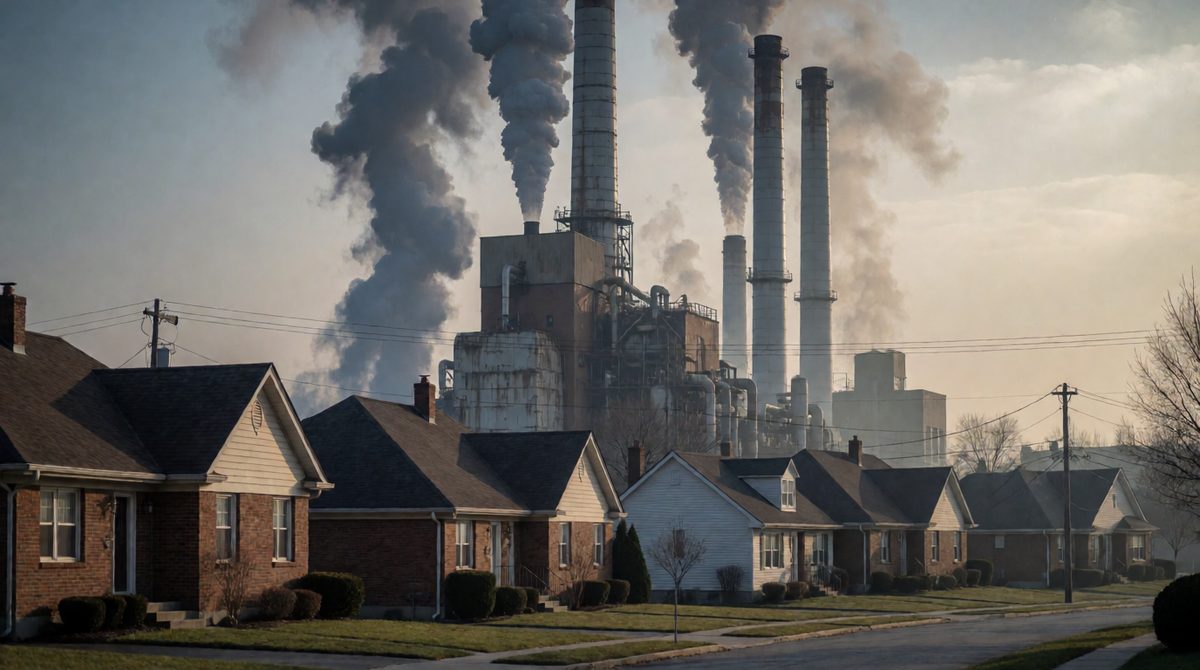
The factory pays for its fuel, but not for the smoke nearby residents breathe - ignored external costs mean the good is over-produced
Buyers and sellers make decisions using private costs and private benefits. They ignore effects on third parties, because they do not pay for them and do not receive them. The market price therefore reflects only the private figures, not the full social figures.
A cement works in the made-up town of Karnel spreads dust over nearby homes. The owners count only their own costs, so they produce more than is best for society. The good is over-produced and over-consumed. The market fails.
People choosing whether to pay for a vaccination think only about their own health. They ignore the gain to others. Fewer people buy it than is best for society. The good is under-consumed. The market fails.
So the cause is the same in both cases: decision-makers ignore the effects on third parties. Social costs differ from private costs, or social benefits differ from private benefits.
Zandria is a made-up country. A paper mill there produces paper for sale. Each year the mill's private costs are $400,000. Smoke from the mill harms the health of nearby residents, which costs them $150,000 a year in medical care and lost work.
(a) Define 'external cost'. [2 marks]
(b) Calculate the social cost of the mill's production. [2 marks]
(c) Explain why this is an example of market failure. [4 marks]
(a) A cost (1) suffered by third parties, not by the buyer or producer (1).
(b) Social cost = private cost + external cost (1) = $400,000 + $150,000 = $550,000 (1).
(c) The mill only counts its private costs (1) and ignores the harm to residents (1). So it produces more paper than is best for society (1). The price mechanism fails to allocate resources efficiently, which is market failure (1).
In an "Explain" answer, name who is ignored (the third parties) and say what the decision-maker does as a result. Do not just say that the mill is bad.