💰 What the firm sees
No one pays, so there is no revenue and no profit. The firm will not build the wall.
Sign up to access the complete lesson and track your progress!
Unlock This Course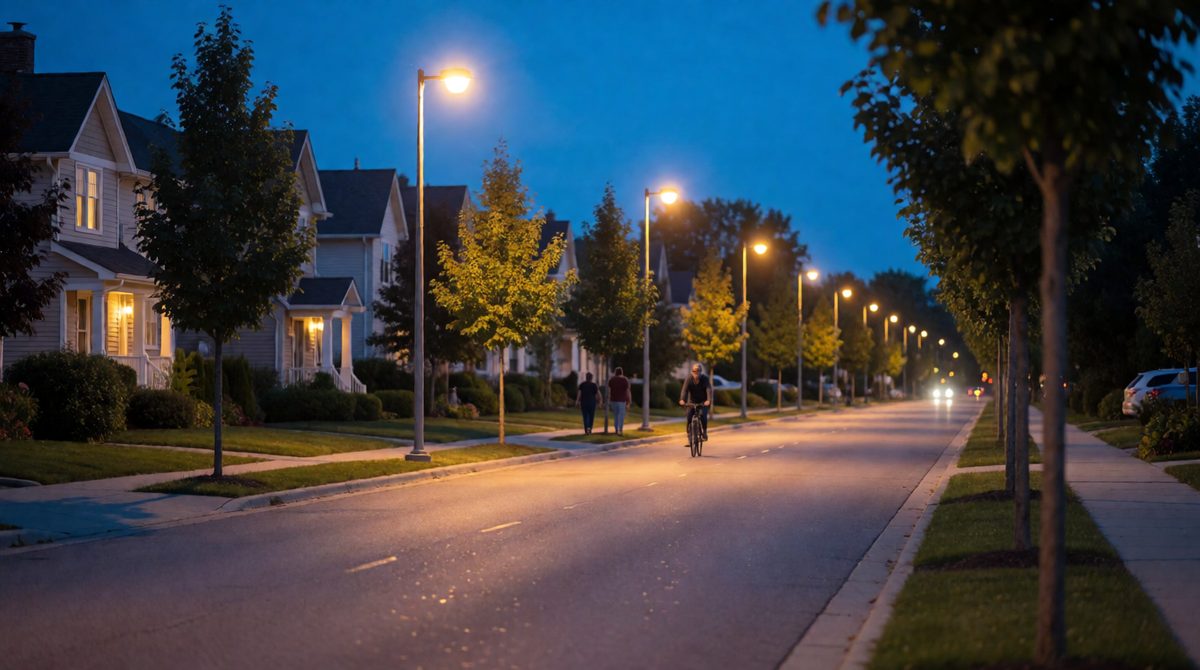
Street lights are a classic public good: non-excludable and non-rival, so one walker's light doesn't dim anyone else's
You have seen that external costs and external benefits cause market failure. This lesson looks at four more causes. The first is public goods.
Think about a street light in the town of Orlea. It lights the road for everyone who walks or drives past. The council cannot easily stop one person from enjoying the light, and one person using the light does not leave less for anyone else.
Key terms:
Other examples are lighthouses, flood defences, national defence and clean public streets.
Suppose a private firm builds a flood wall to protect a coastal town. Once the wall is built, every home behind it is protected. The firm cannot stop anyone from being protected, because the good is non-excludable.
So why would anyone pay? Each household can think, "The wall protects me anyway, so I will let my neighbours pay." Everybody thinks the same, so nobody pays. This is the free rider problem.
No one pays, so there is no revenue and no profit. The firm will not build the wall.
The wall would give big benefits to everyone. Without it, the town stays unprotected.
This is market failure. The market does not provide public goods at all, or provides far too little. For this reason, public goods are usually paid for by the government through taxes.

Education is a merit good - it benefits society as well as the student, but would be under-consumed if left to the market
A merit good is a good that is good for people and gives benefits to society, but is under-consumed if it is left to the market. Education and healthcare are common examples.
There are two reasons why merit goods are under-consumed:
Because of this, the amount bought at the market price is lower than the amount that would be best for society. Resources are misallocated.
A demerit good is a good that is bad for people and for society, but is over-consumed if it is left to the market. Examples are cigarettes, alcohol, gambling and harmful drugs.
Demerit goods are over-consumed for similar reasons, turned the other way round:
The result is that more is consumed than is best for society. Again, the market has failed.
Public good: the market provides too little or none, because of free riders.
Merit good: consumed too little, because benefits are underestimated or ignored.
Demerit good: consumed too much, because harm is underestimated or ignored.
A monopoly is a firm that is the only seller of a good or service in a market, or a firm that has a very large share of the market (you will study monopoly markets in full in a later lesson).
A monopoly has little or no competition, so it has market power. It does not have to worry that customers will go to a rival. If it uses that power in ways that harm consumers, this is the abuse of monopoly power.
Imagine Tolvane has only one company that supplies piped water to homes. Because customers have nowhere else to go, the company might:
Resources are not allocated efficiently. Consumers pay more and get less than they would in a competitive market, so the price mechanism has failed.
In the country of Sandovia, the government is deciding how to provide street lighting, school meals and a gambling industry. Answer the questions.
(a) Define the term 'public good'. [2 marks]
(b) Explain why a private firm would be unlikely to provide street lighting on its own. [4 marks]
(c) Analyse why a demerit good such as gambling may be over-consumed. [4 marks]
(a) A public good is a good that is non-excludable, so people cannot be stopped from using it (1), and non-rival, so one person's use does not reduce what is left for others (1).
(b) Street lighting is non-excludable, so people can use the light without paying (1). This leads to the free rider problem, because each person hopes that others will pay (1). Few people would pay, so the firm would get little or no revenue (1). The firm would not make a profit, so the market fails to provide the good (1).
(c) Gamblers may not know or may underestimate the harm that gambling does to them, such as losing money and damaging their health (1). This is information failure (1). They also ignore external costs, such as the harm to their families and the cost to the government of treating addiction (1). Because they consider only their own private costs, more gambling takes place than is best for society (1).
In (b), always use the words 'non-excludable' and 'free rider'. Examiners look for them as the link in your chain of reasoning.