🌾 Land
The plot the cafe stands on, the coffee beans, the milk, the water from the tap and the sugar. All of these start as natural resources.

Building, ingredients, staff, machines and an owner: every cafe needs all four factors of production
Think about your favourite cafe. To serve you a hot chocolate, it needs a building, ingredients, people to make the drink, machines to heat the milk, and someone who decided to open the cafe in the first place. Without all of these, there is no hot chocolate.
Economists call the resources used to produce goods and services the factors of production. There are four of them. Every business in every country, from a market stall to a car factory, uses some mix of all four.
Key terms:
Let us use a made-up business: the Blue Heron Cafe in the town of Marlow Bay. Here is each factor in action.
The plot the cafe stands on, the coffee beans, the milk, the water from the tap and the sugar. All of these start as natural resources.
The baristas who make the drinks, the cook who prepares the food and the waiter who serves the tables. Mental effort counts too: the manager planning the staff rota is labour.
The coffee machine, the ovens, the fridge, the tables and chairs and the building itself. These are made by people and used again and again to produce drinks and meals.
Mina Okafor, the owner. She had the idea, borrowed the money, hired the staff and bought the equipment. She also takes the risk that the cafe might not make money.
Notice that the coffee beans (land) and the coffee machine (capital) are different. The beans come from nature. The machine was made by people to help make something else. That is the clue for telling land and capital apart.
Also notice that the owner is both an organiser and a risk taker. That is what makes her enterprise, not just labour. A person who does this is often called an entrepreneur.
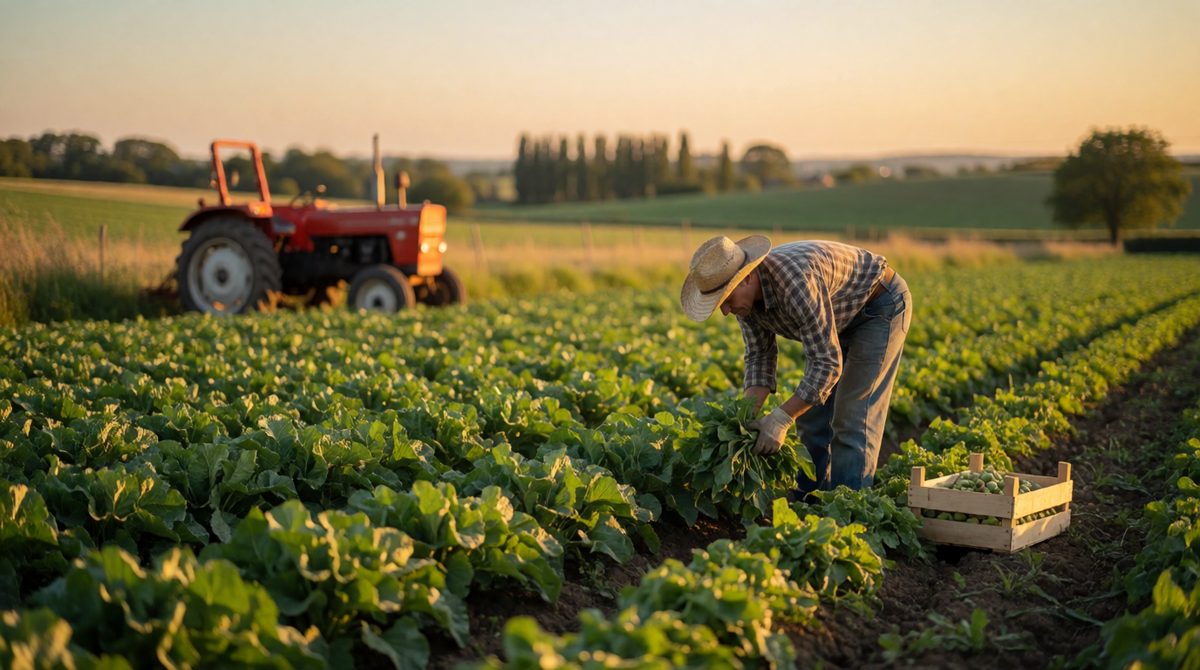
The farmer's wages reward labour, while the field earns rent for its owner
Owners of factors do not give them to businesses for free. Each factor earns a payment, called its reward, when it is used in production.
| Factor | Reward | Why it goes to this factor |
|---|---|---|
| Land | Rent | Payment to the owner for allowing the land to be used |
| Labour | Wages | Payment to workers for their time and effort |
| Capital | Interest | Payment to those who provide the funds to buy capital goods, for lending them |
| Enterprise | Profit | What is left of the firm's income after all other costs are paid, a reward for risk taking |
Back at the Blue Heron Cafe:
Rent, wages and interest are agreed in advance, so the owners of land, labour and capital know what they will get. Profit is not fixed. If the cafe has a bad month, Mina might make less profit, or even a loss. Enterprise carries the risk, so profit is its reward for taking that risk.
The Blue Heron Cafe takes in $6,000 in a month. It pays $1,200 rent, $2,400 wages, $300 interest and $1,500 for ingredients. Total costs are $1,200 + $2,400 + $300 + $1,500 = $5,400. Profit is $6,000 - $5,400 = $600. The reward of $600 goes to Mina, the enterprise factor.
1. Saying capital means money. In this lesson, capital means human-made goods such as machines, not cash in a till. 2. Calling a factory building land. Buildings are made by people, so they are capital. The ground under them is land. 3. Mixing up wages and profit. Workers earn wages. The owner who takes the risk earns profit. 4. Writing "rent" for the reward to capital. Capital earns interest.
The Green Valley Dairy is a made-up firm in a country called Verania. It uses its fields and water to grow grass for its cows. Workers milk the cows and operate the milking machines. The owner, Tomas, took out a loan to buy the machines and employs 12 people.
(a) Define the term 'capital'. [2 marks]
(b) Identify one example of land, one of labour and one of enterprise from the information. [3 marks]
(c) Explain why Tomas earns profit while the workers earn wages. [4 marks]
(a) Capital is goods made by people (1) that are used to produce other goods and services (1).
(b) Land: the fields or water (1). Labour: the workers who milk the cows (1). Enterprise: Tomas, who organises production and takes risks (1).
(c) Workers earn wages, which is the reward for their time and effort (1) and which are agreed in advance (1). Tomas organises the dairy and takes the risk that it may not make enough money (1), so his reward is profit, which is what is left after all costs are paid (1).
In part (b), use the business's own details from the question. Examiners reward answers that name the exact item, not just the factor.
Access the full course and all the resources like custom timetables and progress tracking.
Join Today