🌱 Quantity rises
Discovering new resources: a country finds a new oil field or a new mineral deposit. Land reclamation: turning sea or marsh into usable land by building walls and draining or filling it. Both increase the amount of land.
Sign up to access the complete lesson and track your progress!
Unlock This CourseIn the last lesson you met the four factors of production: land, labour, capital and enterprise. An economy's supply of each one is not fixed. It can grow, shrink or get better over time. There are two ways a factor can change.
Key terms:
A country with 5 million workers has a bigger quantity of labour than one with 2 million. But if the 2 million are highly trained, their quality may be higher. Always say which one changed.
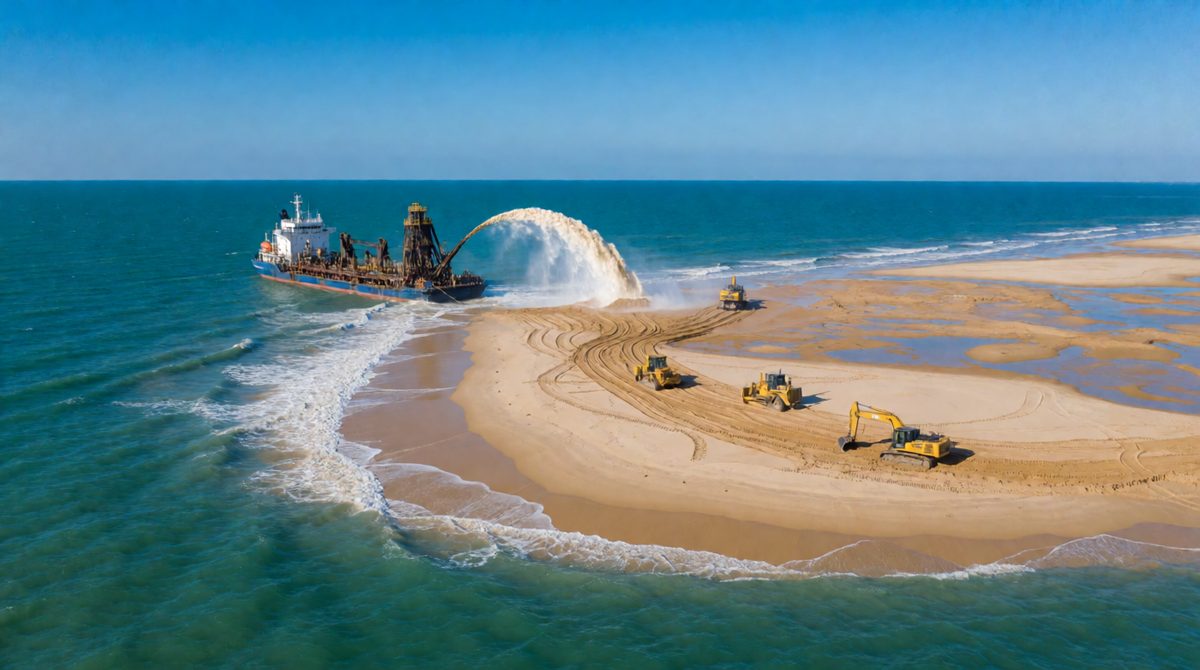
Land reclamation turns sea into new land, raising the quantity of this factor
Discovering new resources: a country finds a new oil field or a new mineral deposit. Land reclamation: turning sea or marsh into usable land by building walls and draining or filling it. Both increase the amount of land.
Depletion: resources are used up faster than they are replaced, such as a fish stock that is over-fished. Pollution: poisons soil and water, so they are less useful. Soil erosion: wind and rain strip away fertile topsoil, so farmland grows less.
Key terms:
Notice that pollution and soil erosion mostly harm the quality of land. Depletion and discovery change the quantity.

Training improves the quality of labour, so each worker can produce more
Key term:
Investment: spending on new machines, tools and buildings adds to the stock of capital. Depreciation: machines wear out or become old, so the stock of capital falls unless it is replaced.
New technology: better machines and software do more, faster. A new robot arm is higher quality capital than the old one it replaces, even if the factory still has one machine.
Key terms:
Tax and regulation: low taxes on profit and simple rules for starting a business make it easier and more rewarding to set one up, so more entrepreneurs appear. High taxes and lots of paperwork put people off. Attitudes to risk: in a society where people are willing to risk failure, more businesses are started.
Education: teaching business skills, such as planning and managing money, helps entrepreneurs run better businesses and make better decisions.
| Factor | Changes in quantity | Changes in quality |
|---|---|---|
| Land | Discovery, land reclamation, depletion | Pollution, soil erosion |
| Labour | Population size, retirement age, migration, participation | Education, training, healthcare |
| Capital | Investment, depreciation | New technology |
| Enterprise | Tax and regulation, attitudes to risk | Education |
The made-up country of Altavia raises its retirement age from 60 to 65. The government also opens many new colleges. Identify which change affects the quantity of labour and which affects the quality. Answer: the higher retirement age raises the quantity of labour, because people work for five more years. The new colleges raise the quality of labour, because workers gain more skills.
Saying that "more workers" is a better quality of labour. More workers is quantity. Quality is about skills and health. Another mistake is forgetting depreciation: a firm that buys 10 machines but loses 12 to wear and tear has less capital than before, not more.
The country of Norvelle has a growing population. Many young people are leaving school with few skills. A new law makes it easier to start a small business. At the same time, years of heavy farming have caused soil erosion on many farms.
(a) Identify one cause of an increase in the quantity of labour. [1 mark]
(b) Explain one way the government could improve the quality of labour. [2 marks]
(c) Analyse how soil erosion may affect the factor land. [3 marks]
(a) Population growth (or migration into the country, or a higher retirement age). (1)
(b) The government could provide more training or education (1), which gives workers new skills so they can do their jobs better. (1)
(c) Soil erosion removes fertile topsoil (1), so the land is less able to grow crops, which lowers the quality of the land (1). Farmers produce less from the same area, so the country's resources become less useful. (1)
In "Explain" and "Analyse" answers, name the factor, say whether quantity or quality changes, then give the reason. That chain earns the extra marks.