🌿 What is an Ecosystem?
Imagine a pond. There's water, mud, sunlight, fish, frogs, algae and bacteria all living and working together. That whole system the living things AND the non-living environment they depend on is called an ecosystem. Ecosystems can be tiny (like a puddle) or absolutely massive (like the Amazon rainforest). What makes something an ecosystem is that all the parts interact with each other.
Key Definitions:
- Ecosystem: A community of living organisms interacting with each other and with their non-living environment.
- Habitat: The place where an organism lives it provides everything the organism needs to survive.
- Community: All the different species of living things found in one area at the same time.
- Population: All the individuals of the same species living in the same area at the same time.
- Niche: The role a species plays in its ecosystem what it eats, what eats it and how it behaves.
💡 Think of it like a city
An ecosystem works a bit like a city. Some people grow food (producers), some people eat the food (consumers) and some people clean up the waste (decomposers). Take away any one group and the whole city starts to fall apart. Ecosystems are exactly the same!
♨ The Two Big Components: Biotic and Abiotic
Every ecosystem has two types of components. Get these two words into your head they come up constantly in iGCSE Environmental Management.
🌿 Biotic Components
Biotic means anything that is alive or was once alive. This includes all the plants, animals, fungi and microorganisms in the ecosystem. Biotic factors affect each other for example, if the number of rabbits increases, the fox population might increase too because there's more food available.
- Plants and trees
- Animals (herbivores, carnivores, omnivores)
- Fungi and bacteria
- Insects and worms
🌞 Abiotic Components
Abiotic means anything that is non-living. These are the physical and chemical conditions of the environment. Abiotic factors have a huge influence on which organisms can survive in a particular place.
- Temperature and climate
- Sunlight and light intensity
- Water availability and rainfall
- Soil type and pH
- Wind speed and direction
- Altitude and topography
🔎 Real Example: The Sahara Desert
The Sahara has extreme abiotic conditions very little rainfall (under 25mm per year), scorching daytime temperatures (up to 50°C) and poor sandy soil. These abiotic factors mean only specially adapted biotic components can survive there, like camels, scorpions and cacti-like succulents. Change the abiotic conditions and the whole community of living things would change too.
🌿 Producers, Consumers and Decomposers
Living things in an ecosystem can be sorted into groups based on how they get their energy. This is one of the most important ideas in the whole topic.
☀ Producers (Autotrophs)
Producers make their own food using energy from the sun through photosynthesis. They are always the starting point of any food chain. Without producers, nothing else in the ecosystem could survive. On land, producers are mostly green plants and trees. In water, they are algae and phytoplankton.
🌳 Land Producers
Grasses, trees, shrubs, mosses, ferns. The Amazon rainforest has over 40,000 plant species acting as producers.
🌊 Water Producers
Algae, phytoplankton, seagrasses, water lilies. Phytoplankton produce around 50% of all the oxygen on Earth!
☀ How They Work
Carbon dioxide + water + sunlight → glucose + oxygen. This glucose is stored energy that gets passed up the food chain.
🦄 Consumers (Heterotrophs)
Consumers cannot make their own food they have to eat other organisms to get energy. They are split into different levels called trophic levels.
- Primary consumers (herbivores): Eat producers directly. Examples: rabbits, caterpillars, zebras, grasshoppers.
- Secondary consumers: Eat primary consumers. Examples: foxes, frogs, small fish, sparrowhawks.
- Tertiary consumers: Eat secondary consumers. Examples: eagles, sharks, lions, killer whales.
- Omnivores: Eat both plants and animals. Examples: humans, bears, badgers, rats.
📈 Energy Loss at Each Level
Here's something really important only about 10% of energy is passed on from one trophic level to the next. The rest is lost as heat, used for movement, or lost in waste. This is why food chains rarely have more than 4 or 5 levels and why there are always far more producers than top predators in any ecosystem.
🍃 Decomposers
Decomposers are the unsung heroes of every ecosystem. They break down dead organisms and waste material, releasing nutrients back into the soil. Without decomposers, dead material would pile up and the nutrients locked inside would never be recycled. The whole ecosystem would grind to a halt.
- Bacteria: Microscopic decomposers found in soil, water and inside other organisms.
- Fungi: Mushrooms and moulds break down tough materials like wood and dead leaves.
- Detritivores: Animals like earthworms, woodlice and millipedes that feed on dead organic matter and help break it into smaller pieces for bacteria and fungi to finish off.
🔁 Food Chains and Food Webs
A food chain shows the flow of energy from one organism to the next in a simple straight line. Arrows show the direction energy moves always from food to feeder.
🌿 Example Food Chain African Savanna
Grass → Zebra → Lion → Vulture
The grass is the producer. The zebra is the primary consumer. The lion is the secondary consumer. The vulture is the tertiary consumer (and also a scavenger). Decomposers break down whatever is left.
But real ecosystems are much more complicated than a single food chain. Most animals eat more than one thing and most organisms are eaten by more than one predator. When you link all the food chains in an ecosystem together, you get a food web.
🌊 Case Study: The Great Barrier Reef Food Web
The Great Barrier Reef in Australia is one of the most complex ecosystems on Earth. Phytoplankton and algae are the main producers. Zooplankton, small fish and sea urchins are primary consumers. Larger fish like parrotfish and wrasse are secondary consumers. Reef sharks and moray eels sit near the top. Crown-of-thorns starfish eat coral polyps directly. When one part of this web is disrupted for example, when overfishing removes too many sharks the whole web can collapse. This is called a trophic cascade.
♻ Nutrient Cycles Keeping the System Going
Ecosystems don't just need energy they need nutrients too. Unlike energy, nutrients are recycled over and over again. The most important nutrient cycles you need to know are the carbon cycle and the nitrogen cycle.
♨ The Carbon Cycle
Carbon moves through ecosystems constantly. Plants absorb CO₂ from the air during photosynthesis. Animals eat plants and release CO₂ through respiration. When organisms die, decomposers release carbon back into the soil and atmosphere. Burning fossil fuels adds extra carbon to the atmosphere, which is why it's a major cause of climate change.
🌿 The Nitrogen Cycle
Nitrogen is essential for making proteins. The air is 78% nitrogen, but most living things can't use it directly. Nitrogen-fixing bacteria (some live in the roots of legume plants like peas and beans) convert nitrogen gas into a form plants can absorb. When organisms die, decomposers release nitrogen back into the soil. Farmers add fertilisers to replace nitrogen lost from fields.
🌎 Ecosystem Case Study: Tropical Rainforest
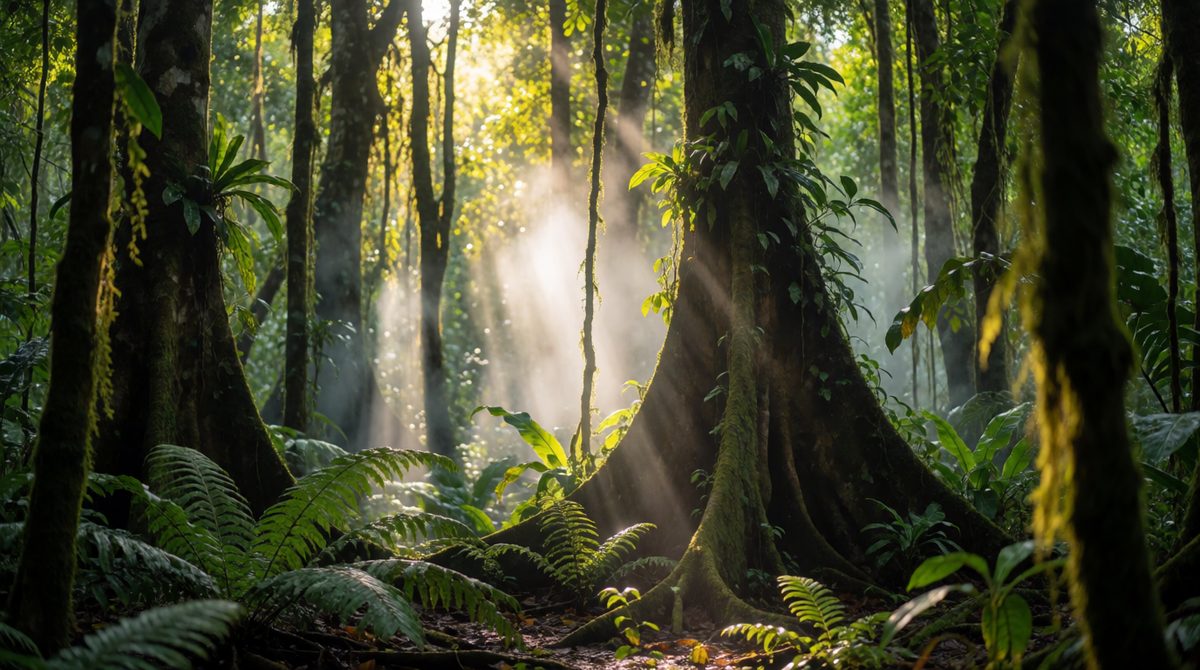
Rainforests are among the richest ecosystems on Earth
The tropical rainforest is the most biodiverse ecosystem on Earth and a brilliant example of how all ecosystem components work together.
🌳 Abiotic Conditions
Tropical rainforests are found near the equator (Brazil, Congo, Indonesia). They receive over 2,000mm of rainfall per year, have temperatures of 25–30°C year-round and get strong sunlight. These ideal abiotic conditions support an enormous variety of life.
🌿 Producers
Towering emergent trees, canopy trees, understorey shrubs, ground-level ferns and mosses. The Amazon alone has over 390 billion individual trees.
🦄 Consumers
Insects, sloths, monkeys, toucans, jaguars, anacondas, poison dart frogs. Each species occupies a specific niche in the ecosystem.
🍃 Decomposers
Warm, moist conditions mean decomposers work incredibly fast. Dead leaves on the rainforest floor can be broken down in just a few weeks.
⚠ Why Rainforest Soil is Actually Poor
Here's a surprising fact despite all that lush growth, rainforest soil is actually quite nutrient-poor. This is because decomposers work so fast that nutrients are immediately taken up by plant roots before they can build up in the soil. The nutrients are locked in the living biomass, not the soil. This is why when rainforests are cleared for farming, the soil quickly becomes useless the nutrient cycle has been broken.
📋 Exam Tips Don't Lose Easy Marks!
- ✅ Always draw arrows in food chains pointing FROM the food TO the feeder (showing energy flow).
- ✅ Remember: biotic = living, abiotic = non-living. Learn these two words cold.
- ✅ When asked about decomposers, mention BOTH bacteria AND fungi don't just say "bacteria".
- ✅ If asked how abiotic factors affect organisms, give a specific example (e.g. low rainfall limits plant growth in deserts).
- ✅ Energy is lost at each trophic level always say it's lost as heat and through respiration.
- ✅ Food webs show MORE realistic feeding relationships than food chains examiners love this distinction.