🌿 Introduction to Biotic Interactions
Every living thing in an ecosystem is connected to other living things. Whether it's a lion hunting a zebra, a bee collecting nectar from a flower, or a tapeworm living inside a dog these are all biotic interactions. "Biotic" just means "living", so biotic interactions are simply the ways that living organisms affect each other. These relationships shape ecosystems, control population sizes and keep nature in balance.
Without these interactions, ecosystems would collapse. Imagine if nothing ate the rabbits they'd eat every plant in sight! Or if bees disappeared most of our food crops wouldn't be pollinated. Everything is linked.
Key Definitions:
- Biotic interaction: Any relationship between two or more living organisms in an ecosystem.
- Ecosystem: A community of living organisms interacting with each other and their non-living environment.
- Population: All the individuals of the same species living in the same area at the same time.
- Community: All the different populations of organisms living together in the same area.
- Producer: An organism (usually a plant) that makes its own food using sunlight also called an autotroph.
- Consumer: An organism that eats other organisms to get energy also called a heterotroph.
- Decomposer: An organism (like fungi or bacteria) that breaks down dead material and recycles nutrients.
📈 Why Biotic Interactions Matter
Biotic interactions control population sizes, help energy flow through ecosystems and maintain biodiversity. When one species is removed or added, it can cause a chain reaction affecting the whole ecosystem this is called a trophic cascade.
🌎 Biotic vs Abiotic
Don't mix these up! Biotic factors are living things plants, animals, fungi, bacteria. Abiotic factors are non-living things temperature, rainfall, sunlight, soil type. Both affect how organisms survive, but biotic interactions are specifically between living things.
🥑 Types of Biotic Interactions
There are five main types of biotic interaction you need to know for iGCSE. Each one describes a different kind of relationship between species and each has a different effect on the organisms involved. We use + (benefits), − (harmed) and 0 (not affected) to describe the effect on each species.
🦀 1. Predation
Predation is when one organism (the predator) hunts and eats another organism (the prey). The predator benefits (+) and the prey is harmed (−). This is one of the most important interactions for controlling population sizes.
Example: A cheetah (predator) chasing and catching a gazelle (prey) on the African savanna.
Predator and prey populations are closely linked. When prey numbers go up, predator numbers follow because there's more food. Then as predators increase, they eat more prey, causing prey numbers to fall. Then predator numbers fall too. This creates a cyclical pattern of population change.
🔎 Case Study: Lynx and Snowshoe Hare in Canada
This is one of the most famous predator-prey examples in the world. In the boreal forests of Canada, the Canadian lynx feeds almost entirely on the snowshoe hare. Scientists studied fur trade records from the Hudson's Bay Company going back to the 1800s and found that both populations go up and down in a roughly 10-year cycle. When hare numbers peak, lynx numbers peak about 1–2 years later. When hares crash, lynx numbers crash too. This is a brilliant real-world example of how predator and prey populations control each other.
⚔️ 2. Competition
Competition happens when two or more organisms need the same limited resource like food, water, light, space, or mates. Both species are harmed (−/−) because they both get less of what they need. There are two types:
- Intraspecific competition: Between individuals of the same species. For example, two male deer fighting over territory.
- Interspecific competition: Between individuals of different species. For example, lions and hyenas competing for the same prey on the savanna.
The competitive exclusion principle says that two species competing for exactly the same resources cannot coexist one will eventually outcompete the other and drive it to local extinction. In reality, species often evolve to use slightly different resources to reduce competition this is called niche differentiation.
🔎 Case Study: Red and Grey Squirrels in the UK
The grey squirrel was introduced to the UK from North America in the 1870s. It competes with the native red squirrel for food (mainly tree seeds like acorns and hazelnuts) and habitat. Grey squirrels are larger, more adaptable and can digest acorns that red squirrels cannot. They also carry the squirrelpox virus, which kills red squirrels but doesn't harm grey ones. As a result, red squirrel numbers have crashed from around 3.5 million to fewer than 140,000, mostly confined to Scotland and a few protected areas. This is a powerful example of interspecific competition combined with disease.
🦋 3. Mutualism
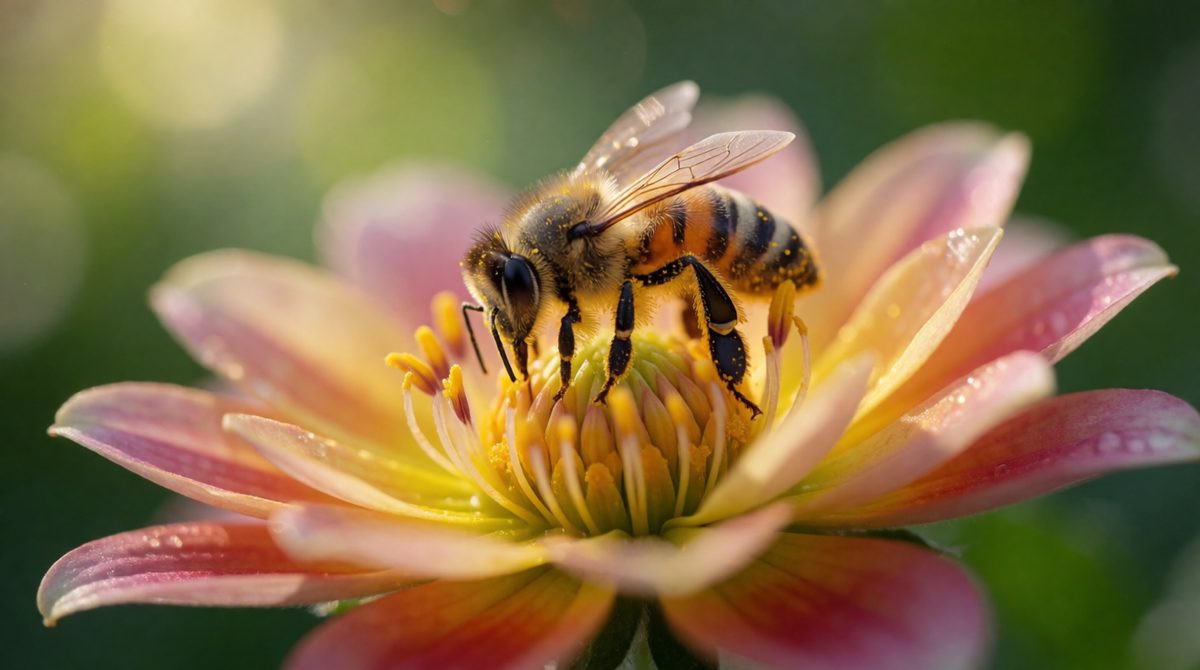
Bees and flowers help each other - mutualism
Mutualism is a relationship where both species benefit (+/+). It's a win-win! These relationships are often so important that neither species could survive without the other.
🍒 Bees and Flowers
Bees get nectar (food) from flowers. Flowers get pollinated by bees. Both benefit the bee gets energy, the plant gets to reproduce.
🦑 Clownfish and Sea Anemones
Clownfish live among the stinging tentacles of sea anemones. The anemone protects the fish; the fish chases away predators and cleans the anemone.
🌿 Nitrogen-fixing Bacteria
Rhizobium bacteria live in the root nodules of legume plants (like peas and beans). The bacteria convert nitrogen gas into usable nitrates for the plant. The plant provides the bacteria with sugars.
🦎 4. Parasitism
In parasitism, one organism (the parasite) benefits (+) while the other (the host) is harmed (−). Unlike predators, parasites don't usually kill their host straight away a dead host is no use to a parasite! Parasites live on or inside their host and take nutrients from them.
- Ectoparasites live on the outside of the host. Example: fleas, ticks, lice.
- Endoparasites live inside the host. Example: tapeworms, malaria parasites (Plasmodium).
Example: The malaria parasite (Plasmodium) lives inside human red blood cells and causes the disease malaria. It is transmitted by the Anopheles mosquito. The parasite benefits; the human host suffers fever, organ damage and sometimes death.
🔎 Case Study: Mistletoe on Oak Trees
Mistletoe is a plant that grows on the branches of trees like oak, apple and lime. It's a hemiparasite it can photosynthesise, but it also taps into the host tree's water and mineral supply using specialised roots called haustoria. Heavy mistletoe infestations can weaken and even kill the host tree. In the UK, mistletoe is particularly common in apple orchards in Herefordshire and Worcestershire, where it can cause significant damage to fruit trees.
🦇 5. Commensalism
Commensalism is where one species benefits (+) and the other is neither helped nor harmed (0). It's quite rare in nature because most relationships have at least some effect on both species.
Example: Barnacles attach themselves to the skin of whales. The barnacles get transported to new feeding areas (benefit). The whale is not significantly affected. Another example is cattle egrets following behind large grazing animals like buffalo the birds catch insects disturbed by the buffalo's feet, while the buffalo is unaffected.
🆕 Food Chains and Food Webs
A food chain shows a simple, straight-line sequence of who eats whom. A food web shows all the food chains in an ecosystem linked together it's much more realistic because most animals eat more than one thing.
Key terms for food chains:
- Producer: Always the start of a food chain. Makes food using sunlight (photosynthesis). Example: grass, algae, oak trees.
- Primary consumer: Eats the producer. Usually a herbivore. Example: rabbit, caterpillar, zooplankton.
- Secondary consumer: Eats the primary consumer. Usually a carnivore or omnivore. Example: fox, thrush.
- Tertiary consumer: Eats the secondary consumer. Example: eagle, shark.
- Apex predator: At the top of the food chain nothing eats it. Example: killer whale, lion.
- Trophic level: The position an organism occupies in a food chain.
🌿 Example Food Chain African Savanna
🌿 Grass → 🦘 Grasshopper → 🦜 Frog → 🐍 Snake → 🦅 Eagle
Energy flows from left to right. At each step, around 90% of energy is lost as heat, movement and waste. This is why food chains rarely have more than 4–5 links there simply isn't enough energy left to support another level.
⚡ What Happens When Populations Change?
Because everything in a food web is connected, a change in one population causes knock-on effects throughout the whole system. This is called a trophic cascade.
📈 If Prey Numbers Increase...
More food is available for predators → predator numbers increase → more prey is eaten → prey numbers fall back down. The system self-regulates. This is called negative feedback.
📉 If a Predator is Removed...
Prey numbers increase rapidly (population explosion) → prey eat more plants → plant numbers fall → other species that depend on those plants also suffer. Removing a top predator can devastate an entire ecosystem.
🔎 Case Study: Wolves in Yellowstone National Park, USA
Wolves were hunted to extinction in Yellowstone by the 1920s. Without wolves, the elk population exploded. Elk overgrazed riverbanks, destroying willow and aspen trees. This caused riverbanks to erode, rivers to change course and many species of birds and beavers to disappear. In 1995, wolves were reintroduced. Within years, elk numbers fell and their behaviour changed they avoided open riverbanks. Trees grew back, rivers stabilised, beavers returned and biodiversity increased dramatically. This is one of the most famous examples of a trophic cascade ever recorded. The wolves even changed the physical geography of the park scientists called it a case of wolves "changing rivers".
📋 Quick Summary Table
| Interaction |
Species A |
Species B |
Example |
| Predation |
+ (benefits) |
− (harmed) |
Lynx eats hare |
| Competition |
− (harmed) |
− (harmed) |
Red vs grey squirrel |
| Mutualism |
+ (benefits) |
+ (benefits) |
Bee and flower |
| Parasitism |
+ (benefits) |
− (harmed) |
Tapeworm in dog |
| Commensalism |
+ (benefits) |
0 (unaffected) |
Barnacles on whale |
⚡ Exam Tips
- Always use arrows correctly in food chains the arrow means "is eaten by" or "energy flows to".
- Learn the +/−/0 system for describing interactions examiners love it.
- Be ready to describe what happens to populations when one organism increases or decreases.
- Know your case studies Yellowstone wolves and Canadian lynx/hare are exam favourites.
- Don't confuse parasitism with predation parasites don't usually kill the host immediately.