🌿 Introduction to Ecosystems
An ecosystem is a community of living things (plants, animals, bacteria, fungi) interacting with each other and with their non-living environment (soil, water, sunlight, temperature). Everything is connected. Energy flows through ecosystems and that energy journey starts with one crucial process: photosynthesis.
Think of an ecosystem like a city. The plants are the power stations they capture energy and supply it to everyone else. Without them, the whole system collapses.
Key Definitions:
- Ecosystem: A community of organisms interacting with each other and their physical environment.
- Producer: An organism (usually a green plant or alga) that makes its own food using sunlight through photosynthesis.
- Consumer: An organism that gets energy by eating other organisms.
- Decomposer: An organism (like bacteria or fungi) that breaks down dead organic matter, recycling nutrients back into the soil.
- Trophic level: A feeding level in a food chain or web.
☀ Producers (Autotrophs)
Plants, algae and some bacteria make their own food using sunlight. They sit at the bottom of every food chain. Without producers, no energy enters the ecosystem. Examples include grass on a savanna, phytoplankton in the ocean and trees in a rainforest.
🍓 Consumers (Heterotrophs)
Animals cannot make their own food they must eat other organisms. Primary consumers eat plants (e.g. rabbits, caterpillars). Secondary consumers eat primary consumers (e.g. foxes, frogs). Tertiary consumers are at the top (e.g. eagles, sharks).
🌿 Photosynthesis The Big Energy Capture
Photosynthesis is the process by which green plants (and algae) use sunlight to convert carbon dioxide and water into glucose and oxygen. It is the foundation of almost all life on Earth. Without it, there would be no food, no oxygen and no ecosystems as we know them.
⚡ The Photosynthesis Equation
You need to know both the word equation and the symbol equation for your iGCSE exam.
📚 Word Equation
Carbon dioxide + Water → Glucose + Oxygen
☀ (using light energy, absorbed by chlorophyll)
⚖ Symbol Equation
6CO₂ + 6H₂O → C₆H₁₂O₆ + 6O₂
Six molecules of carbon dioxide and six molecules of water are converted into one molecule of glucose and six molecules of oxygen using light energy.
💡 Where Does Photosynthesis Happen?
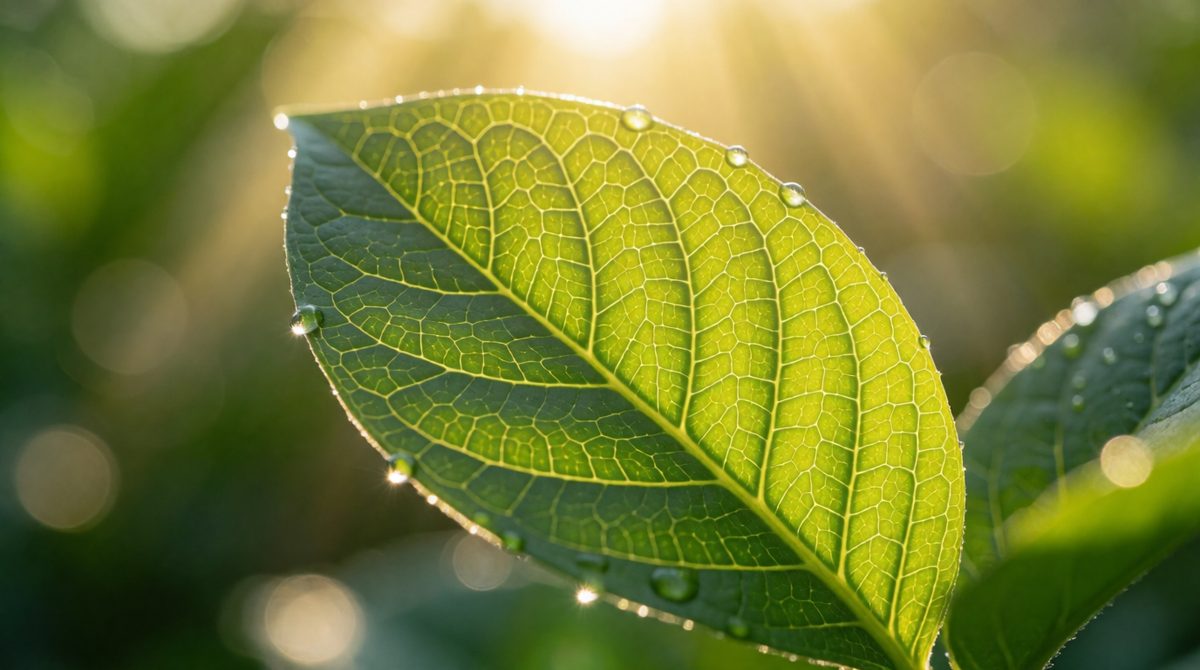
Photosynthesis happens in the leaves of plants
Photosynthesis takes place inside chloroplasts tiny structures found mainly in the cells of leaves. Chloroplasts contain a green pigment called chlorophyll, which absorbs light energy (mostly red and blue wavelengths) and uses it to power the reaction.
☀ Light Energy
Sunlight provides the energy needed to split water molecules and drive the reaction. More light = faster photosynthesis (up to a point).
💧 Water (H₂O)
Absorbed through roots and transported up the stem via the xylem. Water is split during photosynthesis, releasing oxygen as a by-product.
🌿 Carbon Dioxide (CO₂)
Enters the leaf through tiny pores called stomata. CO₂ is the carbon source used to build glucose molecules.
📈 Factors That Affect the Rate of Photosynthesis
The rate of photosynthesis is controlled by limiting factors things that slow it down when they are in short supply. Understanding these is key for both ecology and agriculture.
☀ Light Intensity
As light increases, photosynthesis speeds up until another factor becomes limiting. Shaded plants in a forest floor photosynthesize much more slowly than canopy trees.
🌡 Temperature
Enzymes control photosynthesis. As temperature rises, reactions speed up. But above about 40°C, enzymes are damaged (denatured) and photosynthesis stops.
🌿 CO₂ Concentration
More CO₂ means more raw material available. Greenhouses often pump in extra CO₂ to boost crop growth a direct application of this principle.
🌎 Case Study: The Amazon Rainforest
The Amazon rainforest covers over 5.5 million km² and is often called the "lungs of the Earth". Its billions of trees photosynthesize at an enormous rate, absorbing around 2 billion tonnes of CO₂ per year. The warm temperatures, high rainfall and intense sunlight near the equator create near-perfect conditions for photosynthesis. This makes tropical rainforests the most productive ecosystems on land, with very high Gross Primary Productivity (GPP). Deforestation threatens this carbon sink, releasing stored CO₂ back into the atmosphere and contributing to climate change.
🔥 Respiration Releasing the Energy
Respiration is the process by which organisms release energy from glucose. This energy is used for everything movement, growth, reproduction, keeping warm. Every living cell respires, all the time. It is NOT the same as breathing! Breathing is just the movement of air in and out of your lungs. Respiration is a chemical reaction happening inside your cells.
⚡ Aerobic Respiration
Aerobic respiration uses oxygen to break down glucose completely, releasing a large amount of energy. This is the main type of respiration in most organisms.
📚 Word Equation Aerobic Respiration
Glucose + Oxygen → Carbon Dioxide + Water (+ Energy)
⚖ Symbol Equation Aerobic Respiration
C₆H₁₂O₆ + 6O₂ → 6CO₂ + 6H₂O (+ Energy)
Notice this is the reverse of photosynthesis! The same molecules are involved, just in the opposite direction.
🔥 Anaerobic Respiration
Anaerobic respiration happens when there is not enough oxygen. It releases much less energy than aerobic respiration and produces different waste products depending on the organism.
💪 In Animals and Humans
When you sprint hard and your muscles run out of oxygen, they switch to anaerobic respiration. The waste product is lactic acid, which builds up and causes that burning feeling in your muscles.
Glucose → Lactic Acid (+ a little energy)
🍷 In Yeast and Plants
Yeast (a fungus) uses anaerobic respiration to produce ethanol (alcohol) and carbon dioxide. This is called fermentation and is used to make bread, beer and wine.
Glucose → Ethanol + Carbon Dioxide (+ a little energy)
🔄 Photosynthesis vs Respiration The Balance
In an ecosystem, photosynthesis and respiration are constantly happening at the same time. The balance between them determines whether an ecosystem is a carbon source or a carbon sink a crucial concept in understanding climate change.
💡 Key Concept: Compensation Point
During the day, plants photosynthesize faster than they respire, so they take in CO₂ and release O₂. At night, photosynthesis stops but respiration continues, so they release CO₂. The compensation point is the light intensity at which the rate of photosynthesis exactly equals the rate of respiration there is no net gas exchange.
🌿 Gross Primary Productivity (GPP) and Net Primary Productivity (NPP)
These are key terms for understanding how much energy is available in an ecosystem.
- Gross Primary Productivity (GPP): The total amount of energy fixed (captured) by producers through photosynthesis per unit area per unit time. Measured in kJ/m²/year.
- Respiration (R): The energy used by the plant itself for its own life processes.
- Net Primary Productivity (NPP): The energy left over after the plant has used what it needs for respiration. This is the energy available to consumers.
⚖ The Formula
NPP = GPP – R
Example: A tropical rainforest has a GPP of 8,000 kJ/m²/year and uses 3,000 kJ/m²/year in respiration. Its NPP = 8,000 – 3,000 = 5,000 kJ/m²/year. This is the energy available to herbivores and the rest of the food chain.
🌿 High Productivity Ecosystems
Tropical rainforests and estuaries have very high NPP because they have warm temperatures, plenty of water, nutrients and sunlight. They support enormous biodiversity and complex food webs.
❄ Low Productivity Ecosystems
Deserts and tundra have very low NPP because they lack water or warmth. Very little energy enters these food chains, so they support fewer species and simpler food webs.
🌿 Case Study: Rice Paddies in South-East Asia
Rice paddies are a great example of a managed ecosystem where humans manipulate conditions to maximise photosynthesis and NPP. Farmers in countries like Vietnam and Bangladesh flood fields to control weeds, use fertilisers to boost plant growth and select high-yield rice varieties. However, flooded rice paddies also produce methane a powerful greenhouse gas through anaerobic respiration by bacteria in the waterlogged soil. This is a real tension between food production and climate impact. Rice paddies contribute around 10% of global agricultural greenhouse gas emissions.
♻ Energy Flow and Efficiency
Energy passes through an ecosystem from producers to consumers, but it is never 100% efficient. At each trophic level, most energy is lost used in respiration, lost as heat, or in waste products. Only about 10% of the energy at one level is passed to the next. This is why food chains rarely have more than 4 or 5 links.
📈 Why Is Energy Transfer So Inefficient?
- Energy is lost as heat during respiration at every trophic level.
- Not all parts of a plant or animal are eaten (roots, bones, shells).
- Some material passes through the gut undigested and is lost in faeces.
- Energy is used for movement, growth and reproduction rather than building body tissue.
💡 Why This Matters for Humans
Because energy transfer is so inefficient, eating plants directly is far more energy-efficient than eating animals. A field of wheat can feed far more people than the same field used to raise cattle. This is why many environmental scientists argue that reducing meat consumption is one of the most effective ways to reduce pressure on ecosystems and land use.
♻ Quick Revision Summary
🌿 Photosynthesis
CO₂ + H₂O → Glucose + O₂
Needs: light, chlorophyll, water, CO₂
Happens in: chloroplasts
Produces: glucose (food) + oxygen
🔥 Aerobic Respiration
Glucose + O₂ → CO₂ + H₂O + Energy
Happens in: all living cells
Needs: oxygen
Releases: lots of energy
⚡ Anaerobic Respiration
In animals: Glucose → Lactic Acid
In yeast: Glucose → Ethanol + CO₂
No oxygen needed
Releases: much less energy