🌍 What is the Carbon Cycle?
Carbon is one of the most important elements on Earth. It's found in every living thing from the tiniest bacteria to the biggest whale. But carbon doesn't just sit still. It moves constantly between the atmosphere, living things, the ocean and the ground. This movement is called the carbon cycle.
Think of it like a giant recycling system. Carbon gets used, released, absorbed and used again over and over. When the cycle is balanced, everything works fine. But when humans interfere, things can go wrong and that's where climate change comes in.
Key Definitions:
- Carbon cycle: The continuous movement of carbon through the atmosphere, living organisms, soil, oceans and rocks.
- Carbon dioxide (CO₂): A gas in the atmosphere that contains carbon. It's released by respiration and combustion and absorbed by plants during photosynthesis.
- Carbon sink: Anything that absorbs more carbon than it releases like forests and oceans.
- Carbon source: Anything that releases more carbon than it absorbs like burning fossil fuels.
- Atmosphere: The layer of gases surrounding Earth, including CO₂.
- Fossil fuels: Coal, oil and natural gas formed from ancient organisms over millions of years.
🌿 Carbon in Living Things
All living organisms are made partly of carbon. Plants absorb CO₂ from the air and use it to build their leaves, stems and roots. When animals eat plants, that carbon passes into their bodies too. When organisms die, decomposers break them down and release the carbon back into the soil and air.
🌊 Carbon in the Ocean
The oceans are one of Earth's biggest carbon sinks. Seawater absorbs CO₂ directly from the atmosphere. Tiny marine organisms called phytoplankton also absorb carbon through photosynthesis. When they die, some of that carbon sinks to the ocean floor and gets locked away for thousands of years.
☀️ The Key Processes of the Carbon Cycle
There are several important processes that move carbon around. You need to know each one, what it does and whether it adds or removes CO₂ from the atmosphere.
🌿 1. Photosynthesis Taking Carbon IN
Photosynthesis is how green plants, algae and some bacteria make their food. They take in CO₂ from the air and water from the soil and use energy from sunlight to turn them into glucose (sugar) and oxygen. This removes CO₂ from the atmosphere.
✍️ The Equation
Carbon dioxide + Water → Glucose + Oxygen
CO₂ + H₂O → C₮H₁₂O₮ + O₂
Plants store the glucose and use it to grow. The carbon becomes part of the plant's body in its leaves, wood and roots.
💨 2. Respiration Releasing Carbon OUT
All living things plants, animals, fungi and bacteria carry out respiration. This is the process of breaking down glucose to release energy. CO₂ is released as a waste product. This adds CO₂ back to the atmosphere.
Don't confuse respiration with breathing! Breathing is just moving air in and out. Respiration is the chemical process happening inside every cell.
✍️ The Equation
Glucose + Oxygen → Carbon dioxide + Water + Energy
C₮H₁₂O₮ + O₂ → CO₂ + H₂O + Energy
🍃 3. Decomposition Nature's Recyclers
When plants and animals die, decomposers like bacteria and fungi break down the dead material. As they do this, they respire and release CO₂ back into the atmosphere. This process also releases nutrients into the soil, helping new plants grow.
Decomposition is slower in cold or waterlogged conditions. In peat bogs, for example, dead plant material doesn't fully decompose so the carbon stays locked in the peat for thousands of years. That makes peat bogs an important carbon store.
🔥 4. Combustion Burning Releases Carbon
Combustion means burning. When wood, coal, oil, or gas burns, the carbon stored inside is released as CO₂. This is a fast way to release carbon that took millions of years to store.
🌳 Burning Wood
When forests are burned (deforestation), carbon stored in trees is released instantly. This is a major source of CO₂ in tropical regions.
⛽️ Burning Fossil Fuels
Coal, oil and gas are burned in power stations, cars and factories. This releases ancient carbon that was locked underground for millions of years.
🔥 Wildfires
Natural wildfires also release carbon. But they've always been part of the cycle unlike the massive increase in human-caused burning.
⛏ Fossil Fuels and the Carbon Cycle
Fossil fuels coal, oil and natural gas were formed over millions of years from the remains of ancient plants and animals. As they died, they were buried under layers of rock and sediment. Over time, heat and pressure turned them into fossil fuels. The carbon inside them was locked away, out of the atmosphere.
When we burn fossil fuels, we release that ancient carbon very quickly. The atmosphere simply can't absorb it fast enough. This is why CO₂ levels in the atmosphere have been rising sharply since the Industrial Revolution in the 1800s.
📈 Rising CO₂ Levels The Numbers
Before the Industrial Revolution, CO₂ in the atmosphere was around 280 parts per million (ppm). By 2023, it had risen to over 420 ppm the highest level in at least 800,000 years. Scientists measure this at the Mauna Loa Observatory in Hawaii, which has tracked CO₂ since 1958.
🌎 How Humans Are Disrupting the Carbon Cycle
The natural carbon cycle kept CO₂ levels fairly stable for thousands of years. But human activities have thrown it out of balance. Here are the main ways we're doing it:
- 🚗 Burning fossil fuels releases CO₂ from coal, oil and gas
- 🌳 Deforestation removes trees that absorb CO₂ and burning them releases even more
- 🌾 Agriculture livestock produce methane (another greenhouse gas) and rice paddies release carbon
- 🏭 Cement production releases CO₂ when limestone is heated
- 🎂 Draining peat bogs exposes stored carbon to decomposition, releasing CO₂
🌳 Deforestation in the Amazon
The Amazon rainforest in South America is often called the "lungs of the Earth." It absorbs enormous amounts of CO₂. But large areas are being cleared for farming and cattle ranching. Between 2000 and 2020, Brazil lost around 400,000 km² of forest an area bigger than Germany. This releases huge amounts of stored carbon and removes a vital carbon sink.
🏭 Industrial Emissions in China
China is currently the world's largest emitter of CO₂, producing around 30% of global emissions. Much of this comes from coal-fired power stations. However, China is also investing heavily in renewable energy it has more solar panels installed than any other country. This shows the tension between economic development and environmental protection.
🌿 Carbon Stores Where is Carbon Kept?
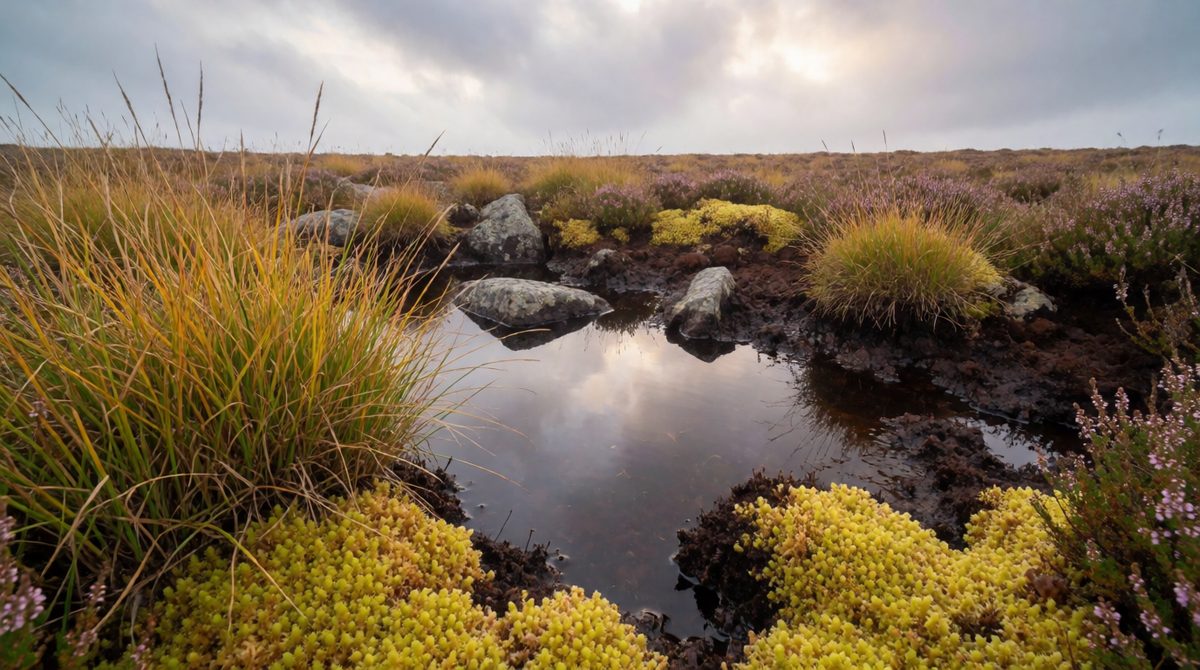
Peat bogs store huge amounts of carbon
Carbon isn't just in the air. It's stored in many different places, called carbon reservoirs or carbon stores. Some stores hold carbon for a very long time; others release it quickly.
🌿 Biosphere
All living things store carbon in their bodies. Forests are the biggest biological carbon store on land. A single large tree can store hundreds of kilograms of carbon.
🌊 Hydrosphere
The oceans hold about 50 times more carbon than the atmosphere. Carbon dissolves in seawater and is also stored in marine organisms and sediments on the ocean floor.
🌎 Lithosphere
Rocks and fossil fuels store vast amounts of carbon. Limestone is made of calcium carbonate a carbon compound. Fossil fuels hold ancient carbon from organisms that lived millions of years ago.
🆕 Case Study: The Scottish Peatlands
Scotland's peat bogs cover around 1.7 million hectares and store more carbon than all the forests in the UK and France combined. Peat forms when dead plant material builds up in waterlogged conditions where decomposition is very slow. Each metre of peat takes around 1,000 years to form. When peat bogs are drained for farming or cut for garden compost, the stored carbon is released as CO₂. The Scottish Government is now funding peatland restoration projects to protect this vital carbon store.
⚖️ Balancing the Carbon Cycle What Can Be Done?
If we want to slow down climate change, we need to restore balance to the carbon cycle. That means reducing the amount of carbon we release AND increasing the amount that gets absorbed. Here are some strategies:
- 🌿 Reforestation planting trees to absorb CO₂ from the atmosphere
- ⚡ Renewable energy using wind, solar and hydroelectric power instead of fossil fuels
- 🌿 Protecting peat bogs keeping carbon locked in the ground
- 🌎 Carbon capture and storage (CCS) technology that captures CO₂ from power stations and stores it underground
- 🌿 Sustainable farming reducing methane from livestock and improving soil carbon storage
🆕 Case Study: The Great Green Wall Africa
The Great Green Wall is an ambitious project to plant an 8,000 km belt of trees across Africa, from Senegal in the west to Djibouti in the east. The aim is to restore degraded land, improve food security and absorb carbon. By 2020, around 18% of the wall had been completed. Ethiopia alone planted over 350 million trees in a single day in 2019. If completed, the Great Green Wall could store 250 million tonnes of carbon and create 10 million jobs.
📚 Summary The Carbon Cycle at a Glance
Let's pull it all together. The carbon cycle is a natural system that keeps carbon moving between the atmosphere, living things, oceans and rocks. The key processes are:
- 🌿 Photosynthesis removes CO₂ from the atmosphere
- 💨 Respiration releases CO₂ into the atmosphere
- 🍃 Decomposition releases CO₂ as organisms break down
- 🔥 Combustion releases CO₂ when things burn
Human activities especially burning fossil fuels and deforestation are releasing carbon much faster than natural processes can absorb it. This is causing CO₂ levels to rise, leading to the enhanced greenhouse effect and global warming. Understanding the carbon cycle is the first step to understanding climate change and what we can do about it.