€镐⚒ Direct Causes
These are the actual actions that destroy forest:
- Clearing land for agriculture
- Commercial and illegal logging
- Mining and oil extraction
- Building roads, dams and settlements
- Fuelwood collection
Sign up to access the complete lesson and track your progress!
Unlock This CourseForests cover about 31% of the Earth's land surface that's roughly 4 billion hectares. But every single year, millions of hectares are cleared, burned or logged. This is called deforestation and it's one of the biggest environmental problems on the planet right now.
Forests aren't just pretty scenery. They store carbon, regulate rainfall, provide homes for wildlife and support the livelihoods of hundreds of millions of people. When we lose them, we lose all of that too.
Key Definitions:
According to the UN Food and Agriculture Organisation (FAO), the world lost approximately 178 million hectares of forest between 1990 and 2020 that's roughly the size of Libya. The rate has slowed slightly, but it's still happening at an alarming pace.
It helps to split the causes of deforestation into two groups. Direct causes are the physical activities that actually remove trees. Indirect causes are the deeper reasons behind those activities things like poverty, population growth and government policies.
These are the actual actions that destroy forest:
These are the underlying pressures that drive those actions:
This is the number one cause of deforestation worldwide. Forests are cleared to make space for crops and livestock. It happens at two very different scales from a poor family clearing a small patch to feed themselves, all the way up to massive corporations bulldozing thousands of hectares for profit.
In many parts of Africa, Asia and Latin America, poor rural families practice slash and burn agriculture (also called shifting cultivation). They cut down trees, burn the vegetation to release nutrients into the soil, grow crops for a few years, then move on when the soil becomes exhausted. This cycle repeats across new areas of forest.
While each individual family clears only a small area, the combined effect of millions of families doing this adds up to enormous forest loss.
The Amazon rainforest is the largest tropical rainforest on Earth, covering over 5.5 million km². Brazil contains about 60% of it. Since the 1970s, the Brazilian government encouraged settlers to move into the Amazon with the slogan "land without people for people without land." Millions of poor families cleared forest for subsistence farming. Roads like the Trans-Amazonian Highway opened up previously inaccessible areas, accelerating the destruction. Today, Brazil has lost around 17% of its original Amazon forest an area larger than France.
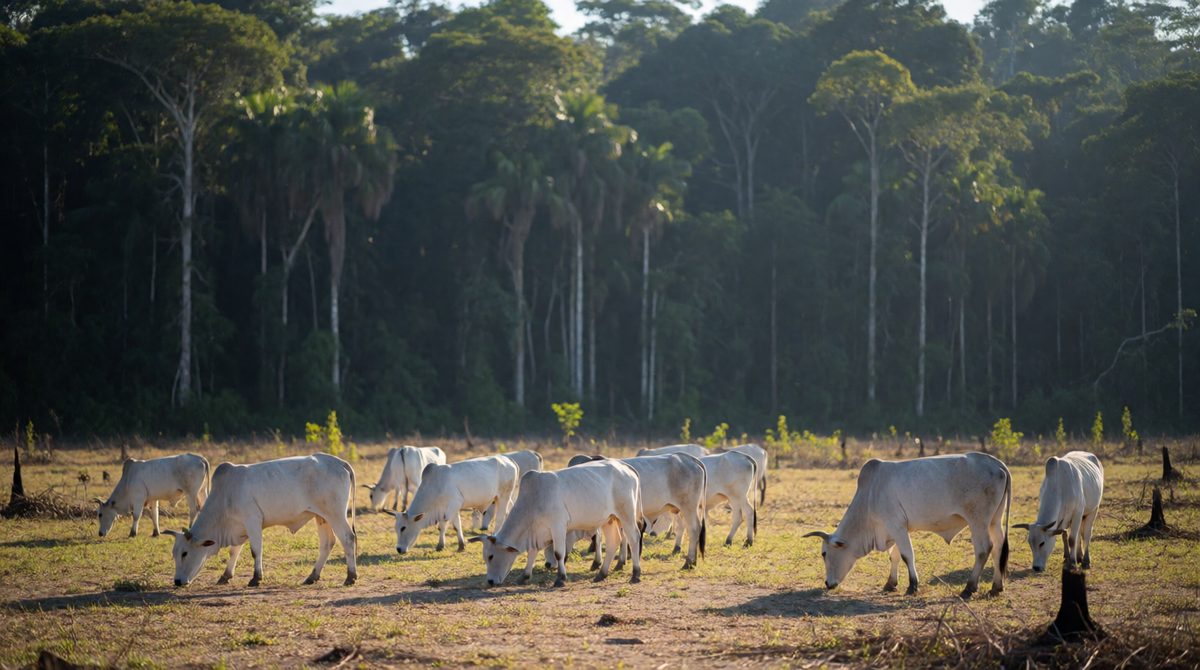
Cattle ranching is a major cause of deforestation
Large-scale commercial farming is now the biggest single driver of deforestation in the Amazon. Vast areas are cleared for:
Brazil is the world's largest beef exporter. Huge ranches require enormous areas of cleared land for grazing. Around 80% of deforested land in the Amazon is used for cattle pasture.
Brazil is also the world's top soya producer. Soya is used in animal feed and processed foods. Global demand especially from China and Europe drives massive forest clearance.
In Southeast Asia (especially Indonesia and Malaysia), rainforests are cleared for palm oil plantations. Palm oil is in roughly half of all supermarket products from biscuits to shampoo.
The island of Borneo has lost over 50% of its forest cover in the last 50 years, largely due to palm oil plantations. Indonesia is the world's largest palm oil producer. The Bornean orangutan is now critically endangered its habitat has been devastated. Fires set to clear land frequently burn out of control, causing massive air pollution across Southeast Asia. In 2015, fires in Indonesia released more greenhouse gases per day than the entire US economy.
Forests contain incredibly valuable timber hardwoods like mahogany, teak and rosewood can fetch enormous prices on international markets. Logging happens in two main forms:
Governments grant licences to timber companies to harvest trees. In theory this should be sustainable, but in practice, large areas are often clear-felled (all trees removed). Roads built for logging also open up forest to settlers and further clearance. Timber is exported to wealthy countries for furniture, flooring and construction.
A huge proportion of logging is completely illegal. The UN estimates that 15–30% of all timber traded globally is illegally sourced. Corrupt officials, weak law enforcement and high profits make it very difficult to stop. The Democratic Republic of Congo (DRC) and Indonesia are among the worst affected countries.
Even so-called selective logging where only certain trees are removed causes widespread damage. Heavy machinery crushes surrounding vegetation and the gaps left in the canopy change the microclimate, making the remaining forest drier and more vulnerable to fire.
Forests sit on top of enormous mineral and energy wealth. Extracting these resources means clearing the forest above them.
Gold, iron ore, bauxite (aluminium), copper and diamonds are all found beneath tropical forests. Open-cast mining involves stripping away all vegetation and topsoil to reach the minerals below. It's devastating and permanent. The Amazon has been heavily affected by gold mining both large industrial operations and thousands of small-scale illegal miners (garimpeiros).
Oil companies build roads, pipelines and drilling platforms deep in the forest. Even if the footprint of the infrastructure is relatively small, the roads they build open up the forest to settlers, loggers and farmers. The Ecuadorian Amazon has been severely damaged by oil extraction since the 1960s the Texaco/Chevron case is one of the most notorious environmental legal battles in history.
Building dams floods huge areas of forest. Brazil's Belo Monte Dam on the Xingu River flooded around 500 km² of Amazon forest and displaced tens of thousands of indigenous people. While dams generate renewable energy, the forest destruction and displacement of communities is a serious cost.
As populations grow, more land is needed for housing, farming and infrastructure. This is a major indirect cause that drives all the other direct causes.
Many tropical countries experiencing high deforestation also have high population growth rates. In sub-Saharan Africa, for example, the population is projected to double by 2050. More people means more demand for food, fuel and land putting forests under enormous pressure.
Migration also plays a role. Governments in countries like Brazil and Indonesia have historically encouraged people to move from overcrowded cities and coastal areas into forested interiors. These transmigration programmes directly caused massive deforestation as settlers cleared land to survive.
Around 2.4 billion people worldwide still rely on wood or charcoal as their primary cooking fuel. In many parts of sub-Saharan Africa and South Asia, collecting fuelwood is a daily necessity for survival. Over time, this strips forests bare particularly around growing towns and cities.
This is especially severe in countries like Haiti, which has lost over 98% of its original forest cover, largely due to charcoal production for cooking fuel. Compare this to neighbouring Dominican Republic, which still has significant forest cover a striking visual contrast visible from space.
Sometimes deforestation is driven not by individuals but by government decisions. Many developing countries carry large national debts and feel pressure to exploit their natural resources to earn foreign currency.
Deforestation rates in the Brazilian Amazon fell significantly between 2004 and 2012 due to stronger environmental laws, satellite monitoring and protected areas. However, when President Jair Bolsonaro came to power in 2019, he weakened environmental protections and encouraged development in the Amazon. Deforestation rates shot up by 75% between 2018 and 2021. This shows how much political decisions can affect forest loss.
It's important to understand that the causes of deforestation rarely work alone. They interact and reinforce each other. A road built for logging opens up land for farmers. Population growth increases demand for food, which drives commercial agriculture. Poverty forces people to clear forest just to survive. Global demand for cheap products like beef, soya and palm oil fuels destruction on the other side of the world.
For your iGCSE exam, you may be asked to evaluate or rank the causes of deforestation. Here are some key points to consider:
Most experts agree this is the leading cause globally responsible for up to 80% of tropical deforestation. Commercial agriculture (cattle, soya, palm oil) is growing fastest.
An important underlying driver but population alone doesn't cause deforestation. Wealthy countries have high populations but low deforestation. Poverty and inequality matter more.
Consumers in wealthy countries drive demand for products that cause deforestation. This makes deforestation a global responsibility, not just a problem for developing nations.
In the exam, always try to give specific examples and statistics when explaining causes of deforestation. Don't just say "farming causes deforestation" say "commercial cattle ranching accounts for around 80% of deforested land in the Amazon, driven by global demand for beef." That's the kind of detail that earns top marks!