🌳 What is Deforestation?
Forests cover about 31% of the Earth's land surface but they're disappearing fast. Deforestation is the large-scale removal of trees and forests, usually by humans. Every year, millions of hectares of forest are cut down or burned. That's roughly the size of a football pitch being lost every single second. It's a massive global problem with knock-on effects for everything from the air we breathe to the animals that call forests home.
Key Definitions:
- Deforestation: The permanent removal of trees and forest cover, usually to use the land for something else.
- Forest ecosystem: A community of living things (plants, animals, fungi, microbes) interacting with each other and their environment in a forested area.
- Biodiversity: The variety of all living species in an area the more variety, the higher the biodiversity.
- Carbon sink: A natural system (like a forest) that absorbs more carbon dioxide than it releases.
- Soil erosion: The wearing away of the top layer of soil by wind or water, often made worse when trees are removed.
- Leaching: When rainwater washes nutrients out of the soil and down into lower layers where plants can't reach them.
🌿 Why Are Forests So Important?
Forests aren't just pretty they do an enormous amount of work. They absorb CO₂, produce oxygen, regulate rainfall, hold soil together and provide homes for over 80% of the world's land-based species. Tropical rainforests alone cover just 6% of the Earth's surface but contain more than half of all plant and animal species on the planet.
📈 How Much Forest Are We Losing?
According to the UN Food and Agriculture Organisation (FAO), the world lost around 178 million hectares of forest between 1990 and 2020. That's an area bigger than Libya. The rate has slowed slightly, but deforestation is still happening at an alarming pace especially in tropical regions like the Amazon Basin, Central Africa and Southeast Asia.
📷 Why Does Deforestation Happen?
There's rarely just one reason forests are cut down. It's usually a mix of economic pressure, population growth and poor land management. Understanding the causes helps us understand the impacts.
📈 Main Causes of Deforestation
🌿 Agriculture
The biggest cause globally. Forests are cleared for cattle ranching, soya bean farming and palm oil plantations. In the Amazon, around 80% of deforestation is linked to beef production.
🔨 Logging
Both legal and illegal logging removes valuable hardwood trees like mahogany and teak. Even selective logging damages surrounding trees and opens up the forest floor to erosion.
🏠 Settlement & Infrastructure
Growing populations need space. Roads, towns, dams and mines all eat into forest land. The Trans-Amazonian Highway opened up vast areas of previously untouched rainforest to settlers.
🌞 Environmental Impacts of Deforestation
This is the big one for your exam. Deforestation triggers a chain reaction of environmental damage. Let's break it down into the key areas.
🌏 1. Climate Change
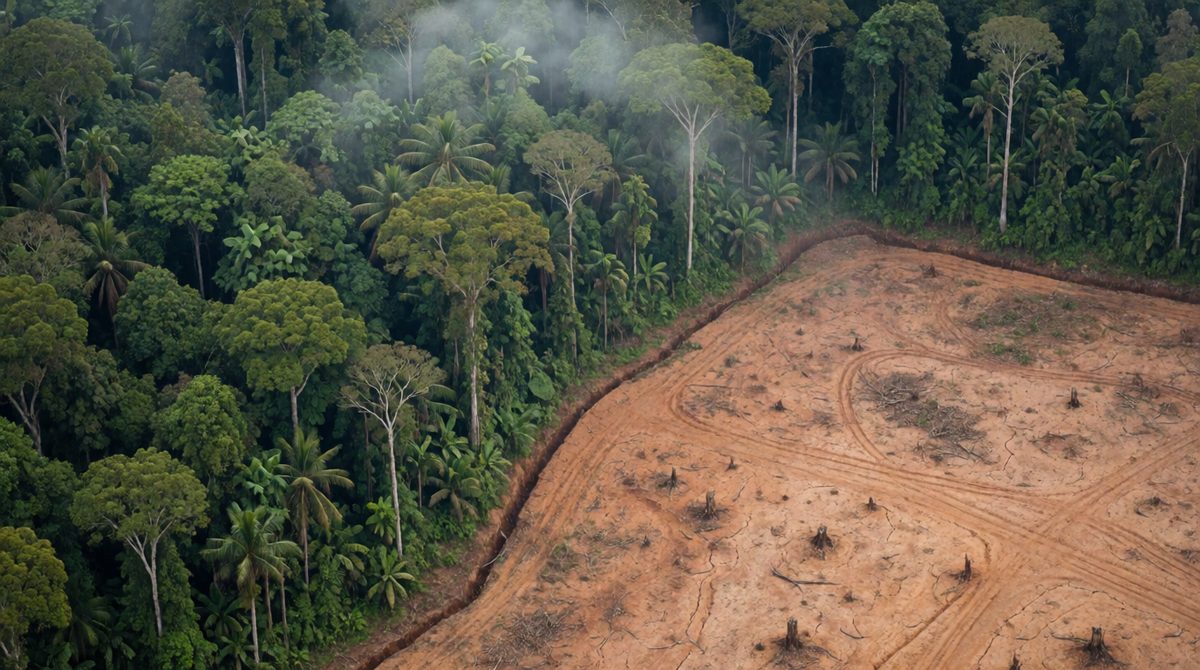
Deforestation releases stored carbon
Forests are the planet's lungs. They absorb billions of tonnes of CO₂ every year through photosynthesis. When trees are cut down and burned, all that stored carbon is released back into the atmosphere. This speeds up the greenhouse effect and global warming.
- Deforestation accounts for around 10–15% of global greenhouse gas emissions.
- The Amazon rainforest stores an estimated 150–200 billion tonnes of carbon.
- When forests are burned (slash and burn agriculture), CO₂ and methane are released rapidly.
- Without trees, less water evaporates into the atmosphere, reducing cloud formation and rainfall this can cause regional droughts.
🌎 Case Study: The Amazon Rainforest, Brazil
The Amazon is the world's largest tropical rainforest, covering over 5.5 million km² across nine countries. It's often called the "lungs of the Earth." Between 2000 and 2022, Brazil lost over 500,000 km² of Amazon forest an area larger than Spain. The main drivers are cattle ranching, soya farming and illegal logging. Scientists warn that if deforestation continues, the Amazon could reach a "tipping point" where it can no longer generate its own rainfall and begins to turn into savannah. This would be catastrophic for global climate.
🌞 2. Soil Erosion and Degradation
Tree roots hold soil together. Remove the trees and the soil becomes loose and vulnerable. Tropical soils are especially fragile most of the nutrients are locked up in the trees themselves, not in the ground.
- Surface runoff increases dramatically without tree cover to intercept rainfall.
- Heavy rain washes the thin topsoil away this is soil erosion.
- Leaching removes remaining nutrients from the soil, making it infertile within just a few years.
- Exposed soil can bake hard in the sun, becoming almost concrete-like a process called laterisation.
- Once degraded, the land often can't support farming or forest regrowth for decades.
💧 Flooding and Water Cycle Disruption
Trees intercept rainfall and slow it down, allowing it to soak into the ground. Without them, rainwater hits the ground hard and fast, causing flash flooding. Rivers fill up quickly and overflow their banks. In countries like Bangladesh and the Philippines, deforestation in upland areas has made flooding much worse downstream. Deforestation also reduces transpiration the process by which trees release water vapour into the air which reduces local rainfall and can lead to drought.
🐙 Loss of Biodiversity
Tropical forests are home to an extraordinary range of species. When forest is cleared, habitats are destroyed. Species that can't adapt or move fast enough face extinction. Even when forests aren't completely removed, habitat fragmentation where patches of forest are separated by farmland or roads isolates animal populations, reduces genetic diversity and makes species more vulnerable. It's estimated that deforestation drives thousands of species to extinction every year, many before they've even been discovered.
🌿 Case Study: Borneo and Palm Oil
The island of Borneo (shared between Malaysia, Indonesia and Brunei) has lost over 50% of its rainforest in the last 50 years, largely due to palm oil plantations. Palm oil is used in hundreds of everyday products from biscuits to shampoo. The Bornean orangutan is now critically endangered, with habitat loss being the primary cause. Pygmy elephants, clouded leopards and proboscis monkeys are also under serious threat. The forests of Borneo are among the most biodiverse on Earth, yet they're disappearing at a devastating rate.
👥 Social and Economic Impacts
Deforestation doesn't just hurt the environment it affects people too, especially those who depend on forests for their survival.
👪 Impact on Indigenous Communities
Millions of people around the world live in or near forests and depend on them for food, medicine, water and shelter. When forests are cleared, these communities lose everything. Indigenous groups like the Yanomami people of the Amazon have had their land invaded by illegal miners and loggers, leading to violence, disease and the destruction of their way of life. Forced displacement is a serious human rights issue linked to deforestation.
💵 Economic Arguments It's Complicated
It's not all black and white. For many developing countries, forests represent economic opportunity. Logging, farming and mining create jobs and generate income. Brazil's agricultural exports much of which come from deforested land are worth hundreds of billions of dollars. But economists argue that the long-term economic cost of deforestation (lost ecosystem services, soil degradation, climate change) far outweighs the short-term gains. Forests provide services worth an estimated $2.5 trillion per year globally from water purification to tourism to carbon storage.
✅ What Can Be Done?
The good news is that people are fighting back. Here are some of the key strategies being used to tackle deforestation:
- 🌿 Reforestation and afforestation planting new trees to replace those lost.
- 📜 National parks and protected areas legally protecting forests from development.
- 🌎 International agreements such as REDD+ (Reducing Emissions from Deforestation and Forest Degradation), which pays developing countries to protect their forests.
- 🌿 Sustainable forestry using certification schemes like the FSC (Forest Stewardship Council) to ensure timber is harvested responsibly.
- 🛒 Consumer choices buying products that are certified palm oil-free or sustainably sourced.
- 👥 Supporting indigenous land rights evidence shows that forests managed by indigenous communities are better protected.
🌎 Global Effort: The Bonn Challenge
Launched in 2011, the Bonn Challenge is a global effort to restore 350 million hectares of degraded and deforested land by 2030. Over 70 countries have made pledges. While progress has been slow, it represents one of the most ambitious reforestation efforts in history. Restoring forests won't undo all the damage, but it's a vital step in tackling climate change and biodiversity loss.
📝 Exam Tips What to Remember
- Always link causes to effects e.g. logging → loss of tree cover → soil erosion → flooding.
- Use specific case studies (Amazon, Borneo) with facts and figures in your answers.
- Remember both environmental AND social/economic impacts examiners love to see both sides.
- Know the difference between direct causes (logging, farming) and indirect causes (population growth, poverty, global demand).
- Be able to evaluate solutions no single answer fixes everything!