🌳 Introduction to Forest Ecosystems
Forests are one of the most important ecosystems on Earth. They cover about 31% of the world's land surface that's roughly 4 billion hectares. But they're disappearing fast. Every year, millions of hectares of forest are cut down, burned, or degraded. Understanding why forests need careful, sustainable management is a key part of your iGCSE Environmental Management course.
Forests aren't just trees. They're complex, living systems packed with wildlife, water cycles, soil, fungi, insects and millions of species all depending on each other. When we damage forests, we don't just lose trees we unravel entire ecosystems.
Key Definitions:
- Forest Ecosystem: A community of trees, plants, animals, fungi and microorganisms that interact with each other and their environment.
- Deforestation: The permanent removal of trees and forest cover, usually to use the land for something else.
- Sustainable Management: Using a resource in a way that meets today's needs without stopping future generations from meeting theirs.
- Biodiversity: The variety of living species in a given area the more, the healthier the ecosystem.
- Carbon Sink: An area that absorbs more carbon dioxide than it releases forests are one of the biggest on Earth.
- Canopy: The upper layer of a forest formed by the tops of the tallest trees.
🌿 Tropical Rainforests
Found near the equator (e.g. Amazon, Congo Basin, Southeast Asia). Hot and wet all year round. Home to over 50% of the world's species despite covering only about 6% of land. These forests grow in layers: emergent, canopy, understorey and forest floor.
🌲 Temperate & Boreal Forests
Temperate forests are found in Europe, North America and East Asia they have four seasons. Boreal forests (taiga) stretch across Canada, Russia and Scandinavia. They grow more slowly than tropical forests but store enormous amounts of carbon in their soil and trees.
⚠️ Why Are Forests Under Threat?
Forests face pressure from many directions and most of it comes from human activity. As the global population grows and demand for food, timber and land increases, forests pay the price. Let's look at the main causes of deforestation and forest degradation.
🖐 The Main Causes of Deforestation
Deforestation doesn't happen for one single reason. It's usually a mix of economic, social and political pressures all pushing in the same direction against the forest.
🌿 Agriculture
The biggest driver globally. Forests are cleared for cattle ranching, soy farming, palm oil plantations and smallholder subsistence farming. In the Amazon, 80% of deforestation is linked to cattle ranching.
🔨 Logging
Both legal and illegal logging removes valuable hardwoods like mahogany and teak. Even selective logging opens up roads that allow further clearance. Illegal logging is worth an estimated $50–150 billion per year globally.
🏠 Infrastructure & Mining
Roads, dams, mines and urban expansion all eat into forest land. The construction of the Belo Monte Dam in Brazil flooded vast areas of Amazon rainforest and displaced thousands of indigenous people.
📈 Key Statistic
The world loses around 10 million hectares of forest every year that's roughly the size of Iceland. Between 1990 and 2020, the world lost 178 million hectares of forest. That's almost the size of Libya.
🌍 What Do Forests Actually Do For Us?
Before we can understand why sustainable management matters, we need to understand what we stand to lose. Forests provide what scientists call ecosystem services the benefits that nature gives us, often for free.
♨️ Ecosystem Services of Forests
Forests do an incredible amount of work. Here's a breakdown of the most important services they provide:
🌞 Climate Regulation
Forests absorb CO₂ through photosynthesis, acting as massive carbon sinks. The Amazon alone stores around 150–200 billion tonnes of carbon. When forests burn, all that carbon is released back into the atmosphere.
💧 Water Cycle
Trees release water vapour through transpiration, helping to form clouds and rainfall. Forests also protect watersheds, filter water and reduce flooding. Deforestation can cause rivers to dry up and rainfall patterns to shift dramatically.
🌎 Soil Protection
Tree roots hold soil together. Without them, heavy rain washes soil away a process called soil erosion. This leads to landslides, river silting and land that can no longer grow crops. In deforested areas of Haiti, erosion has made farming almost impossible.
🐾 Biodiversity Hotspots
Tropical forests are home to an estimated half of all species on Earth. Many haven't even been discovered yet. Medicines like quinine (for malaria) and many cancer treatments come from rainforest plants. Destroying forests means losing species and potential cures forever.
👪 Supporting Human Communities
Around 1.6 billion people depend on forests for their livelihoods for food, fuel, medicine and income. About 70 million indigenous people live in forests and have done so for thousands of years. Their cultures, languages and survival are tied directly to the forest.
🔍 Case Study: The Amazon Rainforest
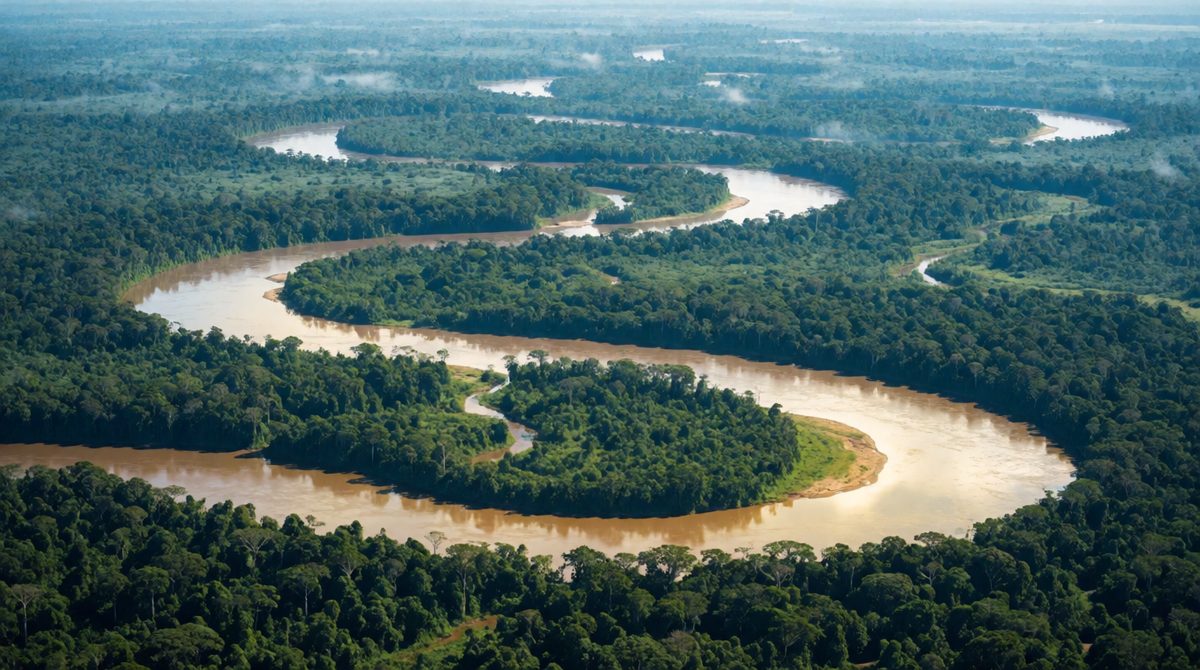
The Amazon is the world's largest rainforest
🌿 Case Study Focus The Amazon, Brazil
The Amazon is the world's largest tropical rainforest, covering 5.5 million km² across nine countries, mostly in Brazil. It is home to 10% of all species on Earth, 390 billion individual trees and around 400 indigenous tribes.
Between 2000 and 2020, Brazil lost over 400,000 km² of Amazon forest an area larger than Germany. The main causes are cattle ranching, soy farming (much of it to feed livestock in Europe and China), illegal logging and road building.
Scientists warn that if deforestation continues, the Amazon could reach a tipping point where so much forest is lost that the remaining trees can no longer generate enough rainfall to sustain themselves. This could trigger a collapse of the entire ecosystem, turning it into dry savanna.
In 2023, Brazil's government under President Lula pledged to achieve zero deforestation by 2030 a major policy shift after years of increased clearance under the previous government.
⚖️ What Is Sustainable Forest Management?
Sustainable forest management (SFM) means managing forests so they continue to provide environmental, social and economic benefits now and in the future. It's not about locking forests away and never touching them. It's about using them wisely.
📌 Key Principles of Sustainable Forest Management
The United Nations and organisations like the Forest Stewardship Council (FSC) have set out clear principles for what sustainable management looks like:
- ✅ Only cut as many trees as can regrow maintaining the forest stock
- ✅ Protect biodiversity by preserving habitats and wildlife corridors
- ✅ Involve local and indigenous communities in decision-making
- ✅ Prevent illegal logging through monitoring and law enforcement
- ✅ Replant cleared areas reforestation
- ✅ Certify sustainably sourced timber so consumers can make informed choices
🌿 Case Study Focus Costa Rica's Forest Recovery
Costa Rica is a brilliant success story. In the 1980s, it had one of the highest deforestation rates in the world. By 2021, forest cover had recovered to over 60% of the country's land area.
How? The government introduced a Payments for Ecosystem Services (PES) scheme paying landowners to protect and restore forests instead of clearing them. Eco-tourism also boomed, making forests more valuable standing than cut down. Costa Rica now earns over $4 billion per year from eco-tourism.
This shows that with the right policies and economic incentives, deforestation can be reversed.
⚖️ Why Sustainable Management Is So Important
Without sustainable management, forests will continue to shrink. And the consequences go far beyond losing pretty trees. Here's the big picture:
🌋 Climate Change Gets Worse
Forests absorb roughly 2.6 billion tonnes of CO₂ per year. Lose the forests, lose the carbon sink. Deforestation currently accounts for around 10–15% of global greenhouse gas emissions more than all the world's cars and trucks combined.
💀 Species Extinction Accelerates
We are currently in what scientists call the sixth mass extinction. Habitat loss mostly deforestation is the number one driver. Species like the Sumatran orangutan, jaguar and harpy eagle are all threatened by forest loss. Once a species is gone, it's gone forever.
The bottom line is this: forests are not just a resource to be used they are a life-support system for the entire planet. Sustainable management isn't optional. It's essential.
💡 Exam Tip
In your iGCSE exam, you may be asked to evaluate strategies for sustainable forest management. Always think about: Does it protect biodiversity? Does it consider local communities? Is it economically realistic? Can it be enforced? Use real examples like Costa Rica or the Amazon to back up your points.