🌎 Introduction to Migration and Population Management
Every single day, millions of people around the world pack up their lives and move somewhere new. Some move by choice chasing better jobs or education. Others are forced out by war, famine, or natural disasters. This movement of people is called migration and it's one of the biggest forces shaping our world today.
Governments care a lot about migration because it directly affects how many people live in a country, what services are needed and how the economy works. Managing population size isn't just about birth rates and death rates it's also about who's coming in and who's going out.
Key Definitions:
- Migration: The movement of people from one place to another, either within a country or between countries.
- Immigrant: A person who moves into a new country to live there permanently or long-term.
- Emigrant: A person who leaves their home country to live somewhere else.
- Refugee: Someone forced to flee their country due to war, persecution, or natural disaster.
- Asylum seeker: A person who has left their country and is waiting to find out if they will be officially recognised as a refugee.
- Net migration: The difference between the number of people moving into a country and the number leaving. If more arrive than leave, it's a positive net migration.
- Population management: Actions taken by governments to influence the size, growth rate, or distribution of a population.
- Brain drain: When skilled, educated people leave a country, taking their talents elsewhere.
🚘 Internal Migration
This is when people move within the same country. A classic example is rural-to-urban migration people leaving the countryside to find work in cities. This is very common in countries like China, India and Brazil, where rapid industrialisation has created jobs in cities but left rural areas behind.
✈ International Migration
This is when people move between countries. It can be voluntary (choosing to move for work or study) or forced (fleeing danger). International migration has a huge impact on both the country people leave and the country they arrive in.
📍 Push and Pull Factors
Why do people migrate? It usually comes down to a mix of push factors (reasons to leave) and pull factors (reasons to go somewhere specific). Think of it like being pushed out of a burning building and pulled towards a warm, safe house.
👉 Push Factors Reasons to Leave
These are the things that make life difficult or dangerous in someone's home country or region, making them want to leave.
⚔ Conflict & War
War destroys homes, kills people and makes life terrifying. Syria's civil war (starting 2011) forced over 6 million people to flee the country one of the largest refugee crises in history.
🏭 Lack of Jobs
High unemployment pushes people to look elsewhere. Many people from Eastern Europe moved to the UK after 2004 when their countries joined the EU, seeking better-paid work.
🌊 Environmental Disasters
Droughts, floods, earthquakes and rising sea levels force people to move. Bangladesh regularly loses land to flooding, pushing people into cities or across borders.
👏 Pull Factors Reasons to Arrive
These are the things that attract people to a new place the reasons why one country or city seems more appealing than another.
💵 Higher Wages
Countries like the USA, UK, Germany and Australia offer much higher wages than many developing nations. A doctor in Nigeria might earn 10 times more working in the UK.
🏫 Better Education
Many students from around the world move to countries with top universities. The UK has over 600,000 international students, drawn by world-class institutions.
🏥 Political Safety
Countries with stable governments and strong human rights records attract people fleeing persecution. Canada and Sweden are known for welcoming refugees.
📌 Case Study: Syrian Refugee Crisis
When civil war broke out in Syria in 2011, millions of people fled. By 2023, Syria had produced over 6.5 million refugees the largest refugee population in the world. Most fled to neighbouring countries: Turkey took in over 3.6 million, Lebanon around 1.5 million and Jordan over 660,000. Many also attempted the dangerous journey to Europe. This crisis showed how conflict can rapidly destabilise population distribution across an entire region, putting enormous pressure on receiving countries' resources, housing and public services.
📋 How Governments Control Migration
Governments use a range of tools to manage who enters and leaves their country. This is called immigration policy. Some countries are very open, others are very strict. The approach a government takes depends on its economy, culture, politics and population needs.
📄 Visa Systems
Most countries require foreigners to have a visa an official document giving permission to enter. Different visas exist for tourists, workers, students and family members. Countries like Australia use a points-based system where migrants are scored on skills, age, language ability and qualifications. The higher your score, the more likely you are to get in.
🔒 Border Controls
Physical and digital border controls limit who can enter a country. This includes passport checks, biometric scanning and border patrols. The USA has a heavily fortified border with Mexico. The EU's Schengen Area allows free movement between member states, but has strict external borders.
🇺🇸 The Points-Based Immigration System UK Example
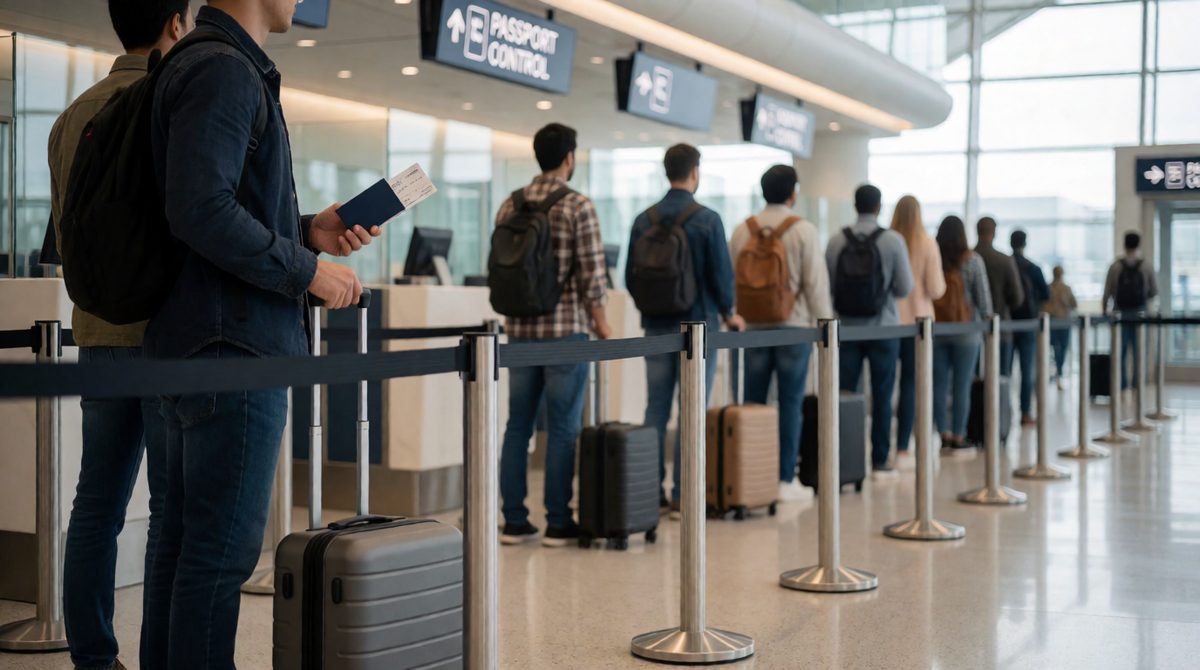
Governments control who can migrate into a country
After Brexit in 2020, the UK introduced a new points-based immigration system for all non-UK citizens (including EU citizens). To qualify to work in the UK, you need to score enough points by meeting certain criteria:
- ✅ Having a job offer from an approved employer
- ✅ The job must meet a minimum skill level
- ✅ You must earn at least £26,200 per year (as of 2024)
- ✅ You must speak English to a required standard
This system is designed to attract skilled workers while reducing low-skilled migration. Critics argue it has caused labour shortages in sectors like farming, hospitality and social care.
🇪🇺 Case Study: The European Union and Free Movement
The EU allows citizens of its 27 member states to live and work freely in any other member state this is called freedom of movement. When poorer Eastern European countries like Poland, Romania and Bulgaria joined the EU in 2004 and 2007, millions of their citizens moved to wealthier Western European countries for better wages. The UK alone received around 3 million EU citizens before Brexit. This boosted the UK economy but also created political tension around housing, NHS pressure and cultural change eventually contributing to the Brexit vote in 2016.
🌎 Effects of Migration on Countries
Migration doesn't just affect the people moving it has major consequences for both the country being left behind and the country receiving new arrivals.
📅 Effects on the Source Country (where people leave from)
😔 Negative Effects
- Brain drain: Skilled workers like doctors, engineers and teachers leave, weakening public services.
- Ageing population: Young people leave, leaving behind an older population that needs more care.
- Family breakdown: Families are split apart, causing emotional and social problems.
😊 Positive Effects
- Remittances: Migrants send money home, which can be vital for families and local economies. In 2022, remittances to low-income countries totalled over $600 billion globally.
- Reduced pressure: Fewer people means less strain on food, water and housing resources.
- Skills return: Some migrants return home with new skills and ideas.
🏠 Effects on the Destination Country (where people arrive)
😔 Negative Effects
- Pressure on housing, schools and hospitals.
- Social tensions if integration is difficult.
- Political backlash and rise of anti-immigration sentiment.
- Overcrowding in urban areas.
😊 Positive Effects
- Migrants fill labour shortages in key sectors (NHS, construction, agriculture).
- Migrants pay taxes and contribute to the economy.
- Cultural diversity enriches society.
- Young migrants help support ageing populations.
🏭 Population Management Policies
Beyond controlling migration, governments also use direct policies to manage how fast their population grows. These can encourage people to have more children, or fewer children, depending on what the country needs.
🇨🇳 Case Study: China's One-Child Policy
From 1980 to 2015, China enforced one of the most dramatic population control policies in history. Families were only allowed to have one child. Those who followed the rule got benefits like free healthcare and education. Those who broke it faced heavy fines or even forced sterilisation. The policy successfully slowed China's population growth but created serious problems. The population began to age rapidly, there were far fewer young workers and a cultural preference for boys led to a gender imbalance (many girls were abandoned or aborted). By 2015, China scrapped the policy and now encourages families to have up to three children.
📈 Pro-natalist vs Anti-natalist Policies
Governments choose between two broad approaches depending on whether they want to increase or decrease their population.
🙂 Pro-natalist (Encourage More Births)
Used by countries with low birth rates and ageing populations. France is a great example it offers generous maternity/paternity leave, free childcare and cash bonuses for having children. Singapore pays up to S$10,000 per child to encourage larger families. These policies aim to grow the workforce and support future pension systems.
😕 Anti-natalist (Discourage Too Many Births)
Used by countries where rapid population growth is straining resources. India ran campaigns promoting two-child families and offered incentives for sterilisation. Iran introduced free contraception and family planning education in the 1990s, successfully cutting its birth rate. The goal is to slow growth so resources can keep up with demand.
👥 Ageing Populations and Migration as a Solution
Many wealthy countries face a big problem: their populations are getting older. As birth rates fall and people live longer, there are fewer young workers to support elderly people through taxes and care. This is called an ageing population and it puts huge pressure on pension systems and healthcare.
One solution governments use is to encourage skilled migration. Young, working-age migrants can fill jobs, pay taxes and support the elderly population. Germany, for example, has actively recruited nurses and engineers from countries like India and the Philippines to fill gaps caused by its ageing workforce.
📌 Key Fact: Dependency Ratio
The dependency ratio measures how many non-working people (children and elderly) depend on each working-age person. A high dependency ratio means fewer workers are supporting more dependants this is a major challenge in countries like Japan and Italy, where over 28% of the population is aged 65 or older. Migration of younger workers can help lower the dependency ratio and keep economies functioning.
⚖ Summary: Why Migration Control Matters
Migration is not just a social issue it's deeply connected to environmental management. More people in an area means more demand for water, food, energy and land. Managing migration carefully helps countries plan for sustainable resource use. At the same time, forcing people to stay in places with failing environments or violent conflict is neither ethical nor practical.
The key is balance: using migration policy alongside birth rate policies, resource management and international cooperation to create a world where population size and the environment can coexist sustainably.
- ✅ Migration is driven by push and pull factors war, poverty, opportunity and safety.
- ✅ Governments control migration through visas, border controls and points-based systems.
- ✅ Migration has both positive and negative effects on source and destination countries.
- ✅ Population policies (pro-natalist and anti-natalist) directly manage birth rates.
- ✅ Ageing populations in wealthy countries often rely on migration to maintain their workforce.
- ✅ Population management is essential for sustainable environmental management.