Introduction to Hydrogen Fuels
Hydrogen is the most abundant element in the universe. It's in water, in living things and in the air around us. But here's the thing it doesn't float around on its own waiting to be used. It's always bonded to something else, like oxygen in water (H₂O). So to use hydrogen as a fuel, we have to extract it first. That process takes energy and where that energy comes from is what makes all the difference.
Hydrogen burns cleanly. When it reacts with oxygen to produce energy, the only by-product is water vapour. No carbon dioxide, no soot, no toxic gases. That sounds perfect, right? Well, it depends entirely on how the hydrogen was made in the first place. This is why scientists and governments use a colour-coding system most commonly blue and green to describe how clean or dirty a particular hydrogen supply really is.
Key Definitions:
- Hydrogen fuel: A fuel made from hydrogen gas (H₂) that releases energy when it reacts with oxygen, producing only water as a by-product.
- Electrolysis: A process that uses electricity to split water (H₂O) into hydrogen and oxygen.
- Steam methane reforming (SMR): A process that extracts hydrogen from natural gas (methane) using high-temperature steam.
- Carbon capture and storage (CCS): Technology that traps CO₂ produced during industrial processes and stores it underground so it doesn't enter the atmosphere.
- Fuel cell: A device that converts hydrogen and oxygen into electricity through a chemical reaction, with water as the only waste product.
- Greenhouse gas (GHG): A gas such as CO₂ or methane that traps heat in the atmosphere and contributes to climate change.
🟢 Green Hydrogen
Made using electrolysis powered by renewable energy (like wind or solar). Water is split into hydrogen and oxygen. No fossil fuels are used and no CO₂ is released. This is the cleanest form of hydrogen but currently the most expensive to produce.
🔵 Blue Hydrogen
Made from natural gas using steam methane reforming. This does release CO₂, but the emissions are captured and stored underground using CCS technology. It's cheaper than green hydrogen but still relies on fossil fuels and CCS isn't 100% efficient.
The Hydrogen Colour Spectrum
You might hear about more than just blue and green hydrogen. The industry uses a whole rainbow of colours to describe different production methods. For iGCSE, blue and green are the most important but it helps to know the others exist.
How Hydrogen Gets Its Colour
The colour isn't about what the hydrogen looks like it's a shorthand for how it was made and how much carbon was released in the process.
⬛ Grey Hydrogen
Made from natural gas using SMR without CCS. This is the most common type today and the most polluting. Around 95% of all hydrogen currently produced is grey.
🔵 Blue Hydrogen
Same as grey but with CCS added. CO₂ is captured before it reaches the atmosphere. Still uses fossil fuels but significantly lower emissions than grey.
🟢 Green Hydrogen
Made using electrolysis powered by renewables. Zero carbon emissions during production. The gold standard but currently less than 1% of global hydrogen supply.
💡 Quick Fact
According to the International Energy Agency (IEA), global hydrogen demand was around 94 million tonnes in 2021 almost all of it grey hydrogen. Switching this to green hydrogen would require enormous amounts of renewable electricity. The challenge is real, but so is the opportunity.
Blue Hydrogen: A Closer Look
Blue hydrogen is often described as a transitional fuel a stepping stone between our current fossil fuel dependence and a fully renewable future. It uses existing technology and infrastructure, which makes it cheaper and faster to scale up than green hydrogen.
How Blue Hydrogen is Made
The main method is Steam Methane Reforming (SMR). Here's how it works:
- Natural gas (mostly methane, CH₄) is mixed with high-temperature steam (700–1000°C).
- This produces hydrogen gas and carbon monoxide (CO).
- The CO reacts with more steam to produce CO₂ and more hydrogen.
- The CO₂ is then captured using CCS technology and stored deep underground often in old oil or gas fields.
- The hydrogen is purified and ready to use.
The key issue is that CCS is not 100% efficient. Studies suggest that even with CCS, blue hydrogen production can still release around 10–20% of the CO₂ that would otherwise escape. There are also concerns about methane leaks during natural gas extraction methane is a very powerful greenhouse gas.
✅ Advantages of Blue Hydrogen
- Uses existing gas infrastructure cheaper to set up
- Can be produced at large scale right now
- Lower carbon than grey hydrogen when CCS works well
- Provides a bridge while green hydrogen technology matures
- Supports energy security by using domestic gas reserves
❌ Disadvantages of Blue Hydrogen
- Still relies on fossil fuels (natural gas)
- CCS is expensive and not fully proven at large scale
- Methane leaks during gas extraction worsen climate impact
- Underground CO₂ storage carries long-term risks
- Locks in fossil fuel infrastructure for decades
🏭 Case Study: H100 Fife, Scotland
The H100 Fife project in Scotland is one of the world's first hydrogen heating networks. It uses green hydrogen produced from offshore wind power to heat around 300 homes in Levenmouth, Fife. The project, backed by SGN (Scotia Gas Networks), began supplying homes in 2024. It is a real-world test of whether hydrogen can replace natural gas in domestic heating one of the UK's biggest sources of carbon emissions. Results from H100 Fife will help shape UK energy policy for decades to come.
Green Hydrogen: A Closer Look
Green hydrogen is the dream. It produces no carbon emissions during manufacture, uses renewable energy and leaves only water as a by-product. If we can produce it cheaply enough, it could transform energy systems around the world from powering ships and aeroplanes to heating homes and running factories.
How Green Hydrogen is Made
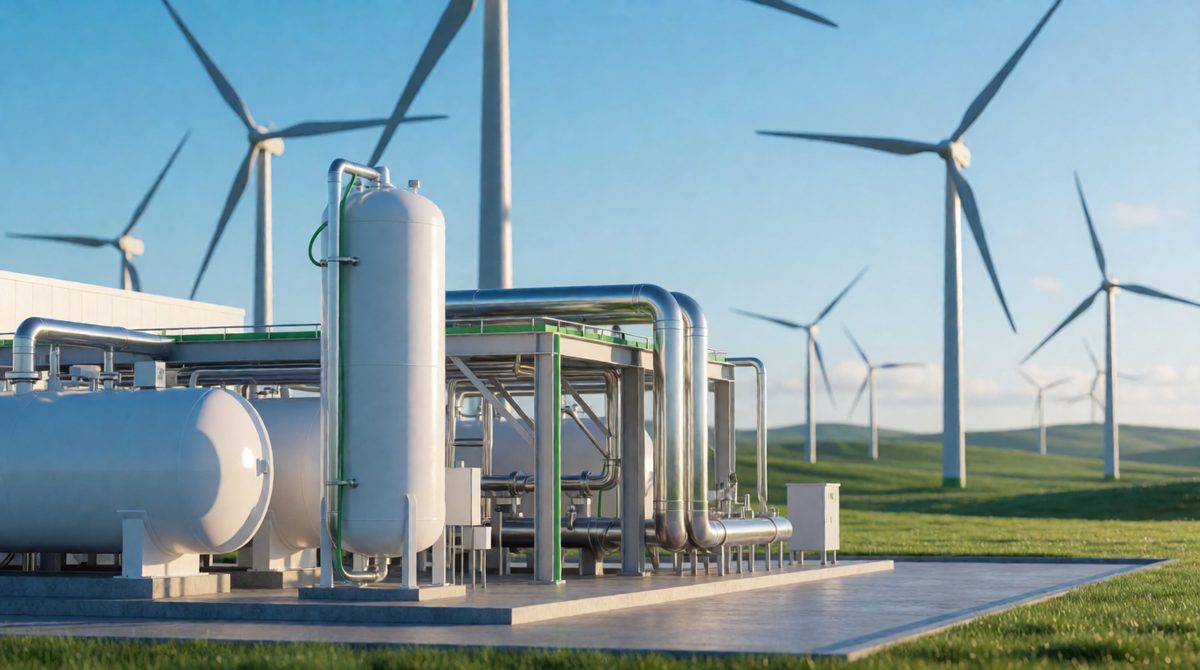
Green hydrogen is made using renewable electricity
Green hydrogen is produced through electrolysis using electricity to split water molecules into hydrogen and oxygen.
- Renewable electricity (from wind turbines, solar panels, or hydropower) powers an electrolyser.
- The electrolyser passes an electric current through water.
- Water molecules split: oxygen is released into the air and hydrogen is collected.
- The hydrogen is compressed, stored and transported for use.
The electrolyser is the key piece of technology. There are different types the most common is the PEM electrolyser (Proton Exchange Membrane), which is compact and efficient. As renewable energy becomes cheaper and electrolysers improve, the cost of green hydrogen is falling rapidly.
✅ Advantages of Green Hydrogen
- Zero carbon emissions during production
- Uses renewable energy truly sustainable
- Water is the only by-product when used as fuel
- Can store surplus renewable energy (e.g. excess wind power)
- Versatile can fuel vehicles, heat buildings, power industry
❌ Disadvantages of Green Hydrogen
- Currently very expensive around 3–6 times the cost of grey hydrogen
- Electrolysis is energy-intensive needs large amounts of renewable electricity
- Hydrogen is difficult to store and transport (highly flammable, low density)
- New infrastructure (pipelines, storage tanks) needed at huge cost
- Currently less than 1% of global hydrogen production
🌎 Case Study: NEOM, Saudi Arabia The NEOM Green Hydrogen Project
In the Saudi Arabian desert, a massive project called NEOM is building what will be one of the world's largest green hydrogen plants. Powered by 4 gigawatts of solar and wind energy, it aims to produce 600 tonnes of green hydrogen per day by 2026. The hydrogen will be converted to ammonia for easier transport and shipped to markets in Europe and Asia. The project costs around $8.4 billion and is a joint venture between ACWA Power, Air Products and NEOM. It shows that green hydrogen can be produced at industrial scale but the costs and challenges are enormous.
Hydrogen as an Energy Carrier
It's important to understand that hydrogen is not really an energy source like coal or sunlight it's an energy carrier. It stores and moves energy from one place to another. Think of it like a rechargeable battery, but in gas form. This makes it incredibly useful for sectors that are hard to electrify directly.
Where Hydrogen Can Be Used
🚘 Transport
Hydrogen fuel cell vehicles (FCEVs) convert hydrogen to electricity to power an electric motor. Toyota's Mirai and Hyundai's NEXO are examples. Hydrogen is also being tested in buses, trains, ships and even aircraft.
🏠 Heating
Hydrogen could replace natural gas in home boilers and heating systems. The H100 Fife project (Scotland) is testing this right now. A key question is whether existing gas pipes can safely carry hydrogen many can, with modifications.
🏭 Industry
Steel, cement and chemical industries are very hard to decarbonise. Hydrogen can replace coal and gas in high-temperature industrial processes. Sweden's HYBRIT project is already making fossil-free steel using green hydrogen.
Environmental Management: Hydrogen's Role
From an environmental management perspective, hydrogen sits right at the heart of the energy transition. It offers a way to decarbonise sectors that renewables alone can't easily reach. But it must be managed carefully the wrong kind of hydrogen (grey or poorly managed blue) could actually make climate change worse.
Comparing Carbon Footprints
The table below gives a rough comparison of CO₂ emissions per kilogram of hydrogen produced:
| Hydrogen Type |
Production Method |
CO₂ Emissions (kg per kg H₂) |
| ⬛ Grey |
SMR without CCS |
~10 kg CO₂ |
| 🔵 Blue |
SMR with CCS |
~1–3 kg CO₂ |
| 🟢 Green |
Electrolysis (renewables) |
~0 kg CO₂ |
⚠️ The Blue Hydrogen Controversy
In 2021, a study by Cornell and Stanford universities argued that blue hydrogen could actually be worse for the climate than burning natural gas directly when methane leaks from gas pipelines are factored in. Methane is around 80 times more potent as a greenhouse gas than CO₂ over 20 years. This sparked a major debate. Supporters of blue hydrogen say the study used worst-case assumptions. Critics say it proves we should skip blue and go straight to green. The debate is ongoing and it's exactly the kind of real-world environmental management challenge you need to understand for iGCSE.
The Future of Hydrogen: Challenges and Opportunities
Hydrogen has huge potential but getting from where we are now to a hydrogen-powered world requires solving some serious problems. Governments, businesses and scientists are all working on this together.
Key Challenges
- Cost: Green hydrogen is still too expensive for most uses. The target is to get the cost below $2 per kilogram by 2030 (it currently costs $4–6/kg in most places).
- Storage and transport: Hydrogen gas is very light and takes up a lot of space. It must be compressed or liquefied at very low temperatures (-253°C) for transport both expensive and energy-intensive.
- Safety: Hydrogen is highly flammable. New safety standards and training are needed for widespread use.
- Infrastructure: Pipelines, refuelling stations and storage facilities all need to be built or adapted at massive scale.
- Public awareness: Many people don't know what hydrogen fuel is or whether it's safe education and communication are vital.
Government Policy and International Action
Many countries have published national hydrogen strategies to guide investment and development:
- 🇬🇧 The UK Hydrogen Strategy (2021) aims for 10 GW of low-carbon hydrogen production capacity by 2030, split between blue and green.
- 🇪🇺 The EU Hydrogen Strategy targets 40 GW of green hydrogen electrolysers by 2030 and aims to make Europe a global leader in clean hydrogen.
- 🇦🇺 Australia's National Hydrogen Strategy aims to become a major exporter of clean hydrogen to Asia by 2030.
- 🇯🇵 Japan plans to use hydrogen for heating, transport and power generation and is investing heavily in hydrogen import infrastructure.
🌎 Case Study: The European Hydrogen Backbone
A group of European gas network operators has proposed the European Hydrogen Backbone a network of around 53,000 km of hydrogen pipelines connecting 28 countries by 2040. Around 60% would be converted existing natural gas pipelines. The network would allow cheap green hydrogen produced in sunny, windy regions (like North Africa and Scandinavia) to be transported to industrial centres in Germany, France and beyond. The estimated cost is €80–143 billion but the economic and environmental benefits could be transformational.
Hydrogen vs Other Renewable Energy Solutions
Hydrogen doesn't exist in isolation it's one tool in a much bigger energy toolkit. It's worth comparing it to other clean energy options to understand where it fits best.
When is Hydrogen the Best Choice?
Direct electrification (using electricity from renewables to power things directly) is often more efficient than using hydrogen. But hydrogen wins in specific situations:
- Long-distance heavy transport lorries, ships and planes where batteries are too heavy
- Seasonal energy storage storing summer solar energy for use in winter
- High-temperature industrial processes where electric heating isn't practical
- Remote locations where grid connection is difficult or impossible
For most home heating and short-distance transport, direct electrification (heat pumps, electric cars) is likely to be more efficient and cheaper. Hydrogen is best where electricity alone can't do the job.
📚 Exam Tip
In your iGCSE exam, you may be asked to evaluate hydrogen as an energy solution. Remember to consider: how it is produced (blue vs green), the environmental impacts of each, the economic challenges and how it compares to other alternatives. Always use specific examples and data where you can case studies like H100 Fife, NEOM and the European Hydrogen Backbone will impress examiners.
Summary: Blue vs Green Hydrogen at a Glance
🔵 Blue Hydrogen Key Points
- Made from natural gas + CCS
- Lower cost, available now
- Still uses fossil fuels
- CCS not 100% effective
- Methane leaks are a concern
- Seen as a short-term bridge
- Example: UK's planned blue hydrogen hubs in Teesside and Humberside
🟢 Green Hydrogen Key Points
- Made from water + renewable electricity
- Zero carbon emissions
- Currently expensive and limited in scale
- Costs falling rapidly
- Long-term sustainable solution
- Example: NEOM project, Saudi Arabia; H100 Fife, Scotland