Agencies do things to teach us
In the lesson Primary and Secondary Socialisation: The Key Agencies you met the agencies of socialisation, such as the family, education and the media. This lesson asks a different question: how do they do it? The ways agencies teach us norms and values are called processes of socialisation. Some are deliberate, like a teacher giving a lesson. Others are quiet, and we hardly notice them happening.
The spec lists seven processes. Each one is led by at least one agency, but agencies often share them.
Key terms:
- Canalisation: channelling a child's interests towards activities and objects seen as right for their gender.
- Hidden curriculum: the things pupils learn in school that are not on the timetable, such as how to behave.
- Media representation: the way the media shows particular people, groups or ideas.
- Peer pressure: the influence people of a similar age have on what we think, say and do.
- Role model: a person whose behaviour we copy because we admire or look up to them.
Canalisation

Canalisation: Oakley's idea that parents steer children's interests through the toys and activities they give them
The sociologist Ann Oakley used the word canalisation to describe how parents steer children's interests, a bit like a canal steers water in one direction. A child may be given dolls and kitchen sets, or toy cars and building sets, depending on whether they are a girl or a boy. Over time the child comes to see some interests as "for me" and others as "not for me".
Example: a family buys a doll and a toy kitchen for their daughter and a football and toy cars for their son. Agency: the family.
The hidden curriculum
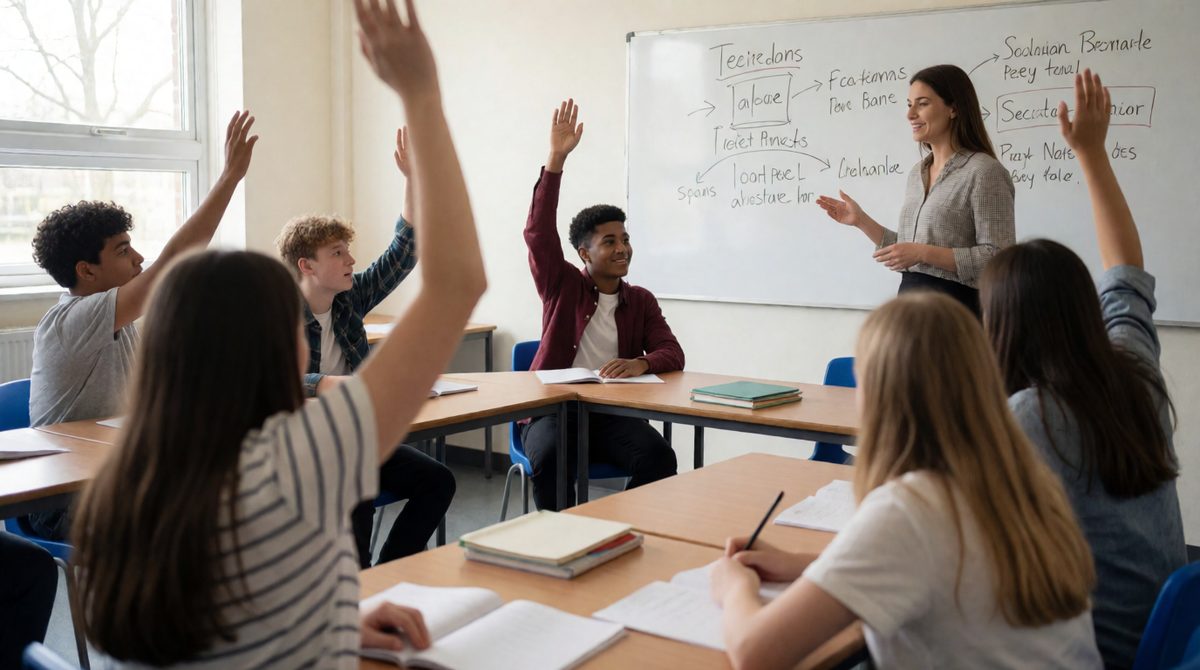
Putting your hand up and waiting your turn is part of the hidden curriculum - lessons nobody writes into the timetable
The official curriculum is the subjects on the timetable. The hidden curriculum is everything else pupils learn from school life itself. Nobody writes it into a lesson plan, but pupils pick it up every day.
Example: pupils learn to put their hand up and wait to be chosen before speaking. Agency: education. Other hidden lessons are covered in the lesson Formal and Informal Education: The Official and Hidden Curriculum.
Media representations
The media does not just report the world, it shows it in a particular way. When the same type of person is shown in the same way again and again, audiences may come to see that image as normal. This can shape how we see ourselves and others.
Example: if adverts nearly always show women cleaning the home, viewers may learn that housework is mainly women's work. Agency: the media.
Peer pressure and religious teachings
👥 Peer pressure
Friends and classmates reward behaviour they like with praise and acceptance. They punish behaviour they dislike with teasing or leaving people out. Most people want to fit in, so this works strongly.
Example: a new member of a sports team is encouraged to train hard, and mocked if they turn up late. Agency: the peer group.
🙏 Religious teachings
Religions teach beliefs about right and wrong, and rules about how to live. These are passed on through holy books, sermons, prayers and festivals, and from parents to children.
Example: a child is taught to fast in a holy month or to honour a weekly day of rest. Agency: religion (a church, mosque, temple or synagogue).
Role modelling
We do not only learn by being told. We also learn by watching and copying people we admire. A role model shows us how to behave without needing to give an order.
Example: a young child copies the way an older sister speaks to visitors. A teenager may copy the training habits of a famous athlete they follow online. Agencies: the family and the media.
Workplace training
Once we start work, we have to learn new norms. Employers teach them through induction days, training courses and rules, and through watching colleagues. This is a clear case of secondary socialisation.
Example: a new shop assistant is shown how to greet customers and how to handle complaints politely. Agency: the workplace.
Summary of the seven processes
- Canalisation: toys and activities chosen by gender (family)
- Hidden curriculum: unwritten lessons of school life (education)
- Media representations: repeated images of groups (media)
- Peer pressure: praise or teasing from equals (peer group)
- Religious teachings: beliefs and rules (religion)
- Role modelling: copying admired people (family, media)
- Workplace training: learning job norms (workplace)
Worked example
A question asks you to explain one way the media socialises young people. Use three steps. Point: the media socialises through representations. Example: a TV series nearly always shows scientists as men in white coats. Effect: viewers may come to see science as a job for men, and some girls may stop thinking of it as an option for them. Naming the process, giving an example and showing the effect earns the marks.
Common mistakes
1. Mixing up the agency and the process. The peer group is the agency, and peer pressure is the process it uses. 2. Writing "canalisation" with no example. Always say what the child is steered towards. 3. Saying the hidden curriculum is the school's rules written down. It is the unwritten learning. 4. Forgetting that one agency can use more than one process, and one process can involve more than one agency.
Exam-style question
(a) Define the term canalisation. [2]
(b) Give two examples of processes used by agencies of socialisation. [2]
(c) Explain three processes that agencies of socialisation use. [6]
Model answer
(a) Canalisation is when parents direct a child's interests (1) towards activities or toys seen as right for their gender (1).
(b) Canalisation (1) and role modelling (1). Other correct answers: hidden curriculum, media representations, peer pressure, religious teachings, workplace training.
(c) Peer pressure (1): friends reward behaviour they like and tease behaviour they dislike, so a teenager changes how they act to fit in (1). Role modelling (1): a child copies an older sibling, so learns how to behave without being told (1). Workplace training (1): a new employee is taught how to deal with customers, so they learn the norms of the job (1).
Exam tip
In part (c), the command word "explain" needs a process and then a developed reason or example. Name each process first, then add a sentence that shows how it socialises someone.