🔒 Closed society
Ascribed status is what counts. Your family, your sex or your ethnic group decides your job, where you live and who you can marry. Doing well at school or working hard cannot change the layer you were born into.
Sign up to access the complete lesson and track your progress!
Unlock This Course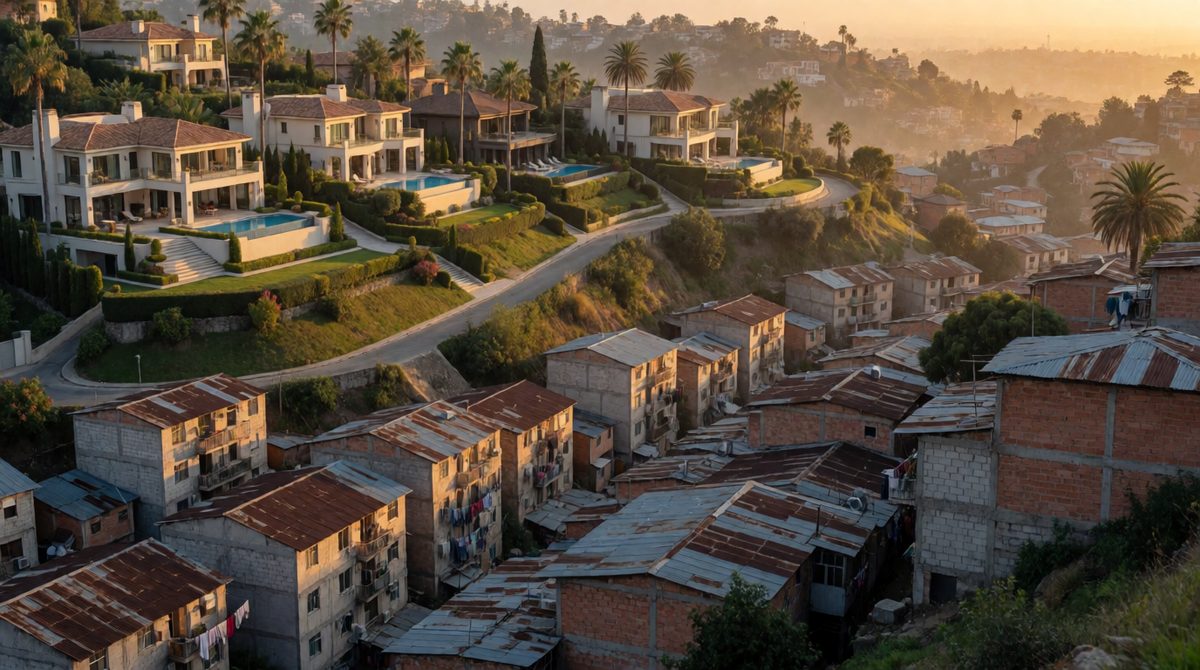
Grand villas up on the hill, tiny flats down below - stratification means society is ranked in layers, just like this city
Picture a layered cake. Each layer sits above or below another. Sociologists use the same picture for society. Some people sit near the top, with plenty of money, respect and influence. Others sit near the bottom, with very little. This is called stratification, from the word strata, which means layers.
Key terms:
No society is completely open or completely closed. Think of a line with a fully closed society at one end and a fully open society at the other. Real societies sit somewhere along it. Later lessons look at how people move between the layers, so here we focus on what makes the layers different.
Remember, ascribed status is given to you at birth and achieved status is earned through your own effort. Stratification depends heavily on which of the two matters most.
Ascribed status is what counts. Your family, your sex or your ethnic group decides your job, where you live and who you can marry. Doing well at school or working hard cannot change the layer you were born into.
Achieved status counts most. A farmer's child can become a surgeon by passing exams and working hard. Jobs go to people with the right skills and qualifications, whoever their parents are.
Even in a mostly open society, ascribed status still matters. A child born into a very rich family starts life with big advantages that nobody earned. That is why sociologists describe societies as more open or more closed, not simply one or the other.
People in the lowest layers often live in poverty. Sociologists split poverty into two kinds.
A family has a flat, heating and a phone, so they are not in absolute poverty. But they cannot afford a school trip, a birthday party or a club membership, and they have much less than most families around them. They are in relative poverty. Relative poverty changes from society to society, because what counts as normal is different in different places.

The house is wealth (what you own); the monthly wages that pay for it are income (money flowing in)
People often mix up wealth and income. They are not the same thing.
Money that comes in over a period of time, for example wages, pensions, benefits, or rent from a property. It is like water flowing into a bath.
What a person owns, for example property, land, savings, shares and businesses. It is like the water already in the bath.
A person can have high wealth and low income. A retired person might own a large house but live on a small pension. Wealth can also be passed on to children, so a family's wealth can last for generations. This is one reason why, in many societies, wealth is shared out less equally than income.
Power is the ability to get your own way and make decisions that affect other people, even if they disagree. Power comes from different sources:
Wealth, status and power often go together, but not always. A well-known charity worker may have high status but little money. A rich person may have wealth but no official role. In a closed society, power is usually inherited. In an open society, people can gain power through elections and careers.
1. Saying income and wealth are the same. Income is money coming in; wealth is what you own.
2. Saying relative poverty means being a bit poor. It means having much less than others in your own society.
3. Writing that open societies have no ascribed status. They still do, it just matters less.
4. Defining stratification as just 'rich and poor'. It is about layers ranked by wealth, status and power.
(a) Define the term:
(i) social stratification [2]
(ii) relative poverty [2]
(b) Give two examples of ascribed status. [2]
(c) Explain three differences between income and wealth. [6]
(a)(i) Social stratification is the division of society into layers (1) ranked above one another by wealth, status and power (1).
(a)(ii) Relative poverty is having much less than most people in the same society (1), so you cannot take part in its normal way of life (1).
(b) Being born into a royal family (1). Your sex or your ethnic group (1).
(c) First, income is money coming in over a period of time, but wealth is what a person owns (1). Second, income comes from things like wages and pensions, but wealth is things like property, savings and shares (1). Third, wealth can be inherited and last for generations, but income is usually earned and stops when the work or payment stops (1). A retired person may have a low income but high wealth (1). Wealth is also often shared out less equally than income (1). [Any three differences, each explained.]
For a 'give two examples' question, write two short, separate examples. Do not explain them, as there are no extra marks for that.