🏫 Higher social class
More likely to attend a private or well-resourced school, to gain more qualifications and to go to university.
Sign up to access the complete lesson and track your progress!
Unlock This Course
Same day, same city, different starts - life chances are the opportunities each child has to get the good things in life
Two babies are born on the same day in the same country. One family is wealthy and the other struggles to pay the bills. Will the two children have the same opportunities in life? Sociologists say they will not. This is the idea of life chances.
Key terms:
The term comes from the sociologist Max Weber. It does not say what will happen to one person. It describes how likely it is that people in a certain group will get these things. A person from a low position can still do very well, but in general the odds are worse.
Remember, social class is a person's position in the layers of society. It is one of the strongest influences on life chances. This lesson looks at five areas: education, employment, health, housing and life expectancy. Age, gender and ethnicity are covered in later lessons.
Education is often called the key to a good life, because qualifications lead to jobs. In many societies, children from higher social classes do better on average at school and are more likely to stay on to university. Children from lower social classes are more likely to leave school with fewer qualifications.
More likely to attend a private or well-resourced school, to gain more qualifications and to go to university.
More likely to attend an under-resourced school, to leave with fewer qualifications and to leave education earlier.
The reasons for these patterns are covered later in the course. Here you only need to describe the pattern.
Social class also affects the kind of job a person gets. In many societies, people from higher social classes are more likely to get professional and managerial jobs. These usually bring higher pay, more security and better working conditions. People from lower social classes are more likely to do manual and low-paid work, often with less job security and a greater risk of unemployment.
There is a clear link between social class and health. In many societies, people in lower social classes are more likely to suffer from illness during their lives, and to suffer it earlier. People in higher social classes tend to have better health.
Healthy food, sports clubs and time to rest cost money, so higher-class families find them easier to afford.
Some people can pay for private healthcare or live near good clinics. Others face long waits or have to travel far, so illness is treated later.
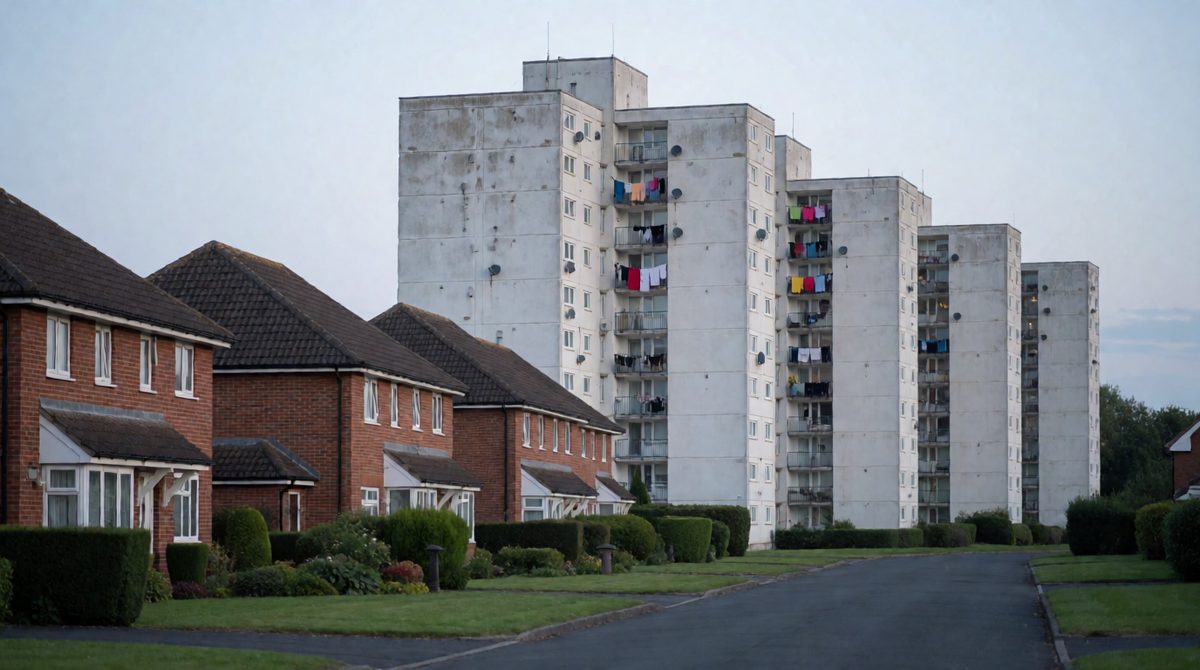
Renting a cramped flat or owning a big house with a garden - housing is one of the clearest signs of social class
Housing is one of the clearest signs of class. In many societies, people in higher social classes are more likely to own their home, and to live in larger, safer homes in pleasant areas. People in lower social classes are more likely to rent, to live in overcrowded or damp homes, and to live in areas with fewer services. Some are at greater risk of homelessness.
Housing links to other life chances, because a warm, dry home is better for health.
In many societies, people in higher social classes live longer on average than people in lower social classes. The gap can be several years, even between two neighbourhoods in the same city.
This is the end result of the other areas. A better education leads to a better job, which pays for a better home and healthcare, and all of these add up to a longer life.
The five areas are linked. A disadvantage in one can lead to a disadvantage in another. This is why sociologists see social stratification as important: it does not just rank people, it changes what their lives are like.
1. Saying that every person in a lower class will fail. Life chances are about likelihood, not certainty.
2. Confusing life chances with life choices. Chances are the opportunities open to a person, whatever they choose.
3. Writing that rich people are always healthy. Say 'on average' or 'in many societies'.
4. Giving one example only. Use education, employment, health, housing and life expectancy.
5. Listing facts without linking them to social class.
(a) Define the term: (i) life chances [2]
(b) Give two examples of ways in which social class can affect life chances. [2]
(c) Explain three ways in which a person's social class can affect their life chances in health. [6]
(a)(i) Life chances are the opportunities a person has to gain things society values, such as education, a good job or good health (1), and to avoid things that harm them (1).
(b) Social class can affect the type of school a person attends (1). It can affect the type of housing a person lives in (1).
(c) First, people in higher social classes can afford healthy food and sport, so they are more likely to stay well (1)(1). Second, they can often afford private healthcare or live near good clinics, so they are treated sooner (1)(1). Third, people in lower classes may live far from good clinics or face long waits, so illness is treated later and can get worse (1)(1).
In (c), three developed points beat six short ones. Name the health factor, then add 'so' or 'because' and say what happens as a result.