🏫 Formal education
- Takes place in schools, colleges and universities
- Planned, with a timetable and a set programme
- Taught by trained teachers
- Tested, and ends in qualifications
Sign up to access the complete lesson and track your progress!
Unlock This Course
Learning to cook with Gran is informal education: no timetable, no exams, but real skills learned
Think about everything you know how to do. Some of it you learned in a classroom, such as algebra or how to write an essay. Some of it you learned somewhere else, such as how to cook a meal, how to talk to a grandparent or how to be a good friend. Sociologists say there are two kinds of education, and they are not the same.
Key terms:
For example, a teenager might learn chemistry in a school laboratory (formal) and learn how to look after a younger brother by watching an older relative (informal). Both are real education, but only the first one leads to a certificate.
Schools do not just teach whatever they like. The official curriculum is the planned and openly stated content of what students are taught in school. It has three main parts.
Students sit tests and exams. These measure what they have learned and give them grades and qualifications.
A syllabus is a list of exactly what must be taught and learned in a subject. Teachers and students follow it.
Learning is split into subjects such as maths, science, languages and history. Some subjects are compulsory and others are optional.
The official curriculum is visible. You can read it in a timetable, a syllabus document or an exam paper. A student can say exactly what they are supposed to be learning.
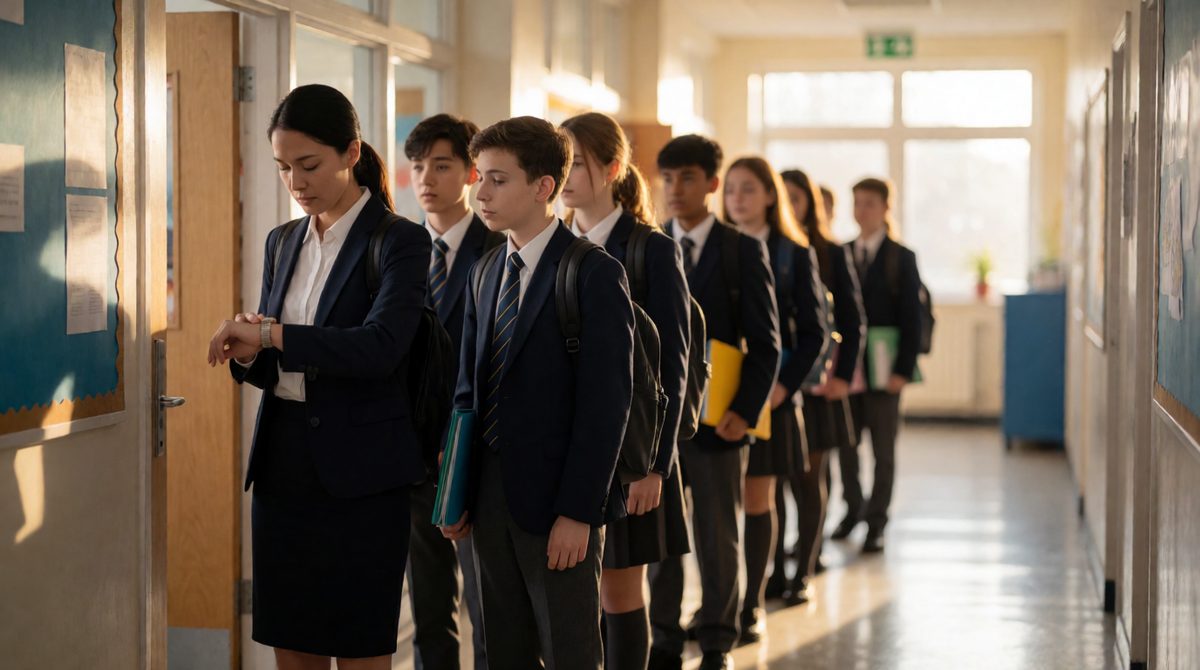
Lining up quietly before class teaches punctuality and conformity: lessons from the hidden curriculum that no timetable shows
Remember, the hidden curriculum is the set of lessons learned in school that are not on any timetable. Nobody writes them in a syllabus, yet students learn them every day just by being in school. The spec names four of these lessons.
School teaches students what is seen as right and normal behaviour: respect teachers, wait your turn, work hard, be honest and share. Students pick up the values of the wider society without being told in a lesson.
Bells, registers and late slips teach students to be on time. This prepares them for work, where being on time is expected.
Uniform, rules and the same routine for everyone teach students to follow the rules and fit in. Students who do this are rewarded and those who do not are punished.
Without anyone planning it, school can teach ideas about what boys and girls should do. For example, textbooks may show men and women in different jobs, or girls may be steered away from woodwork and boys away from cookery.
Situation: a school has a uniform, a bell for every lesson and a register taken each morning.
Step 1: Work out which curriculum this belongs to. None of it is a subject, so it is the hidden curriculum.
Step 2: Name the lesson learned. The bell and register teach punctuality, and the uniform teaches conformity.
Step 3: Link it to society. Later, employers expect workers to be on time and to follow workplace rules.
Do not say informal education is "not real" education. It is real learning, just unplanned. Do not say the hidden curriculum is a secret that teachers hide on purpose. It is hidden because it is not written down, and many teachers do not even notice they are teaching it. Do not describe the hidden curriculum without an example: always name the lesson, such as punctuality or conformity.
(a) Define the term formal education. [2 marks]
(d) Explain three things students learn from the hidden curriculum in school. [6 marks]
(a) Planned learning (1) that takes place in an institution such as a school, with teachers, a timetable and qualifications (1).
(d) First, students learn punctuality (1). The bell and the register teach them to arrive on time, which prepares them for work (1). Second, students learn conformity (1). Uniform and school rules teach them to follow the rules and fit in, and those who do not may be punished (1). Third, students learn gender roles (1). For example, textbooks may show men and women in different jobs, which can shape what students think is normal for men and women (1).
In an "explain three" question, name each lesson of the hidden curriculum in a short phrase, then add a sentence of explanation or an example. Do not describe the official curriculum, such as exams or subjects, because the question asks about the hidden one.