✅ Strengths
It reaches pupils who live far from a school, who are ill, or who travel a lot. Pupils can learn at their own pace and repeat a lesson as often as they need. Costs can be lower because no building is needed.
Sign up to access the complete lesson and track your progress!
Unlock This CourseFor most children, education means a school building, a timetable and a teacher at the front of a class. But this is only one way to learn. Around the world, some families and schools choose alternative approaches to education. These are ways of learning that differ from the usual school pattern in where, how or what pupils learn.
Sociologists do not simply ask whether an approach is good or bad. They ask: who is it good for, what does it achieve, and what does it leave out? That is why every approach in this lesson has strengths and limitations.
Key terms:
In online learning, lessons, notes, quizzes and teacher feedback arrive through a computer, tablet or phone. Pupils may watch recorded lessons, join live video classes or work through set tasks at their own speed. Some use it for a whole education, while others use it for a single subject.
It reaches pupils who live far from a school, who are ill, or who travel a lot. Pupils can learn at their own pace and repeat a lesson as often as they need. Costs can be lower because no building is needed.
It needs a device and a good internet connection, so poorer families may be left out. Pupils have less face-to-face contact with friends and teachers, and need strong self-discipline to keep going.

Kitchen-table classroom: in homeschooling a parent or tutor takes over the job of the school
Homeschooling means the family takes over the job of the school. A parent, a relative or a hired tutor teaches the child at home, often following a plan or a national curriculum. The rules differ between societies: it is allowed with few conditions in some, checked closely in others and not permitted in a few.
Teaching can be fitted to one child, with lots of individual attention. Families can include their own values or beliefs, and can choose when and where to learn. Some children feel safer and avoid problems such as bullying.
One parent may need to give up paid work, so it costs the family money and time. Parents may not know every subject well. The child may have fewer chances to mix with other children of different backgrounds.
Unschooling goes one step further than homeschooling. There are no set lessons, textbooks or exams. The child follows their own interests, for example by building things, cooking, reading, visiting places or using the internet, and the parent helps and gives resources. Learning happens through everyday life, so it is close to informal education.
Children learn what really interests them, so they may be more motivated and curious. There is no pressure of tests, and a child can spend as long as they like on a subject.
Children may miss subjects they would not choose, such as maths or a second language. With no exams, it can be hard to get qualifications for further study or jobs. The results depend heavily on the parents.
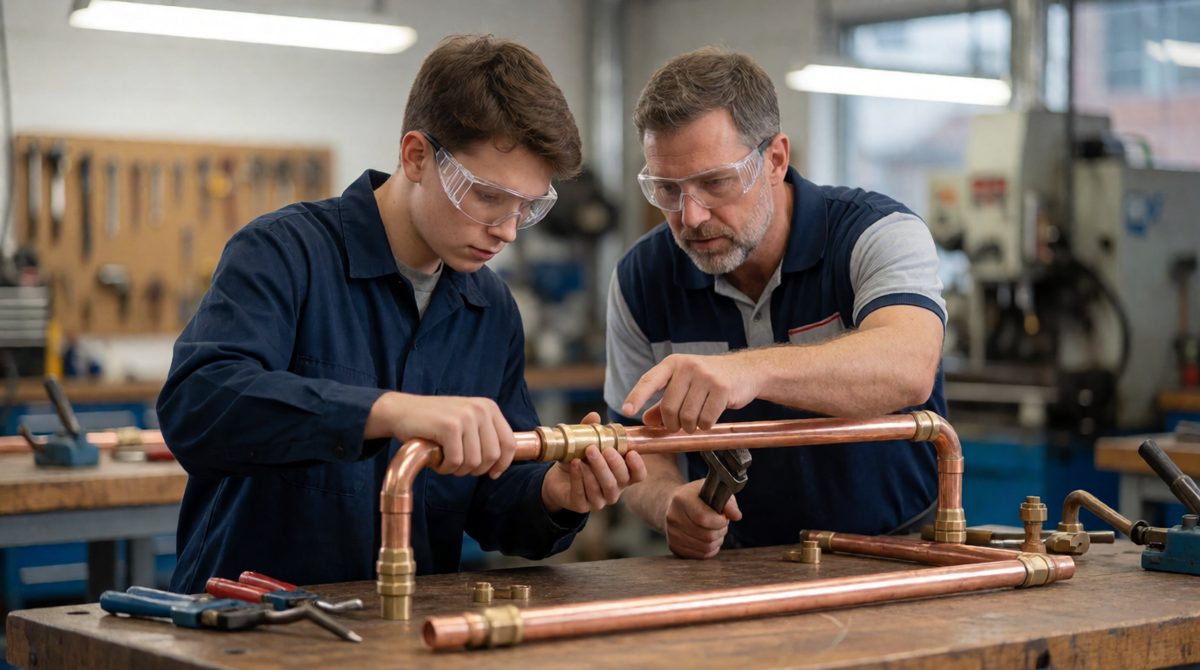
Learning a trade hands-on: vocational learning teaches the practical skills for a particular job, like plumbing
Vocational learning teaches the skills needed for a particular job or trade, such as plumbing, nursing, catering, hairdressing or engineering. It is often practical. Pupils may study at a college, train on the job as an apprentice or follow a work-related course in school.
Learners gain skills that employers want and can move into work quickly. It suits people who prefer practical learning to written exams, and it can help fill jobs that society needs.
It can be seen as lower in status than academic study. A narrow skill may become out of date, or leave the learner with fewer choices if they want to change career. Young people may choose a path too early.
A progressive school is built around the child rather than the curriculum. Lessons often involve projects, discussion, creativity and learning by doing. Pupils may help to decide what they study, and teachers act more like guides than lecturers. Summerhill, a well-known school in England, even lets pupils choose whether to attend lessons.
Pupils are encouraged to think for themselves, be creative and take responsibility. Learning is often more enjoyable, and pupils can develop confidence and problem-solving skills.
With less structure, some pupils may fall behind in basic skills. Results can be harder to measure, and some parents and employers prefer traditional exam success. Such schools often need small classes, so they can be costly.
In an exam, do not just describe each approach. Weigh them up. Ask who gains and who loses: families with time and money may find some approaches easier than poorer families. Ask what is lost, too: several of these approaches reduce the time pupils spend mixing with a wide range of other children. Then give a judgement, such as saying that online learning works well alongside school but is harder as a full replacement for pupils without a device or support.
Mixing up homeschooling and unschooling: in homeschooling the parent still plans and teaches, but in unschooling the child leads. Another mistake is writing that vocational learning is only for pupils who cannot do academic work. Say instead that it teaches practical, job-related skills. Finally, do not write only strengths or only limitations when the question asks for both.
(a) Define the term vocational learning. [2 marks]
(b) Explain one strength and one limitation of homeschooling. [4 marks]
(a) Vocational learning is learning practical skills (1) for a particular job or trade (1).
(b) One strength is that teaching can be fitted to one child (1), so the child gets plenty of individual attention and can learn at their own pace (1). One limitation is that the child may have fewer chances to mix with other children (1), so they may find it harder to learn to get on with people from different backgrounds (1).
When asked for a strength and a limitation, label them clearly and give a reason for each. Two separate short paragraphs make the marks easy to find.