📋 What Does "Evaluating" Actually Mean?
You've already studied the individual sociocultural impacts of tourism the good, the bad and the complicated. Now it's time to bring it all together and evaluate them. That means making a judgement: overall, is tourism's sociocultural impact positive or negative? And does it depend on the situation?
Key Definitions:
- Evaluation: Making a judgement based on evidence looking at both sides and deciding which is stronger, or under what conditions.
- Sociocultural impact: The effect tourism has on people's way of life, traditions, values, social structures and sense of identity.
- Balanced argument: One that considers both positive and negative evidence before reaching a conclusion.
- Mitigation: Steps taken to reduce the negative effects of tourism.
💡 Why Evaluation Matters in Your Exam
IGCSE questions often ask you to "evaluate", "assess", or "discuss" sociocultural impacts. This means you must go beyond just listing impacts you need to compare them, consider context and reach a conclusion. A student who evaluates will always score higher than one who simply describes.
⚖️ The Big Question: Is Tourism Good or Bad for Society?
The honest answer is: it depends. Tourism can bring pride, preserve heritage and improve facilities but it can also cause crime, erode culture and create inequality. The key is understanding what factors tip the balance one way or the other.
👍 Factors That Make Tourism More Positive
- Local communities have control over tourism development
- Government policies protect culture and limit visitor numbers
- Tourism revenue is reinvested into communities
- Tourists are educated about local customs before they arrive
- Tourism is small-scale and sustainable
👎 Factors That Make Tourism More Negative
- Mass tourism with little regulation
- Profits leave the country (economic leakage)
- Local people have no say in how tourism develops
- Rapid growth overwhelms communities
- Cultural traditions are commercialised without community consent
🇮🇪 Case Study 1: Barcelona, Spain When Tourism Turns Sour
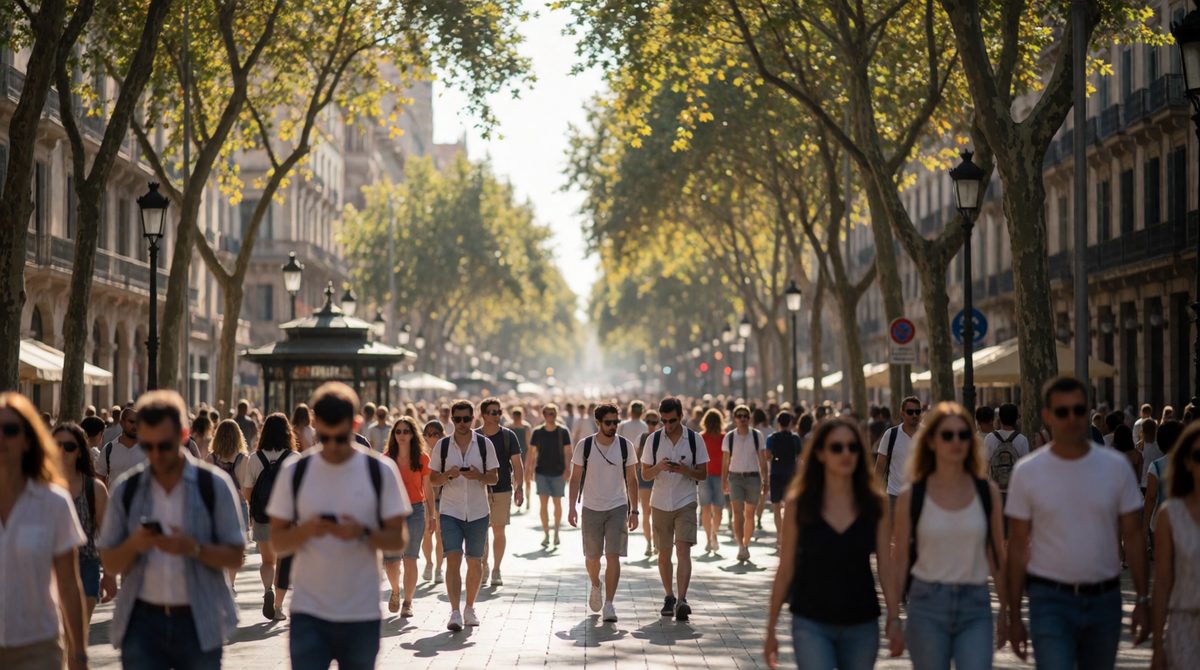
Barcelona has faced tension over tourism
Barcelona is one of the most visited cities in Europe, attracting over 32 million tourists per year more than six times its resident population of 1.6 million. It's a powerful example of how tourism's sociocultural impacts can shift from positive to deeply negative when growth is uncontrolled.
📈 The Positive Side (Early Tourism)
In the 1990s, following the 1992 Olympics, Barcelona used tourism to revitalise its economy. The city gained international recognition, locals felt proud and investment poured in. Cultural sites like the Sagrada Família and Park Güell became globally famous and the city's Catalan identity was celebrated on the world stage.
🚫 The Negative Side (Overtourism)
By the 2010s, the sheer volume of tourists had created serious sociocultural problems. Residents in the Gothic Quarter and Barceloneta neighbourhood began protesting with signs reading "Tourists Go Home" and "Tourism Kills the City."
🏠 Housing Crisis
Short-term lets (like Airbnb) pushed up rents. Long-term residents were priced out of their own neighbourhoods. Between 2015 and 2020, rents in tourist areas rose by over 40%.
🔐 Crime and Anti-Social Behaviour
Pickpocketing, noise and drunken behaviour in residential streets became major complaints. Locals reported feeling like strangers in their own city.
🏭 Loss of Local Culture
Traditional local shops and restaurants were replaced by souvenir stalls and tourist-focused bars. The authentic neighbourhood character began to disappear.
📌 Barcelona's Response
In 2017, Barcelona's mayor Ada Colau introduced a tourist moratorium a freeze on new hotel licences in the city centre. The city also capped the number of tourist apartments and introduced fines for bad tourist behaviour. This shows that government intervention can help manage negative sociocultural impacts an important evaluation point for your exam.
🇮🇹 Case Study 2: Bhutan Choosing Quality Over Quantity
Bhutan, a small Buddhist kingdom in the Himalayas, takes a completely different approach to tourism. Rather than welcoming as many visitors as possible, Bhutan deliberately limits tourist numbers to protect its culture and environment.
📌 The "High Value, Low Volume" Policy
Bhutan charges tourists a Sustainable Development Fee currently $100 per person per day (previously $250). This means only wealthier, more committed tourists visit. In 2019, Bhutan received just 315,000 tourists a tiny fraction compared to Barcelona's millions.
🏆 Sociocultural Benefits
- Traditional Bhutanese dress (the gho and kira) is still worn daily tourism has reinforced rather than eroded this
- Buddhist festivals (like the Tsechu) remain authentic and community-led
- Young Bhutanese feel proud of their culture rather than embarrassed by it
- Local communities maintain control over how tourism operates
⚠️ Limitations
- The high cost excludes most tourists, limiting cultural exchange
- Some argue the policy is elitist only the wealthy can experience Bhutan
- Economic benefits are smaller than in mass-tourism destinations
- Young Bhutanese still access global media and are influenced by outside cultures
💡 Exam Evaluation Point
Bhutan proves that tourism policy directly shapes sociocultural outcomes. When governments prioritise cultural protection over profit, tourism can be managed sustainably. However, this approach isn't available to every country poorer nations may need the economic income that mass tourism brings, even if it comes at a sociocultural cost.
🇮🇰 Case Study 3: Kenya Maasai Communities and Ecotourism
Kenya's Maasai people have experienced both the damaging and empowering sides of tourism. Earlier lessons covered how their culture was commercialised without their consent. Here, we evaluate what happens when communities take back control.
🤝 Community-Based Tourism (CBT)
In parts of southern Kenya, Maasai communities have set up their own tourism enterprises guided walks, cultural villages and conservation projects. Crucially, the profits stay within the community and locals decide what is shared with tourists and what remains private.
🏭 Il Ngwesi Eco-Lodge, Kenya
The Il Ngwesi community-owned eco-lodge in Laikipia employs only local Maasai staff, uses tourism revenue to fund schools and clinics and has helped the community conserve over 8,000 acres of wildlife habitat. Cultural performances are voluntary and community-approved. This is a model of tourism that strengthens rather than erodes cultural identity.
📈 Evaluating the Maasai Experience
The contrast between exploitative tourism (where outsiders profit from Maasai culture) and community-based tourism (where the Maasai themselves control and benefit) is a powerful evaluation tool. The same culture can be either damaged or strengthened by tourism the difference lies in who controls it.
🇮🇹 Case Study 4: Thailand Balancing Tourism Income with Social Costs
Thailand welcomes around 40 million tourists per year, making it one of Asia's top destinations. Tourism accounts for roughly 20% of GDP. But the sociocultural costs have been significant and evaluating Thailand means weighing enormous economic benefits against serious social problems.
📈 Economic Benefit
Tourism has lifted millions out of poverty. Improved infrastructure, hospitals and schools have benefited local communities not just tourists.
🚫 Social Cost
Sex tourism, particularly around Bangkok and Pattaya, has created serious exploitation and trafficking problems. Crime rates in tourist areas are higher than the national average.
⚖️ Cultural Change
The demonstration effect has been strong especially among young Thais in tourist areas, who have adopted Western dress, music and attitudes, sometimes at the expense of traditional Buddhist values.
💡 Evaluation Point: Can You Separate the Economic from the Sociocultural?
Thailand shows that it's very hard to say "tourism is good" or "tourism is bad" in simple terms. The economic gains are real and have improved lives. But the sociocultural costs exploitation, cultural erosion, inequality are also real. A strong exam answer acknowledges both sides and explains why the balance tips one way in a particular context.
📋 A Framework for Evaluation: The PEEL Method
When evaluating sociocultural impacts in your exam, use this structure to write a strong, well-organised answer:
📝 PEEL Structure
- P Point: Make a clear statement (e.g. "Tourism can have negative sociocultural impacts...")
- E Evidence: Use a specific case study or statistic
- E Explain: Say why this happens or what it means
- L Link: Connect back to the question or offer a counter-argument
✍️ Example PEEL Paragraph
"Tourism can cause cultural erosion, particularly in mass-tourism destinations. In Barcelona, the rapid growth of tourist apartments displaced local residents and replaced authentic neighbourhood shops with souvenir stalls. This happened because profit was prioritised over community wellbeing. However, Barcelona's 2017 tourist moratorium shows that government action can limit these effects, suggesting the impact depends on policy choices rather than tourism itself."
⚖️ Factors That Affect the Scale of Sociocultural Impact
Not all tourism destinations are affected equally. When you evaluate, always consider these key factors:
📈 1. Volume of Tourists
The more tourists, the greater the potential impact. A small village receiving 500 visitors a year will experience very different sociocultural pressures to a city receiving 30 million. Overtourism where visitor numbers exceed what a destination can comfortably absorb dramatically increases negative impacts.
🏠 2. Type of Tourism
Mass tourism (package holidays, cruise ships) tends to have greater negative sociocultural impacts than ecotourism or community-based tourism, where visitors engage more respectfully and money stays local. Backpacker tourism often involves more genuine cultural exchange than resort tourism.
📚 3. Level of Economic Development
In less economically developed countries (LEDCs), communities may have fewer resources to manage tourism's impacts. Cultural protection laws may be weaker, communities may have less political power and economic desperation may mean accepting tourism on unfavourable terms.
🏭 4. Cultural Resilience
Some cultures are more resilient than others. Bhutan's strong Buddhist identity and government support has helped it resist cultural erosion. In contrast, smaller or more marginalised communities like some hill tribes in Thailand may have less ability to protect their traditions when faced with mass tourism pressure.
📌 5. Government Policy
This is arguably the most important factor. Strong, well-enforced policies like Bhutan's visitor fee, Barcelona's moratorium, or New Zealand's Treaty of Waitangi protections for Maori culture can dramatically change whether tourism's sociocultural impact is positive or negative.
🌟 Exam Gold: The "It Depends" Conclusion
The best exam answers don't just say "tourism is good" or "tourism is bad." They say: "The sociocultural impact of tourism depends on factors such as the volume of tourists, the level of community control and the strength of government policy. In destinations like Bhutan, careful management has made tourism largely positive, while in Barcelona, rapid uncontrolled growth led to significant negative impacts." This kind of nuanced conclusion earns top marks.
📚 Bringing It All Together: Evaluation Summary
Here is a summary of the key evaluation points from this session and the wider topic:
👍 Tourism Can Be Positive When...
- Communities control their own tourism
- Governments enforce protective policies
- Tourism is small-scale and sustainable
- Revenue is reinvested locally
- Cultural exchange is genuine and respectful
👎 Tourism Can Be Negative When...
- Visitor numbers are too high
- Profits leave the local economy
- Communities have no voice
- Culture is commodified without consent
- Crime and anti-social behaviour increase
⚖️ The Balance Depends On...
- Type and scale of tourism
- Government policy strength
- Level of community involvement
- Cultural resilience of the host community
- Economic context of the destination
📋 Key Vocabulary for Evaluation Questions
- Evaluate: Weigh up evidence on both sides and make a judgement
- Overtourism: When visitor numbers exceed what a destination can sustainably absorb
- Community-based tourism (CBT): Tourism planned and managed by local communities for their own benefit
- Cultural resilience: A community's ability to maintain its identity and traditions despite outside pressures
- Sustainable Development Fee: Bhutan's daily charge on tourists to limit numbers and fund development
- Tourist moratorium: A temporary ban or freeze on new tourism development, as used in Barcelona
- Mitigation: Actions taken to reduce negative impacts
- Leakage: When tourism money leaves the local economy rather than benefiting residents