📦 What's Included in a Typical Package?
- ✈ Return flights (often charter)
- 🏠 Hotel or resort accommodation
- 🚌 Airport transfers
- 📄 Holiday rep support at the resort
- 🍽 Meals (in all-inclusive packages)
Sign up to access the complete lesson and track your progress!
Unlock This CourseA package holiday is when two or more travel services are bundled together and sold as one product at a single price. These services usually include transport, accommodation and sometimes meals or excursions. Package holidays are put together by tour operators companies that organise and sell these bundles to customers, either directly or through travel agents.
Think of it like a meal deal at a sandwich shop. Instead of buying your sandwich, drink and crisps separately, you get them all together for one price. It's easier, often cheaper and you know exactly what you're getting!
Key Definitions:
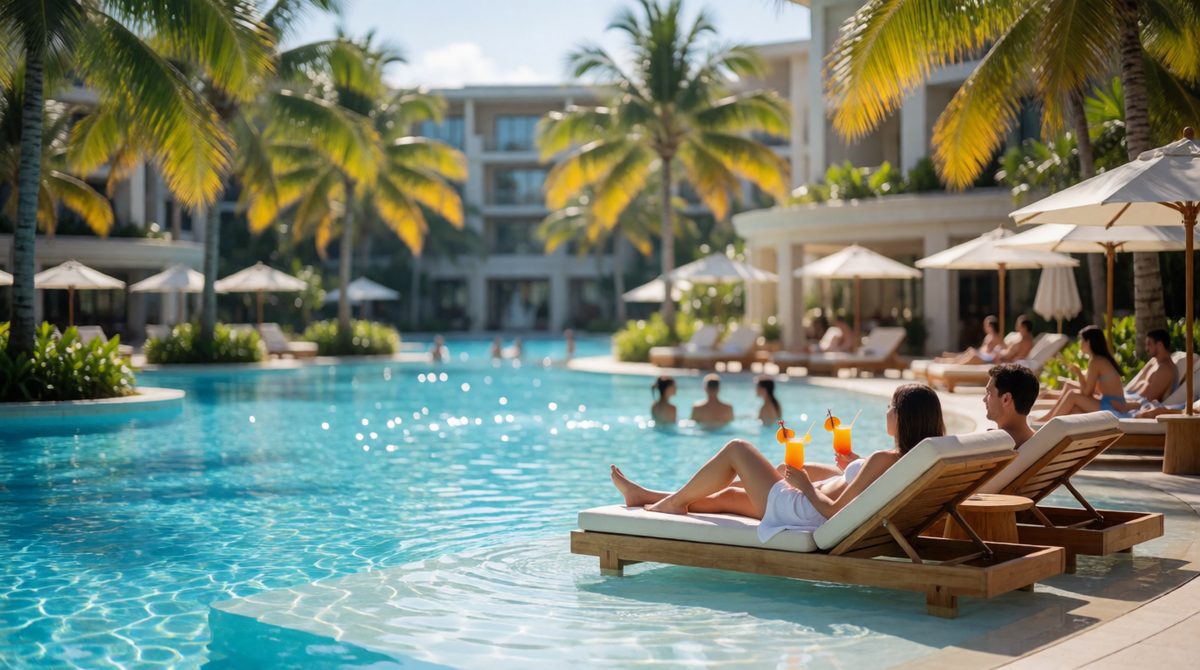
All-inclusive resorts include food and drink
An all-inclusive holiday is a package where almost everything is included in one upfront price. Once you arrive at your resort, you don't need to spend much extra money. Food, drinks (including alcohol at many resorts), entertainment, sports facilities and sometimes excursions are all covered. It's a very popular choice for families and couples who want a stress-free break.
The exact meaning of "all-inclusive" can vary between resorts and tour operators, so it's important to check what's included before booking. Some resorts include absolutely everything; others have "premium" drinks or specialist restaurants that cost extra.
All-inclusive holidays have grown massively since the 1990s. The Caribbean, Turkey and Egypt are the most popular all-inclusive destinations. Resorts like those in Cancún, Mexico attract millions of all-inclusive tourists every year.
Club Med is widely considered the inventor of the all-inclusive concept. Founded in France in 1950, Club Med opened its first resort in Mallorca, Spain. By the 1970s and 80s, it had resorts across the world. Today, Club Med operates over 70 resorts globally and has repositioned itself as a premium all-inclusive brand, targeting wealthier travellers. Its resorts in the Alps offer all-inclusive ski holidays showing how the concept has evolved beyond just beach breaks. Club Med's success proved that tourists would pay upfront for a hassle-free experience, inspiring the all-inclusive model used by hundreds of resort chains today.
All-inclusive resorts are often criticised for economic leakage this is when money spent by tourists doesn't stay in the local economy. Because tourists pay everything upfront to a foreign tour operator and eat and drink entirely within the resort, local restaurants, bars and shops lose out. In some Caribbean islands, studies have estimated that up to 80% of tourist spending leaks out of the local economy. This is a major concern for sustainable tourism development.
A mass market holiday (also called a mass tourism package) is designed to be sold to as many people as possible. These holidays are standardised the same product is sold to millions of tourists. They are usually affordable, use charter flights and head to well-known "sun, sea and sand" destinations. Think of Benidorm in Spain, Magaluf in Mallorca, or Hurghada in Egypt.
Mass market holidays became hugely popular in the 1960s and 70s when air travel became more affordable. Companies like Thomas Cook and TUI grew to enormous size by selling millions of these holidays every year.
Before the 1960s, foreign holidays were only for the wealthy. The introduction of jet aircraft, rising wages and paid holiday entitlement meant that ordinary working families could suddenly afford to go abroad. Tour operators spotted this opportunity and began buying up blocks of hotel rooms and charter flights in bulk reducing costs and passing savings on to customers.
Package holidays to Spain exploded in popularity. Benidorm transformed from a small fishing village into a resort of skyscrapers and hotels. Thomas Cook and Thomson (now TUI) became household names.
Mass market destinations spread to Greece, Turkey, Tunisia and long-haul destinations like Florida and the Canary Islands. All-inclusive resorts began to merge with mass market packages.
Budget airlines like Ryanair and easyJet allowed tourists to book independently online. Tour operators had to adapt many now offer more flexible and niche packages alongside traditional mass market products.
TUI Group is the world's biggest integrated tourism business. It owns airlines (TUI Airways), hotels (RIU Hotels, Robinson Clubs), cruise ships (TUI Cruises) and travel agencies this is a perfect example of vertical integration. TUI sells millions of mass market package holidays every year, primarily to sun-and-sea destinations in Spain, Greece, Turkey and the Caribbean. In 2019, TUI served over 21 million customers across 180 destinations. TUI's business model relies on volume selling huge numbers of standardised holidays at competitive prices. The collapse of rival Thomas Cook in 2019 showed how vulnerable large tour operators can be when costs rise and bookings fall.
Benidorm on Spain's Costa Blanca is one of the most famous examples of mass market tourism in the world. In the 1950s it was a tiny fishing village. Today it has over 40,000 hotel beds more than any other European resort and welcomes around 10 million visitors a year. The majority arrive on package holidays from the UK, Germany and Scandinavia. Benidorm has benefited enormously from tourism it has one of the lowest unemployment rates in Spain. However, it has also faced criticism for environmental pressure, water shortages and the loss of traditional Spanish culture. It is now trying to attract higher-spending tourists and reduce its reliance on cheap mass market packages.
It's important to understand that all-inclusive and mass market holidays are not the same thing, although they often overlap. A mass market holiday might be half-board or self-catering. An all-inclusive holiday is always a specific pricing model. Here's a quick comparison:
📦 A package holiday bundles transport and accommodation together at one price, organised by a tour operator.
🍽 All-inclusive holidays include meals, drinks and entertainment great for budget certainty but bad for local economies due to leakage.
👥 Mass market holidays are standardised, affordable packages sold to millions they boosted tourism in places like Benidorm but can cause environmental and cultural damage.
🌎 TUI is the world's biggest tour operator and uses vertical integration. Club Med pioneered the all-inclusive concept. Thomas Cook (collapsed 2019) was a warning about the risks facing large tour operators.