✈ What Are Ancillary Service Providers?
When people travel, they don't just need a plane ticket and a hotel room. They need loads of extra support someone to help them plan the trip, a guide to show them around and a way to pay for things abroad. These extra services are called ancillary services and the businesses that provide them are called ancillary service providers.
Think of ancillary services as the supporting cast in a film. The destination is the star, but without the supporting cast, the whole thing falls apart!
Key Definitions:
- Ancillary Services: Additional services that support the main travel experience things like booking help, guided tours and currency exchange.
- Ancillary Service Provider: A business or organisation that offers these extra services to travellers.
- Travel Agent: A person or company that sells and arranges travel products and services on behalf of suppliers.
- Guided Tour: An organised trip led by a knowledgeable guide who provides information and manages the group.
- Currency Exchange: The process of converting one country's money into another country's money.
📌 Why Are Ancillary Services Important?
Ancillary services make travel smoother, safer and more enjoyable. They fill in the gaps between getting on a plane and actually having a great holiday. Without them, many tourists especially first-timers would feel completely lost.
They also create millions of jobs worldwide and contribute hugely to the tourism economy.
🌐 Who Uses Ancillary Services?
Pretty much everyone who travels uses at least one ancillary service! A family booking a package holiday uses a travel agent. A tourist visiting Rome might join a guided walking tour. A student going to Spain for the first time will need to exchange their pounds for euros. These services are everywhere.
📍 Travel Agents
A travel agent is like a personal travel expert. Instead of spending hours online trying to figure out flights, hotels, transfers and insurance, you can go to a travel agent and they'll sort it all out for you. They work on behalf of both the customer and the travel suppliers (like airlines and hotels).
Travel agents can be found on the high street (like a shop you walk into), over the phone, or online. Some specialise in luxury travel, others in adventure holidays and some focus on business travel.
💼 Types of Travel Agents
Not all travel agents are the same. There are two main types you need to know for your iGCSE:
🏠 Retail Travel Agents
These are the high-street shops you walk into. They sell holidays directly to the public. Examples include TUI and Thomas Cook (before it collapsed in 2019). They display brochures, offer advice and book everything for you.
💻 Online Travel Agents (OTAs)
These operate entirely online. Examples include Expedia, Booking.com and lastminute.com. They allow customers to compare prices and book 24/7 from their sofa. OTAs have grown massively since the internet became widespread.
👔 Business Travel Agents
These specialise in organising travel for companies and their employees. They handle flights, hotels, car hire and visas for business trips. Examples include American Express Global Business Travel and Carlson Wagonlit Travel.
✅ What Do Travel Agents Actually Do?
Travel agents offer a wide range of services. Here's a breakdown of the main things they do:
- Booking flights, hotels and transfers they find the best deals and package them together.
- Selling package holidays an all-in-one deal including flights, accommodation and sometimes meals.
- Providing travel advice visa requirements, health precautions, best time to visit, local customs.
- Selling travel insurance protecting customers if things go wrong.
- Handling complaints and problems if something goes wrong on holiday, the agent can help sort it out.
🔍 Case Study: TUI Group
TUI is one of the world's largest travel companies. Based in Germany, it operates travel agencies, airlines, hotels and cruise ships across more than 180 destinations. In the UK, TUI has hundreds of high-street shops and a major online presence. What makes TUI interesting is that it's a vertically integrated company it owns the whole chain from the travel agent to the plane to the hotel. This means it can offer competitive prices and control the quality of the experience. TUI serves around 21 million customers per year, showing just how important travel agents remain even in the digital age.
👍 Advantages of Using a Travel Agent
- Expert knowledge and personal advice
- Saves time they do all the research for you
- Financial protection (e.g. ATOL protection in the UK)
- Can handle problems and complaints
- Access to exclusive deals and packages
👎 Disadvantages of Using a Travel Agent
- May charge commission or booking fees
- Less flexibility packages can be rigid
- High-street agents are declining as people book online
- Advice may be biased towards preferred suppliers
- Not always available 24/7 (for high-street agents)
🏭 Guided Tours
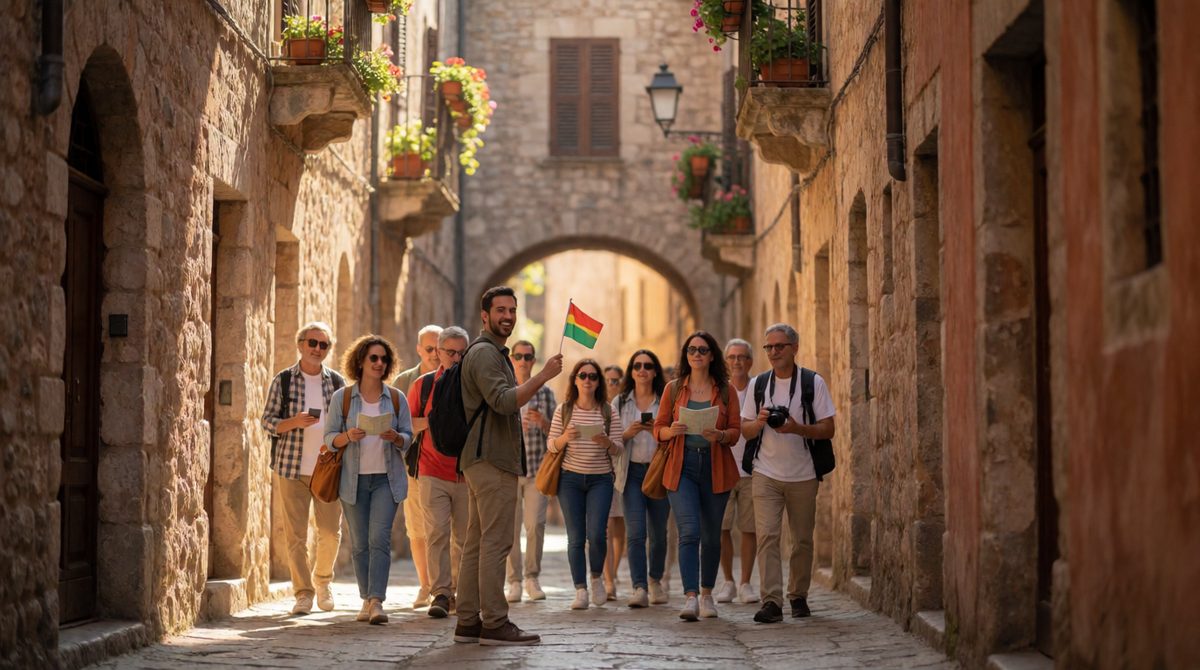
Guided tours help tourists explore
A guided tour is when a group of tourists is led around a destination by a trained guide. The guide provides information, keeps the group safe, manages the schedule and makes the experience much richer than just wandering around alone. Guided tours can last an hour or several weeks!
🗺 Types of Guided Tours
There are many different types of guided tours, each suited to different kinds of travellers and destinations:
🚶 Walking Tours
A guide leads a group on foot around a city or site. Very popular in historic cities like London, Rome and Prague. Often themed ghost tours, food tours, history tours. Usually 1–3 hours long.
🚌 Coach Tours
A group travels by coach to multiple destinations. Popular with older tourists and those who want to see a lot without the hassle of driving. Companies like Shearings and Trafalgar offer these across Europe and beyond.
🏔 Adventure & Eco Tours
Led by specialist guides in natural environments rainforests, mountains, national parks. Examples include gorilla trekking in Uganda or hiking tours in Patagonia. Guides need expert knowledge of the environment and safety procedures.
🌟 The Role of a Tour Guide
A good tour guide does far more than just talk about history. They are the face of the destination and play a vital role in the tourist experience. Key responsibilities include:
- Providing accurate information historical facts, cultural context, local stories.
- Managing the group keeping everyone together, on time and safe.
- Language skills communicating with tourists from different countries.
- Problem solving dealing with lost tourists, medical issues, or changes to the itinerary.
- Promoting responsible tourism encouraging respectful behaviour towards local culture and the environment.
🔍 Case Study: Intrepid Travel
Intrepid Travel is an Australian adventure tour company founded in 1988. It operates small-group guided tours in over 100 countries, focusing on sustainable and responsible tourism. Their tours are led by local guides people who actually live in the destination which means tourists get an authentic, insider experience. Intrepid has won numerous awards for its ethical approach. For example, in their tours of Morocco, local Berber guides lead treks through the Atlas Mountains, providing income for local communities while giving tourists an unforgettable, genuine experience. This is a brilliant example of how guided tours can benefit both tourists AND local people.
👍 Advantages of Guided Tours
- Expert knowledge enhances the experience
- Safe and organised great for unfamiliar destinations
- Social meet other travellers
- Everything is arranged no stress
- Access to places you might not find alone
👎 Disadvantages of Guided Tours
- Less freedom and flexibility
- Can feel rushed too many stops
- More expensive than independent travel
- Quality depends heavily on the guide
- Large groups can feel impersonal
💵 Currency Exchange
When you travel to another country, you usually need to use that country's currency. A British tourist going to Japan needs Japanese Yen. A French tourist visiting the USA needs US Dollars. The process of swapping one currency for another is called currency exchange (or foreign exchange, often shortened to forex).
Currency exchange is a crucial ancillary service because without it, international tourism simply wouldn't work. You can't pay for a meal in Tokyo with British pounds!
🏭 Where Can You Exchange Currency?
There are several places where tourists can exchange their money. Each has different exchange rates and fees:
- Banks generally offer fair rates but may charge fees. You often need to order in advance.
- Post Offices in the UK, the Post Office offers competitive rates with no commission.
- Bureau de Change specialist currency exchange shops found in airports, city centres and tourist areas. Rates vary widely always check!
- ATMs abroad convenient but can have high fees, especially if your bank charges for overseas withdrawals.
- Online currency services companies like Wise (formerly TransferWise) offer excellent exchange rates with low fees.
- Credit/Debit cards many cards now offer fee-free spending abroad (e.g. Starling Bank, Halifax Clarity).
📈 Understanding Exchange Rates
An exchange rate tells you how much of one currency you get for another. For example:
- If £1 = €1.17, then £100 = €117
- If £1 = $1.27, then £200 = $254
Exchange rates change constantly every minute of every day based on global financial markets. This means the rate you get today might be different from the rate tomorrow. This is important for tourists because a weak pound means your holiday becomes more expensive!
Commission is a fee charged by the exchange provider. Some places advertise "0% commission" but make their money by offering a worse exchange rate instead. Always compare the final amount you receive, not just the headline rate.
🔍 Case Study: Wise (formerly TransferWise)
Wise was founded in London in 2011 by two Estonian friends who were frustrated by the high fees banks charged for international money transfers. Wise uses the real mid-market exchange rate (the fairest rate available) and charges a small, transparent fee. It now serves over 16 million customers in 80+ countries. For travellers, Wise offers a multi-currency debit card that lets you hold and spend money in over 50 currencies with no hidden fees. This has been a game-changer for budget travellers and backpackers who previously lost significant amounts of money to poor exchange rates and bank charges. Wise is a perfect example of how technology is disrupting traditional ancillary services.
⚠️ Tips for Getting the Best Exchange Rate
🚫 Avoid Airport Bureaux
Airport currency exchange desks are notorious for offering terrible rates. They know you're in a rush and have no other option. You could lose 10–15% compared to a good online rate. Always exchange before you travel if possible.
📅 Plan Ahead
Order currency online in advance for home delivery. Services like the Post Office or online providers often give better rates when you order ahead. Avoid last-minute panic exchanges at the airport or hotel.
💳 Use a Travel Card
Prepaid travel cards (like Caxton or Revolut) let you load money at a fixed rate before you go. This protects you if the exchange rate gets worse. Cards like Starling Bank offer fee-free spending at the real exchange rate.
💡 Exam Tip: Linking It All Together
In your iGCSE exam, you might be asked to explain how ancillary service providers support the tourism industry. Remember to link travel agents, guided tours and currency exchange back to the overall tourist experience. A tourist might use a travel agent to book their trip, join a guided tour when they arrive and use a bureau de change to get local currency. Each service adds value and makes the trip more accessible, enjoyable and safe. Think about how removing any one of these services would affect the tourist's experience!
📋 Summary: Ancillary Service Providers at a Glance
Let's pull everything together. Ancillary service providers are essential parts of the tourism industry. They don't provide the destination itself, but they make it possible for tourists to get there, understand it and pay for things when they arrive.
- ✈️ Travel Agents plan, book and manage travel arrangements. Can be retail, online, or business-focused.
- 🏭 Guided Tours provide expert-led experiences at destinations. Range from city walking tours to multi-week adventure expeditions.
- 💵 Currency Exchange convert money so tourists can spend abroad. Available through banks, bureaux de change, ATMs and online services.
- 🌟 All three services contribute to the quality, safety and accessibility of the tourist experience.
- 📈 Technology is changing all three sectors online booking, virtual tours and digital banking are reshaping how ancillary services work.