🚀 Scalability
Can the scheme be expanded or copied elsewhere? A great idea that only works in one tiny location has limited global impact. Scalability asks: could this work at a bigger scale, or in other countries?
Sign up to access the complete lesson and track your progress!
Unlock This CourseYou've already learned about lots of sustainable transport developments electric vehicles, hydrogen trains, solar-powered airports and more. But knowing what they are isn't enough. The iGCSE syllabus wants you to be able to evaluate them. That means making a judgement: How well does this actually work? Is it truly sustainable? Who benefits? Who doesn't?
Think of evaluation like being a judge on a talent show. You don't just clap you score each act on different criteria and explain your reasoning. In geography, your "criteria" are the things that make transport genuinely sustainable.
Key Definitions:
When an exam question says "evaluate," it's asking you to discuss both sides strengths AND weaknesses and then reach a conclusion. A one-sided answer will lose marks. Always aim to say something like: "Overall, this scheme is largely successful because... however, it is limited by..."
To properly evaluate a sustainable transport development, you need a set of clear criteria. Geographers typically look at five main areas. Think of them as five questions you ask about every scheme.
Does it actually reduce carbon emissions, pollution, or habitat damage? By how much? Compared to what alternative?
Is it affordable to build and run? Does it create jobs? Is it cost-effective compared to traditional transport?
Is it accessible to everyone or just wealthy tourists? Does it benefit local communities or exclude them?
Can the scheme be expanded or copied elsewhere? A great idea that only works in one tiny location has limited global impact. Scalability asks: could this work at a bigger scale, or in other countries?
Will it still be working in 20 or 30 years? Does it rely on government subsidies that might disappear? Is the technology likely to improve or become outdated?
Here's a handy way to remember the five criteria above use the acronym SEEMS:
Who benefits? Is it fair and accessible?
Does it genuinely cut emissions and pollution?
Is it affordable and financially sustainable?
Can it be rolled out widely? Does it have potential beyond its current location?
Will it last? Is it dependent on subsidies or rare materials?
The United Nations World Tourism Organisation (UNWTO) estimates that tourism accounts for around 8% of global greenhouse gas emissions when you include transport, accommodation and activities. Transport alone makes up roughly 75% of tourism's carbon footprint which is why evaluating sustainable transport is so important.
The Hyperloop is a proposed ultra-fast transport system where passenger pods travel through near-vacuum tubes at speeds of up to 1,200 km/h. Companies like Virgin Hyperloop have promoted it as a revolutionary sustainable transport option potentially connecting cities like London and Edinburgh in under 30 minutes with very low emissions.
Evaluation Verdict: Using the SEEMS framework, the Hyperloop scores well on environmental potential but poorly on economic viability, scalability and long-term sustainability in its current form. It is an example of a sustainable transport idea that is not yet a sustainable transport reality.
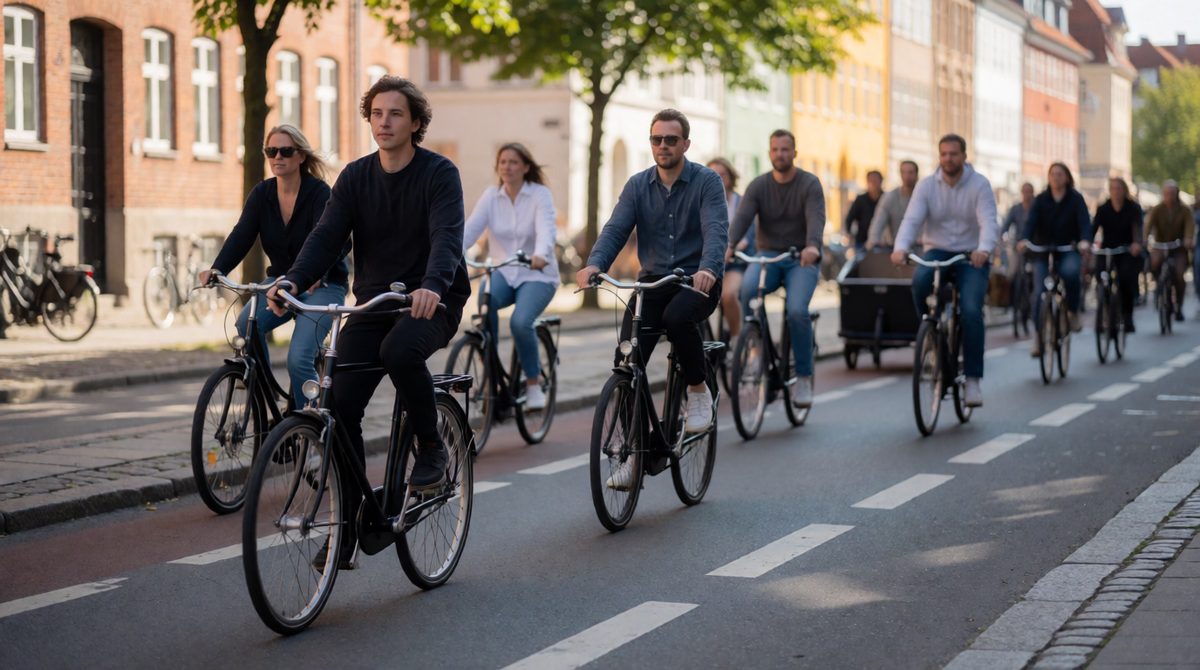
Copenhagen is famous for its cycling infrastructure
Copenhagen, Denmark, is widely regarded as the world's most cycle-friendly city. Over 62% of residents cycle to work or school every day. The city has invested heavily in dedicated cycle lanes, bike bridges and cycle-friendly traffic signals. Tourists are actively encouraged to hire bikes and explore the city by pedal power.
Zero direct emissions from cycling. Reduces car and bus traffic significantly. City aims to be carbon neutral by 2025.
Cycling infrastructure is far cheaper to build than roads or rail. Bike hire generates local income. Reduces healthcare costs from pollution-related illness.
Accessible to most tourists. Bike hire is affordable. However, elderly or disabled visitors may find it less accessible.
Scalability: Copenhagen's model has been copied in Amsterdam, Utrecht and parts of London. It works best in flat cities hilly cities like Edinburgh or Lisbon face greater challenges adopting this model.
Long-Term Sustainability: Cycling infrastructure requires relatively little maintenance. The culture of cycling is deeply embedded in Danish society, making it likely to continue long-term.
Copenhagen scores highly across all five SEEMS criteria. It is one of the most genuinely successful sustainable transport developments in the world. However, it is worth noting that it took decades of investment and cultural change it didn't happen overnight. This is a key limitation for cities trying to copy it quickly.
Not every transport scheme that claims to be "sustainable" actually is. Greenwashing is when a company or government makes something sound more environmentally friendly than it really is often to attract eco-conscious tourists or avoid criticism.
Several airlines have claimed to be "carbon neutral" by purchasing carbon offsets. But critics point out that:
When evaluating a sustainable transport claim, always ask: "Is this genuinely reducing emissions, or just paying someone else to absorb them?"
Different groups of people judge sustainable transport developments differently. A scheme that seems like a great success to one group might be seen as a failure by another. This is a really important point for your exam answers.
Want convenience, affordability and comfort. May support sustainable transport if it doesn't cost much more or take much longer. May resist it if it feels like a sacrifice.
Want reduced pollution, noise and congestion. May benefit from jobs created by new transport schemes. May be displaced or ignored if schemes are designed only for tourists.
Balance economic growth from tourism with environmental targets. May invest in sustainable transport to meet international climate agreements like the Paris Agreement.
Bhutan limits tourist numbers and charges a high daily fee (currently around $200 per day). Tourists are encouraged to travel by foot, horse, or small vehicle within the country. The government evaluates transport success not just by economic income, but by its Gross National Happiness index which includes environmental wellbeing. From a local community perspective, this is highly successful. From a tourist accessibility perspective, it excludes budget travellers entirely. This shows how evaluation depends on whose perspective you use.
Here's how to structure a strong evaluation answer in your iGCSE exam:
"Overall, Copenhagen's cycling infrastructure is one of the most successful sustainable transport developments in the world. It reduces emissions, is economically efficient and benefits both tourists and residents. However, its success depends on flat terrain, long-term political commitment and a cultural willingness to cycle factors that limit how easily it can be replicated in other cities."