🌿 What Is Sustainable Transport Infrastructure?
As tourism grows, so does its impact on the environment. Planes, cars, cruise ships and coaches all burn fossil fuels, releasing carbon dioxide (CO₂) and other greenhouse gases. This contributes to climate change one of the biggest challenges facing the planet today. Sustainable transport infrastructure is all about building and running transport systems that cause less harm to the environment, while still getting people where they need to go.
This isn't just about being "green" it also makes good business sense. Tourists are increasingly choosing destinations and operators that take sustainability seriously. Governments and international bodies like the United Nations World Tourism Organisation (UNWTO) are pushing for greener travel too.
Key Definitions:
- Sustainable transport: Transport that meets current travel needs without damaging the environment or using up resources that future generations will need.
- Carbon footprint: The total amount of greenhouse gases (especially CO₂) produced by a journey, person, or organisation.
- Infrastructure: The physical systems that support transport roads, railways, airports, ports, charging stations, etc.
- Net zero: When the amount of carbon emitted is balanced by the amount removed from the atmosphere a major goal for many countries and airlines.
- Green transit: Transport options that use renewable energy or produce very low emissions, such as electric trains or hydrogen buses.
⚡ Key Fact: Tourism's Carbon Problem
Tourism is responsible for around 8% of global carbon emissions, according to research published in the journal Nature Climate Change. Transport especially aviation makes up the largest share of this. Making transport more sustainable is therefore one of the most important steps in reducing tourism's environmental impact.
⚡ Electric Vehicles (EVs) and Tourism
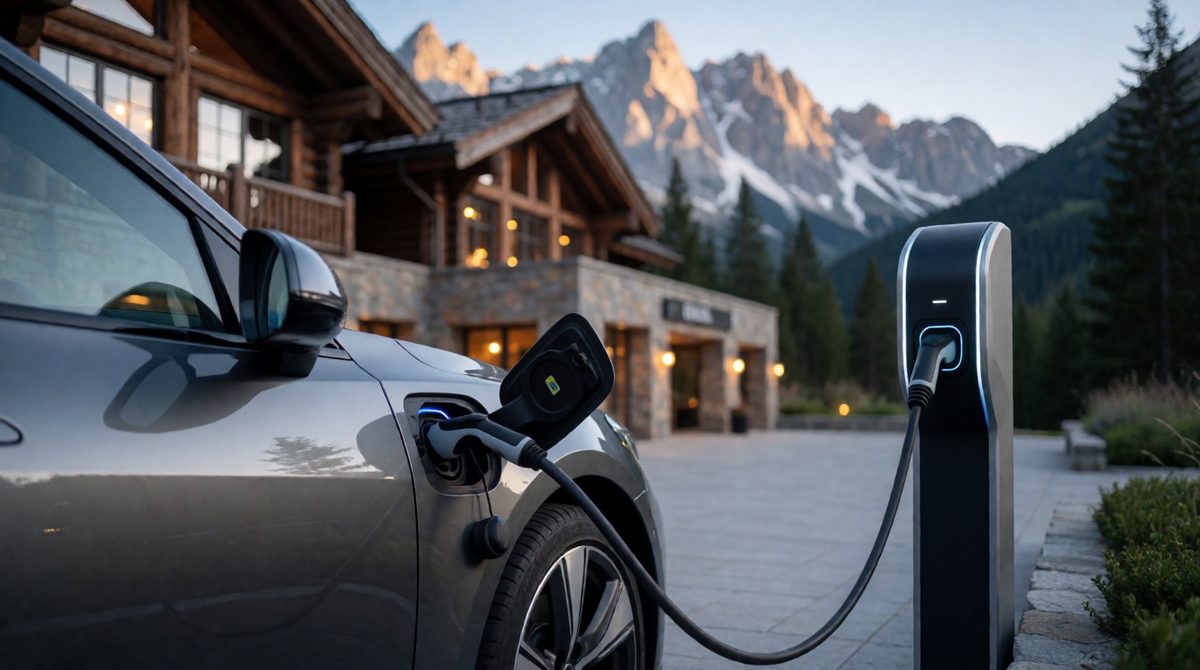
Electric vehicles are changing how tourists travel
One of the most visible changes in sustainable transport is the rise of electric vehicles (EVs). These include electric cars, electric buses, electric taxis and even electric ferries. Instead of burning petrol or diesel, they run on batteries charged by electricity which can come from renewable sources like wind or solar power.
For tourism, EVs matter in several ways. Tourist destinations are investing in electric shuttle buses to move visitors around without polluting the air. Rental car companies are adding EVs to their fleets. And charging infrastructure the network of charging points is expanding rapidly across Europe, North America and parts of Asia.
✅ Benefits of Electric Vehicles in Tourism
- Zero direct emissions cleaner air at the destination
- Quieter than petrol/diesel vehicles less noise pollution
- Lower running costs over time
- Positive image for destinations marketing themselves as sustainable
- Can be powered by renewable energy, making them truly low-carbon
❌ Limitations of Electric Vehicles in Tourism
- High upfront cost of vehicles and charging infrastructure
- Range anxiety tourists worry about running out of charge in remote areas
- Charging takes longer than refuelling with petrol
- Electricity may still come from fossil fuels in some countries
- Less practical in developing countries with unreliable power grids
🔍 Case Study: Electric Buses in Zermatt, Switzerland
Zermatt is a famous ski resort at the foot of the Matterhorn. Private cars with combustion engines have been banned from the town since 1930. Today, visitors arrive by electric train and all local transport taxis, hotel shuttles, delivery vehicles runs on electricity. The result is clean mountain air, a quiet atmosphere and a premium sustainable tourism brand. Zermatt is often cited as a world-leading example of how a tourist destination can operate with near-zero local transport emissions.
🚛 High-Speed Rail and Sustainable Long-Distance Travel
One of the most powerful tools in sustainable transport is high-speed rail (HSR). Trains produce far fewer carbon emissions per passenger than planes, especially over medium distances (roughly 300–900 km). When powered by renewable electricity, they can be almost carbon neutral.
Many countries are investing heavily in expanding their high-speed rail networks as a direct alternative to short-haul flying. This is sometimes called the "modal shift" encouraging travellers to switch from one type of transport (planes) to another (trains).
🌎 The Modal Shift: From Planes to Trains
The idea is simple: if you can get from London to Paris in 2 hours 20 minutes by Eurostar, why fly? The train journey produces roughly 90% less CO₂ than the equivalent flight. Governments across Europe are now promoting rail over air travel for journeys under 4 hours and some countries have gone further.
🇫🇷 France
In 2023, France banned domestic flights on routes where a train journey of under 2.5 hours exists. This is a direct policy to reduce aviation emissions and encourage rail travel.
🇸🇪 Spain
Spain has one of Europe's largest high-speed rail networks (AVE). In 2023, the government introduced free rail passes on many routes to encourage people to switch from cars and planes to trains.
🇯🇵 Japan
Japan's Shinkansen (bullet train) network is a global model for sustainable rail. It carries over 450,000 passengers per day and has an extraordinary safety record. It runs on electricity and is increasingly powered by renewables.
🔍 Case Study: Eurostar and the London–Paris Rail Route
The Eurostar service through the Channel Tunnel connects London St Pancras with Paris Gare du Nord in just over 2 hours. A return flight on this route produces around 166 kg of CO₂ per passenger, while the Eurostar produces just 6 kg a reduction of over 96%. Eurostar has committed to becoming carbon neutral and is investing in new trains that are more energy-efficient. The service carries around 11 million passengers per year and is a key example of sustainable international transit replacing short-haul aviation.
☀️ Solar-Powered and Renewable Energy Infrastructure
Airports, railway stations and ports are huge consumers of energy. Lighting, heating, air conditioning and powering systems all add up. Many transport hubs are now investing in renewable energy infrastructure particularly solar panels to reduce their carbon footprint.
☀️ Solar-Powered Airports
Cochin International Airport in Kerala, India, became the world's first fully solar-powered airport in 2015. It has over 46,000 solar panels generating enough electricity to power all airport operations. It has won multiple international sustainability awards and inspired other airports worldwide to follow suit.
🔌 Solar Rail Tracks
In Belgium, solar panels were installed along a railway line as early as 2011, generating electricity fed directly into the rail network. The UK has also trialled solar-powered train carriages that use rooftop panels to power lighting and air conditioning, reducing energy drawn from the main grid.
🚢 Hydrogen Transport: The Next Frontier
Hydrogen fuel cell technology is emerging as one of the most exciting developments in sustainable transport. Hydrogen-powered vehicles produce only water vapour as exhaust making them truly zero-emission at the point of use. They can be refuelled quickly (unlike battery EVs) and are well-suited for heavy vehicles like buses, trains and ferries.
🔍 Case Study: Alstom Coradia iLint The Hydrogen Train
In 2022, Germany launched the world's first commercial hydrogen passenger train service, using Alstom's Coradia iLint trains in the state of Lower Saxony. These trains replaced diesel trains on a non-electrified route, producing zero direct emissions. Each train can travel up to 1,000 km on a single tank of hydrogen. The UK, France and several other countries are now trialling or ordering hydrogen trains for routes where full electrification is too expensive.
⚡ Key Fact: Hydrogen vs Battery Electric
Hydrogen trains are particularly useful on rural or remote routes where installing overhead electric wires would cost too much. Battery electric trains are better for shorter urban routes. Both are far cleaner than diesel and both are being adopted as part of sustainable transport strategies worldwide.
⚓ Sustainable Water Transport
Ferries and cruise ships are major polluters traditional vessels burn heavy fuel oil, which produces sulphur dioxide and particulate matter as well as CO₂. However, the shipping industry is undergoing significant change, with new fuels and technologies being introduced.
⚡ Electric Ferries
Norway has pioneered electric ferry services. The MF Ampere, launched in 2015, was the world's first fully electric car ferry. Norway now has over 70 electric ferries in operation, dramatically cutting emissions on busy fjord crossings popular with tourists.
🌿 LNG-Powered Cruise Ships
Liquefied Natural Gas (LNG) burns much cleaner than traditional ship fuel. Several major cruise lines, including MSC and AIDA, have launched LNG-powered ships that produce near-zero sulphur emissions and significantly less CO₂.
☀️ Wind-Assisted Shipping
Some modern cargo and passenger vessels are using rotor sails tall spinning cylinders that harness wind power to reduce engine use. The Enercon E-Ship 1 and Flettner rotor technology are being adopted by several shipping companies to cut fuel use by up to 30%.
🔍 Case Study: Norway's Green Ferry Network
Norway's government has mandated that all ferry routes on national contracts must use zero or low-emission technology by 2025. This has driven rapid investment in electric and hybrid ferries. The UNESCO-listed Geirangerfjord one of Norway's top tourist attractions is particularly targeted, as cruise ships and ferries have been major polluters in this fragile environment. From 2026, only zero-emission vessels will be permitted in Norway's most sensitive fjords. This is a landmark policy linking sustainable infrastructure directly to protecting a world-class tourism destination.
📍 Sustainable Airport Infrastructure
Airports are working hard to reduce their own carbon footprints separate from the flights themselves. This includes energy-efficient terminal buildings, electric ground vehicles, sustainable fuels and better public transport links to reduce car journeys to and from airports.
- Sustainable Aviation Fuel (SAF): Made from waste materials like used cooking oil, SAF can reduce lifecycle carbon emissions by up to 80% compared to conventional jet fuel. Airlines including British Airways and KLM are already using SAF on some flights.
- Electric Ground Vehicles: Baggage tugs, pushback vehicles and shuttle buses at airports are being converted to electric. Amsterdam's Schiphol Airport has committed to fully electric ground operations.
- Green Terminal Buildings: Singapore's Changi Airport and Oslo's Gardermoen Airport have invested heavily in energy-efficient design, LED lighting, rainwater harvesting and green roofs.
- Rail Connections: Reducing car journeys to airports is key. London Gatwick, Amsterdam Schiphol and Frankfurt Airport all have direct high-speed rail connections, encouraging passengers to arrive by train rather than car or taxi.
🌎 How Sustainable Infrastructure Affects Domestic vs International Tourism
Sustainable transport developments affect domestic and international tourists differently. It's important to understand these differences for your iGCSE exam.
🏭 Domestic Tourism
- High-speed rail makes domestic travel faster and greener encouraging people to explore their own country
- EV charging networks make road trips more viable for eco-conscious travellers
- Electric buses and trams improve access to tourist sites within cities
- Domestic tourists are more likely to use rail and road, so sustainable improvements here have a big impact
🌐 International Tourism
- SAF and more fuel-efficient aircraft reduce the carbon cost of long-haul travel
- Better rail connections between countries (e.g. Eurostar, TGV) reduce short-haul flights
- Sustainable port infrastructure makes cruise tourism less damaging
- International tourists often have higher carbon footprints due to long-distance flights making sustainable aviation especially important
📈 Challenges in Building Sustainable Transport Infrastructure
Switching to sustainable transport isn't easy or cheap. There are real barriers that slow down progress and these are important to understand for exam questions about challenges and limitations.
🔍 Case Study: Developing Countries and the Sustainability Gap
Many of the world's most visited tourism destinations are in developing countries places like Thailand, Kenya, Indonesia and Peru. These countries often lack the financial resources and technical expertise to invest in sustainable transport infrastructure. For example, while European countries are rolling out hydrogen trains and electric ferries, many parts of Southeast Asia and sub-Saharan Africa still rely on ageing diesel buses and poorly maintained road networks. This creates a "sustainability gap" where the countries that most need sustainable transport investment are the least able to afford it. International organisations like the World Bank and UNWTO are working to address this through funding and technical support programmes.
💰 Cost
New sustainable infrastructure electric trains, hydrogen fuelling stations, solar airports requires massive upfront investment. Governments and private companies must weigh long-term environmental benefits against short-term financial costs.
🕐 Time
Building new rail lines, upgrading ports and installing charging networks takes years or even decades. Climate targets are urgent, but infrastructure change is slow. Political will and long-term planning are essential.
👥 Behaviour Change
Even when sustainable options exist, tourists and operators don't always choose them. Changing habits like choosing train over plane, or renting an EV requires education, incentives and sometimes regulation.
💡 Why This Matters for iGCSE
In your exam, you may be asked to evaluate sustainable transport developments, discuss their advantages and disadvantages, or apply them to specific case studies. Make sure you can: define key terms clearly, give named examples (Zermatt, Eurostar, Cochin Airport, Norway's ferries), explain both benefits and limitations and link sustainability to the wider tourism industry including impacts on destinations, tourists and the environment.
📝 Exam Tips: Sustainable Transport Infrastructure
- ✅ Always use named examples vague answers lose marks. Learn at least 3–4 specific case studies.
- ✅ Know the difference between types of sustainable transport: electric, hydrogen, solar, wind-assisted, SAF.
- ✅ Be able to explain why sustainable transport matters climate change, tourist expectations, government policy.
- ✅ Understand the challenges cost, time, behaviour change, the sustainability gap in developing countries.
- ✅ Link sustainable transport to both domestic and international tourism they are affected differently.
- ✅ For evaluation questions, always give a balanced answer benefits AND limitations.
- ✅ Remember the modal shift concept encouraging travellers to switch from higher-carbon to lower-carbon transport modes.