📍 Handling Customer Enquiries: Directions, Itineraries and Information
When a customer walks up to a hotel reception desk, calls a travel agent, or messages a tour operator online, they usually want one of three things: to know where to go, to know what's happening when, or to get useful information about their trip. Being able to handle these enquiries well is a core skill in travel and tourism and it's a big part of what makes the difference between a good experience and a bad one.
This session focuses on the practical side of customer service: giving directions, building itineraries and providing accurate, helpful information. These might sound simple, but doing them well takes real skill, knowledge and the right attitude.
Key Definitions:
- Customer Enquiry: A request from a customer for information, help or advice.
- Directions: Instructions that help a customer get from one place to another.
- Itinerary: A detailed plan of a journey or trip, including dates, times, places and activities.
- Destination Information: Facts about a place that help a traveller prepare such as opening times, transport links, local customs and attractions.
💬 Verbal Enquiries
These happen face-to-face or over the phone. A customer might ask a hotel concierge how to get to the nearest train station, or call a tour operator to ask what's included in a package. Staff need to speak clearly, listen carefully and give accurate answers without making the customer feel rushed or confused.
✉️ Written Enquiries
These come in by email, letter, or online chat. Written responses need to be clear, well-structured and professional. They also create a record so accuracy really matters. A written itinerary sent to a customer before their holiday, for example, must be completely correct.
📍 Giving Directions: More Than Just Left and Right
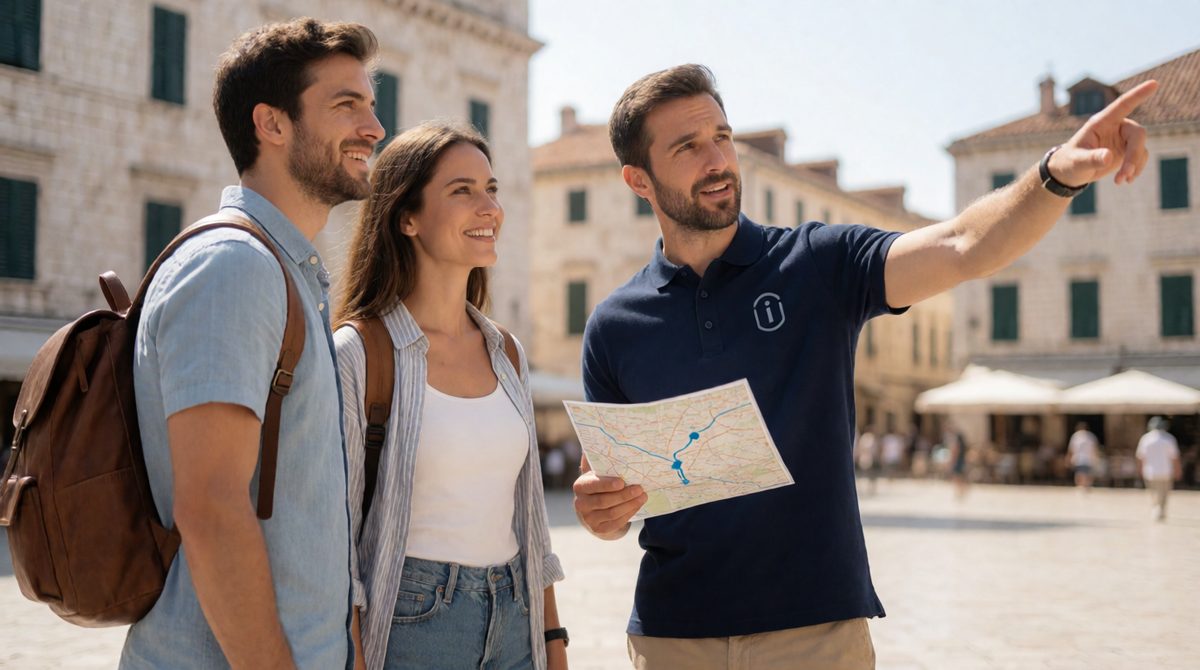
Staff often help tourists with directions
Giving directions sounds easy but in a travel and tourism context, it's a real skill. Whether you're a resort rep pointing tourists towards the beach, a hotel receptionist explaining how to reach the city centre, or an airport worker directing a passenger to their gate, you need to be clear, confident and accurate.
🚶 What Makes Good Directions?
Good directions are simple, logical and easy to follow. They use landmarks the customer can actually see, avoid jargon and check that the customer has understood. Here's what to think about:
🔎 Use Landmarks
Instead of saying "turn east on the B4056," say "turn left at the big Tesco." Landmarks are much easier to follow, especially for tourists who don't know the area.
🕑 Give Distances and Times
Tell the customer how far it is and how long it will take. "It's about a 10-minute walk" is much more helpful than just "it's not far." People need to plan their time.
❓ Check Understanding
Always ask "Does that make sense?" or "Would you like me to write that down?" A customer who nods politely but is actually confused will end up lost and frustrated.
✈️ Directions in Different Settings
The type of directions you give depends on where you work. A hotel concierge might give walking directions to a restaurant. An airport information desk worker might direct a passenger to a specific terminal or gate. A cruise ship worker might explain how to get from the port to the town centre. In each case, the approach is the same: be clear, be accurate and make sure the customer feels confident.
📍 Real Example: The Hotel Concierge
At The Savoy Hotel in London, concierge staff are trained to know the local area in great detail. They can give directions to nearby attractions, recommend the best walking routes and even draw simple maps for guests. This level of local knowledge is considered a key part of luxury customer service. The concierge doesn't just say "go left" they explain the route step by step, mention what the customer will see along the way and often hand over a printed hotel map with the route highlighted. This makes the customer feel looked after and confident.
📋 Itineraries: Planning the Perfect Trip
An itinerary is a written plan of a journey. It tells the traveller exactly what is happening, when and where. Itineraries are used by tour operators, travel agents, hotels, airlines and event organisers. Getting an itinerary right is crucial mistakes can cause missed flights, double bookings, or very unhappy customers.
📝 What Goes Into an Itinerary?
A good itinerary includes all the essential details a traveller needs, presented in a clear, logical order. Here's what's typically included:
- Travel dates and times departure and arrival times for all transport
- Flight or transport details carrier name, flight number, seat numbers, terminal information
- Accommodation details hotel name, address, check-in and check-out times, booking reference
- Activities and excursions what's planned each day, with times and meeting points
- Contact information local rep details, emergency numbers, hotel phone numbers
- Transfers how the customer gets between the airport, hotel and any other locations
- Important notes visa requirements, local currency, dress codes for certain venues
✈️ Case Study: TUI UK Building a Package Holiday Itinerary
TUI is one of the UK's biggest package holiday companies. When a customer books a two-week holiday to Tenerife, TUI automatically generates a detailed itinerary and sends it to the customer before departure. This includes the outbound and return flight details (with airline, flight number and departure time), the name and address of the hotel, the transfer time from the airport and the name of the local TUI rep. Customers can also access this itinerary through the TUI app. If anything changes such as a flight time update TUI sends an updated itinerary immediately. This keeps customers informed and reduces the number of enquiries the customer service team has to handle.
👥 Tailoring Itineraries for Different Customers
Not all travellers are the same and a good itinerary reflects the needs of the specific customer. A family with young children needs different information to a solo business traveller or a group of retired tourists on a coach tour.
👪 Families
Need child-friendly activity suggestions, information about kids' clubs, meal times and whether the hotel has a pool. They also want to know about baggage allowances for pushchairs and car seats.
💼 Business Travellers
Need precise timings, Wi-Fi availability, transport to meeting venues and hotel check-in flexibility. They often travel alone and want efficiency above all else.
👴 Group Tours
Need clear meeting points, group meal arrangements and a day-by-day schedule. The itinerary must account for the pace of the whole group, including any passengers with mobility needs.
🔍 Providing Information: Getting It Right Every Time
Customers ask all kinds of questions about opening times, local transport, visa requirements, weather, local customs, currency and much more. Providing accurate, up-to-date information is one of the most important parts of customer service in travel and tourism. Getting it wrong can ruin a trip.
📚 Sources of Information
Travel and tourism staff need to know where to find reliable information quickly. Here are the main sources they use:
- Official tourism websites such as VisitBritain, the Spanish Tourism Board, or local council tourism pages
- Transport operator websites National Rail, TfL (Transport for London), airline websites
- Government travel advice the UK Foreign, Commonwealth and Development Office (FCDO) provides up-to-date safety and visa information for every country
- In-house databases and booking systems most large travel companies use software that holds all customer and destination information
- Printed materials brochures, maps, local guides and leaflets available at tourist information centres
- Personal knowledge experienced staff who have visited destinations themselves are often the most helpful
🌎 Case Study: Thomas Cook Travel Agents The Importance of Accurate Information
Before Thomas Cook collapsed in 2019, its travel agents were trained to use a combination of their booking system (called Excalibur) and personal destination knowledge to answer customer enquiries. Agents were expected to know visa requirements, health advice and local customs for popular destinations. If a customer asked whether they needed a visa for Turkey, the agent would check the FCDO website and the booking system to give a confirmed, up-to-date answer never guessing. This was vital because giving wrong visa information could mean a customer being turned away at the airport. The lesson here is clear: when it comes to travel information, accuracy is everything.
📢 Communicating Information Effectively
Finding the right information is only half the job. You also need to communicate it clearly. Here are the key principles:
🗣️ Keep It Simple
Avoid technical jargon. If a customer asks about baggage allowance, don't say "your checked luggage entitlement is 23kg per person in economy class with a maximum linear dimension of 158cm." Say "you can take one bag weighing up to 23kg." Simple and clear wins every time.
📄 Confirm in Writing
For important information especially itineraries, booking confirmations and visa requirements always follow up in writing. This protects both the customer and the business. If there's ever a dispute, a written record is essential.
👨💻 Digital Tools for Handling Enquiries
Modern travel and tourism businesses use a wide range of digital tools to handle customer enquiries about directions, itineraries and information. These tools make the process faster and more accurate.
📱 Apps and Online Portals
Many large travel companies now give customers access to a personal app or online portal where they can view their full itinerary, get directions to their hotel, download boarding passes and message customer service directly. This reduces the number of phone calls and emails the company receives and gives customers the information they need instantly.
✈️ easyJet App
Allows customers to view their booking, check in online, download boarding passes and get real-time flight updates. Customers can also access directions to the airport and terminal information.
🏠 Booking.com
Sends customers a full itinerary by email and app notification. Includes hotel address, check-in time, map link and a direct message function to contact the property before arrival.
📍 Google Maps Integration
Many travel apps now link directly to Google Maps so customers can get step-by-step directions from their current location to their hotel, attraction or transport hub with one tap.
💡 Exam Tip: Types of Enquiry Handling
In your exam, you may be asked to describe or evaluate different ways of handling customer enquiries. Remember to consider: verbal (face-to-face or phone), written (email, letter, printed itinerary) and digital (apps, online portals, chatbots). Each has advantages and disadvantages. For example, verbal communication is immediate and personal, but there's no written record. Written communication creates a record but takes longer. Digital tools are fast and convenient but rely on the customer having a smartphone and internet access.
⚠️ Common Mistakes When Handling Enquiries
Even experienced staff can make mistakes when handling customer enquiries. Knowing what to avoid is just as important as knowing what to do.
- Giving outdated information always check that the information you're sharing is current. Opening times change, transport routes are updated and visa rules can change overnight.
- Assuming the customer knows the area never assume a tourist knows local landmarks or transport systems. Always explain from scratch.
- Overloading the customer with information giving too much information at once is just as unhelpful as giving too little. Focus on what the customer actually needs.
- Not confirming understanding always check that the customer has understood your directions or information before they walk away.
- Errors in written itineraries a typo in a flight number or a wrong date in an itinerary can cause serious problems. Always proofread before sending.
📚 Quick Recap: The Key Skills for Handling Enquiries
📍 Directions: Use landmarks, give distances and times, check understanding, offer a written or printed version if possible.
📋 Itineraries: Include all essential details, tailor to the customer type, check for errors and update immediately if anything changes.
🔍 Information: Use reliable sources, keep it simple, confirm important details in writing and always check that your information is up to date.
📱 Digital Tools: Apps and online portals are increasingly important know how they work and what they offer customers.