🌟 Putting It All Together: Customer Service in Action
You've already studied the individual building blocks of customer service product knowledge, complaints procedures, reservations, recommendations and more. Now it's time to do something harder: apply all of that to real situations.
In the iGCSE exam, you won't just be asked to define terms. You'll be given a scenario a short description of a situation in a travel or tourism setting and asked to explain what good customer service looks like in that specific context. This lesson is all about practising that skill.
Key Definitions:
- Scenario: A short description of a real or realistic situation that you must respond to using your knowledge.
- Customer service delivery: The way a business or member of staff actually provides service to a customer not just what they plan to do, but what they actually do.
- Context: The specific details of a situation who the customer is, where they are, what they need and what has gone wrong (if anything).
💡 Why Scenario Questions Matter in the Exam
Scenario-based questions are worth the most marks in the iGCSE Travel & Tourism paper. Examiners want to see that you can think like a travel professional, not just recite facts. A strong answer links the situation to specific customer service skills and explains why those skills are needed in that context.
📋 What Makes a Scenario Different from a Definition Question?
Let's be clear about what you're being asked to do when a scenario appears in the exam.
🔍 Reading a Scenario Carefully
Every scenario contains clues. Your job is to spot them. Look for:
- Who the customer is (age, group type, special needs)
- What setting the service is happening in (airport, hotel, travel agency, visitor attraction)
- What the customer wants or needs
- Whether anything has gone wrong
- What the member of staff should do next
Once you've identified those clues, you can match them to the right customer service skills and explain how they should be applied.
😡 Weak Exam Answer
"The staff member should be polite and helpful." This scores very few marks because it's too vague. It doesn't link to the scenario at all.
✅ Strong Exam Answer
"Because the customer is elderly and travelling alone, the hotel receptionist should speak clearly, avoid jargon, offer written confirmation of directions and check the customer has understood showing empathy and patience throughout."
🏠 Scenario 1: The Hotel Check-In Problem
📋 The Situation
A family of four arrives at a seaside hotel in Cornwall after a long drive. They booked a family room with a sea view, but the receptionist informs them that their room has been given to another guest by mistake. The family are tired, the children are upset and the parents are frustrated.
🔍 Applying Customer Service Skills to This Scenario
This scenario tests several skills at once. Let's break it down.
💬 Communication
The receptionist must stay calm, speak clearly and avoid being defensive. Apologising sincerely without making excuses is essential. The family need to feel heard before solutions are offered.
👥 Empathy
Recognising that this family has young children and has been travelling all day means the receptionist should prioritise speed. Offering refreshments or a place to sit while the issue is resolved shows genuine care.
✅ Problem-Solving
The receptionist should offer a concrete solution: an upgraded room, a discount, or a complimentary meal. Vague promises ("we'll sort something out") are not good enough. The customer needs a clear outcome.
In the exam, you'd be expected to explain why each of these matters not just list them. For example: "Offering an upgrade rather than just an apology turns a negative experience into a positive one, which is more likely to retain the family as future customers and generate positive word-of-mouth."
✈️ Scenario 2: The Airport Information Desk
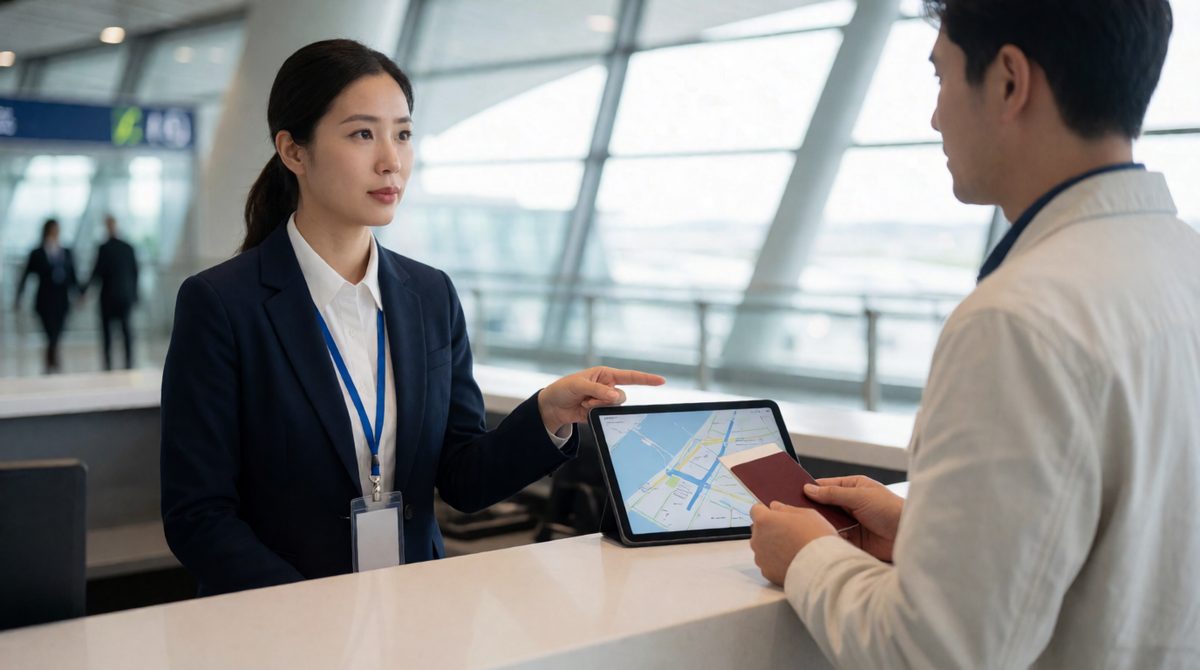
Airport information desks help travellers
📋 The Situation
A solo traveller approaches an information desk at Heathrow Airport. She is visibly anxious and explains that she has missed her connecting flight to Madrid. She doesn't speak much English and is holding a paper ticket. Her onward flight left 20 minutes ago.
🔍 Applying Customer Service Skills to This Scenario
This is a high-pressure scenario involving a vulnerable customer. The member of staff needs to act quickly but carefully.
- Language barrier: Use simple words, speak slowly and use visual aids or a translation app if available. Do not raise your voice this is a common mistake.
- Body language: Maintain a calm, open posture. Smile reassuringly. Avoid crossing arms or looking rushed.
- Practical action: Contact the airline immediately to check rebooking options. Explain each step clearly, even if the customer's English is limited. Write down key information (gate number, new flight time) so she has something to refer to.
- Escalation: If the desk cannot resolve the issue, the staff member should escort the customer or arrange for someone to do so to the correct airline desk. Leaving a vulnerable customer to find their own way is poor service.
💡 Exam Tip: Vulnerable Customers
Whenever a scenario includes a customer who is elderly, very young, anxious, has a disability, or faces a language barrier, the examiner is testing whether you understand that customer service must be adapted. One size does not fit all. Always explain how and why you would adapt your approach.
🌎 Case Study: Center Parcs Handling a Difficult Group Scenario
🌎 Real-World Application
Center Parcs UK is well known for its family-friendly holiday villages. Staff are trained to handle a wide range of scenarios from lost children to broken equipment to noise complaints between neighbouring lodges. In one documented training scenario, a group of adults in a lodge are playing loud music late at night, disturbing families nearby. The night duty manager must resolve the situation without escalating it into a confrontation.
Center Parcs trains staff to: approach calmly and professionally, acknowledge the group's right to enjoy their holiday, explain the impact on other guests (especially children) and offer a reasonable compromise such as moving the party indoors or reducing volume after a set time. This approach uses assertiveness without aggression, which is a key customer service skill in hospitality.
The outcome? Most complaints are resolved without formal action, guests on both sides feel respected and the brand's reputation for family-friendly service is maintained.
👴 Scenario 3: The Travel Agency Matching the Right Holiday
📋 The Situation
A couple in their 60s walk into a high street travel agency. They say they want "something different" for their anniversary they've done beach holidays before and want an experience. Their budget is £4,000 for two people and they have three weeks available in October. One of them has a mild walking difficulty.
🔍 Applying Customer Service Skills to This Scenario
This scenario is about needs analysis and tailored recommendations but it also tests how well you can apply those skills when the customer's needs are complex.
💬 Questioning Technique
The agent should use open questions to find out more: "What kind of experiences have you enjoyed before?" and "Are there any activities you'd like to try?" Closed questions like "Do you want a hotel?" are less useful at this stage.
👴 Accessibility Awareness
The walking difficulty must be factored in. This rules out certain destinations (e.g. hilly cities with cobblestones) and means the agent should check accessibility features of any accommodation or excursion recommended.
A strong recommendation might be a river cruise through Europe it's different from a beach holiday, suits October weather, fits the budget, involves minimal walking and offers cultural experiences. The agent should explain why this matches the couple's specific needs, not just describe the product.
This is the difference between a good travel agent and a great one and it's exactly what the examiner is looking for in a high-mark answer.
📈 Evaluating Customer Service Delivery: Was It Good Enough?
In some exam questions, you'll be asked to evaluate customer service meaning you need to judge how well it was delivered and suggest improvements. This is a higher-order skill and is worth more marks.
🔍 A Framework for Evaluation
Use this simple structure when evaluating customer service in a scenario:
- What was done well? Identify specific actions that were appropriate and effective.
- What could have been better? Identify gaps, missed opportunities, or mistakes.
- What was the impact? Explain the effect on the customer and the business.
- What would you recommend? Suggest a realistic improvement.
📋 Evaluation in Practice
Scenario: A hotel receptionist apologised to a guest whose room wasn't ready, offered them a seat in the lobby, but didn't offer any refreshments and didn't give a time estimate for when the room would be available.
Evaluation: The receptionist showed empathy by apologising and offering a seat, which was positive. However, failing to offer refreshments or a time estimate left the guest feeling uncertain and undervalued. This could lead to a negative review. The receptionist should have said: "Your room will be ready in approximately 30 minutes can I offer you a complimentary tea or coffee while you wait?" This small addition would significantly improve the customer experience.
📢 The Link Between Context and Service Style
One of the most important things to understand is that the same customer service skill looks different in different contexts. Being "professional" at a luxury spa hotel means something very different from being "professional" at a budget hostel or a busy theme park.
🏢 Luxury Hotel
Formal language, personalised service, anticipating needs before they're expressed, remembering guest preferences, discreet and unhurried pace.
🎪 Theme Park
Friendly and energetic tone, quick responses, clear directions, managing queues efficiently, keeping families informed about wait times and safety.
✈️ Budget Airline
Efficient and clear communication, strict adherence to rules (baggage, boarding), managing high volumes of passengers, staying calm under pressure.
In the exam, always tailor your answer to the specific context given in the scenario. A generic answer about "being polite" will not score highly. Show the examiner you understand how the setting shapes the service.
⚠️ Common Mistakes Students Make in Scenario Questions
📝 Avoid These Pitfalls
- Being too vague: "The staff should be friendly and helpful" this tells the examiner nothing. Be specific.
- Ignoring the customer type: If the scenario mentions a family, an elderly person, or someone with a disability, your answer must address that specifically.
- Forgetting the business perspective: Good customer service isn't just about making the customer happy it's also about protecting the business's reputation and revenue. Mention both.
- Not suggesting a resolution: If something has gone wrong in the scenario, always explain how it should be resolved not just acknowledged.
- Repeating the scenario back: Don't just restate what happened. The examiner knows what happened. Explain what should be done and why.
💡 Exam Tip: The STAR Approach for Scenario Answers
Use STAR to structure your scenario answers:
- S Situation: Briefly acknowledge the context (one sentence).
- T Task: Identify what the staff member needs to achieve.
- A Action: Describe the specific customer service actions that should be taken.
- R Result: Explain the positive outcome for the customer and the business.
This keeps your answer focused, logical and easy for the examiner to follow.
📚 Quick Recap: Applying Customer Service to Scenarios
- ✅ Always read the scenario carefully and identify the customer type, setting and problem.
- ✅ Match your customer service response to the specific context don't give generic answers.
- ✅ Adapt your approach for vulnerable customers (elderly, children, language barriers, disabilities).
- ✅ Use the STAR structure to write clear, well-organised exam answers.
- ✅ When evaluating, identify what was good, what was missing, the impact and a recommendation.
- ✅ Always link good service back to benefits for both the customer and the business.
- ✅ Remember: context shapes service style luxury, budget and family settings all require different approaches.