🏆 Reputation, Industry Awards and Monitoring Methods
Imagine you're choosing between two hotels. One has hundreds of glowing reviews and a "Best Hotel 2024" badge. The other has no reviews and a couple of complaints. Which do you pick? Almost everyone picks the first one. That's the power of reputation in travel and tourism.
In this industry, what people say about you is often more powerful than what you say about yourself. A business can spend thousands on adverts, but a single bad review going viral can undo all of that. This is why managing reputation, winning awards and monitoring customer feedback are core parts of any travel marketing strategy.
Key Definitions:
- Reputation: The overall opinion that customers, the public and the industry have of a travel business, built up over time through experiences and word of mouth.
- Industry Award: A formal recognition given by a respected organisation or publication to a business that has demonstrated excellence in a particular area.
- Monitoring Method: A system or tool used to collect, track and analyse information about customer satisfaction and service quality.
- Word of Mouth: When customers tell others about their experiences one of the oldest and most trusted forms of marketing.
💬 Why Reputation is a Marketing Factor
Reputation directly affects how much a business needs to spend on marketing. A hotel with an outstanding reputation gets bookings through recommendations alone. A business with a poor reputation has to spend more on advertising just to attract customers and even then, people may be put off by bad reviews. Reputation is essentially free marketing when it's good and a serious cost when it's bad.
📈 How Reputation Affects Pricing Power
Businesses with strong reputations can often charge higher prices. Customers trust them and believe the experience is worth paying more for. For example, a five-star hotel with consistently excellent reviews can command premium rates, while a similar hotel with average reviews must compete on price. Reputation therefore affects not just marketing spend but also revenue.
🌟 Industry Awards More Than Just a Trophy

Industry awards boost a business's reputation
Winning an industry award is a big deal in travel and tourism. It's not just about having something to put on the wall awards are actively used in marketing materials, websites, booking platforms and social media to build trust and attract customers.
🏅 Major Awards in Travel and Tourism
There are dozens of awards across the industry, but some carry much more weight than others. The most respected ones are judged by experts or based on large volumes of genuine customer feedback.
✈️ Skytrax World Airline Awards
Voted for by millions of travellers worldwide. Winning "World's Best Airline" (often Singapore Airlines or Qatar Airways) is a massive marketing asset. Airlines display the award prominently in adverts and on their websites. It directly influences passenger choice.
🏠 Which? Travel Awards
The UK consumer group Which? surveys thousands of members about their travel experiences. Winning a Which? award is highly trusted because it's based on real customer opinions not industry insiders. Tour operators like Kuoni and Trailfinders have benefited greatly from these awards.
🌎 World Travel Awards
Often called the "Oscars of the travel industry," these awards cover categories from best airline to best tourist board. They're voted for by travel professionals and consumers. Winning destinations and businesses use the award logo heavily in promotional materials.
🔍 Case Study: Qatar Airways and Skytrax
Qatar Airways has won the Skytrax "World's Best Airline" award multiple times. The airline uses this achievement across all its marketing TV adverts, billboards, its website homepage and social media. The award gives potential passengers confidence that they're choosing a quality airline, even if they've never flown with them before. This is a perfect example of how an industry award directly supports marketing by building trust without the business having to make its own claims about quality.
📋 How Awards Are Used in Marketing
Simply winning an award isn't enough businesses need to use it effectively. Here's how smart travel companies put awards to work:
- Website badges: Award logos displayed prominently on homepages and booking pages increase conversion rates (the number of visitors who actually make a booking).
- Social media posts: Announcing an award win generates engagement and shares, spreading the message organically.
- Printed materials: Brochures, leaflets and in-store displays featuring award logos reassure customers at the point of decision.
- Press releases: Award wins are newsworthy and can generate free media coverage in travel magazines and newspapers.
- Staff motivation: Awards also boost employee morale, which in turn improves customer service continuing the cycle of good reputation.
🔍 Case Study: Trailfinders and Which? Awards
Trailfinders, the independent travel company, has consistently topped Which? Travel surveys for customer satisfaction. Rather than spending heavily on mass advertising, Trailfinders relies heavily on its reputation and award wins. The company prominently displays its Which? recognition across its website and branches. This strategy works because the Which? brand is trusted by British consumers it acts as a third-party endorsement that no amount of self-promotion can replicate. Trailfinders demonstrates that a strong reputation, backed by recognised awards, can reduce the need for expensive advertising campaigns.
🔎 Monitoring Methods Keeping Track of What Customers Think
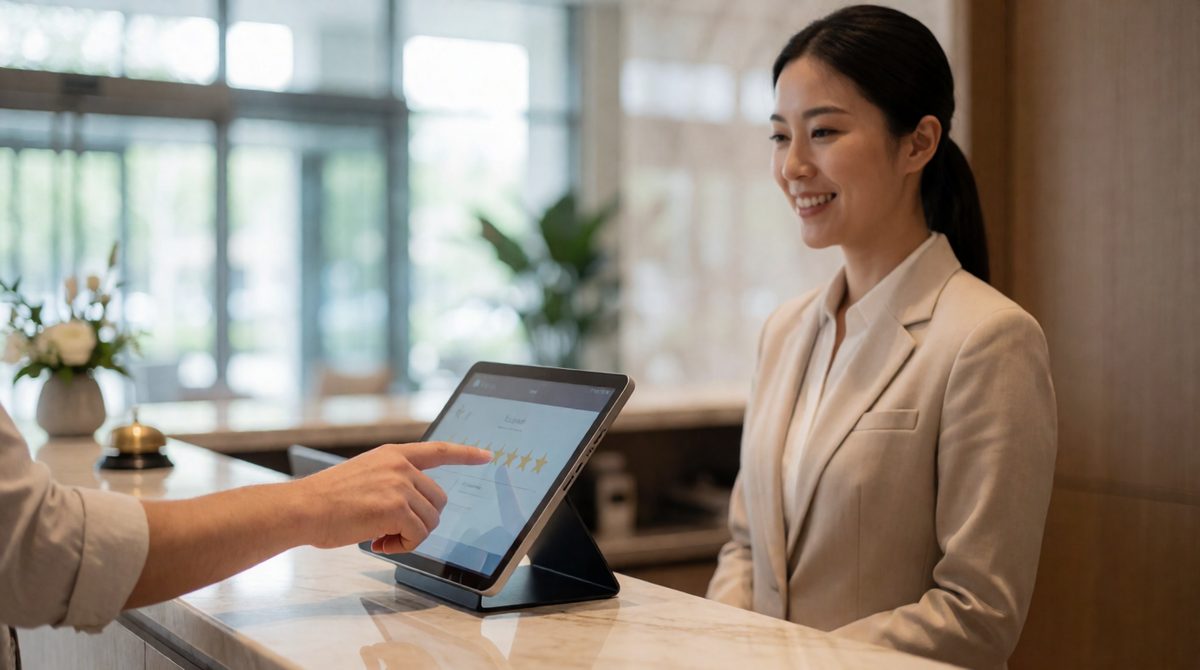
Customer feedback is gold: guests rating their stay helps hotels monitor reputation and improve
You can't manage your reputation if you don't know what people are saying. Monitoring methods are the tools and systems businesses use to collect feedback, spot problems early and measure how well they're doing. This information then feeds directly into marketing decisions.
📊 The Main Monitoring Methods
Different businesses use different methods depending on their size, budget and type of customer. Most successful travel businesses use a combination of several methods.
📋 Customer Surveys
Questionnaires given to customers during or after their experience. Can be paper-based (on a plane or in a hotel) or digital (email surveys after a stay). They collect structured data that's easy to analyse. Airlines like British Airways send post-flight surveys to frequent flyers.
⭐ Online Review Platforms
Sites like TripAdvisor, Google Reviews and Booking.com allow customers to leave public reviews. These are incredibly powerful studies show over 80% of travellers read reviews before booking. Businesses must monitor these platforms constantly and respond to both positive and negative feedback.
📱 Social Media Monitoring
Tracking mentions, comments and hashtags on platforms like Instagram, X (Twitter) and Facebook. Tools like Hootsuite or Sprout Social help businesses see what's being said in real time. A complaint going viral on social media can damage reputation within hours if not handled quickly.
👥 Mystery Shopping
A trained assessor poses as a normal customer to evaluate the service experience. They check things like staff friendliness, cleanliness, accuracy of information and response times. Mystery shopping gives businesses an honest, unbiased view of what customers actually experience. Hotel chains and travel agents commonly use this method. The results are used to improve training and service standards.
📄 Comment Cards and Feedback Forms
A traditional but still widely used method. Hotels place comment cards in rooms; tour operators include feedback forms in holiday packs. They're simple, low-cost and give customers an easy way to share opinions. The downside is that response rates can be low most people only fill them in if they had an exceptionally good or bad experience, which can skew the results.
🔍 Case Study: TripAdvisor and the Hotel Industry
TripAdvisor is one of the most influential monitoring and reputation platforms in travel. With over 1 billion reviews, it has transformed how hotels market themselves. A hotel that climbs into the top 10 on TripAdvisor for its area sees a significant increase in bookings often without spending anything extra on advertising. Hotels actively encourage guests to leave reviews, respond professionally to negative feedback and use their TripAdvisor ranking as a marketing tool. The "TripAdvisor Certificate of Excellence" is displayed by thousands of hotels worldwide as a trust signal. This shows how a monitoring platform has become a marketing tool in its own right.
🔗 How Monitoring Links to Marketing Decisions
Monitoring isn't just about spotting problems it directly shapes marketing strategy. Here's how the information collected feeds back into how a business markets itself:
- Identifying strengths to promote: If surveys consistently show customers love a hotel's breakfast, that becomes a feature in adverts and listings.
- Fixing weaknesses before they damage reputation: If reviews mention slow check-in, the business can fix the process before it becomes a PR problem.
- Targeting the right customers: Feedback data reveals who your happiest customers are, helping you target similar people in future campaigns.
- Measuring campaign effectiveness: After a marketing campaign, monitoring tools can show whether customer satisfaction or booking rates improved.
- Responding to trends: If customers start mentioning sustainability concerns, a business can adjust its marketing message to address this.
📈 Net Promoter Score (NPS)
One of the most widely used monitoring tools in the travel industry is the Net Promoter Score (NPS). It's based on a single question: "How likely are you to recommend us to a friend or family member?" Customers score from 0–10. Those scoring 9–10 are "Promoters," 7–8 are "Passives," and 0–6 are "Detractors." The NPS is calculated by subtracting the percentage of Detractors from the percentage of Promoters.
A high NPS means customers are likely to recommend the business which is essentially free marketing through word of mouth. Airlines, cruise companies and hotel chains all use NPS to benchmark their performance and track improvements over time. easyJet, for example, uses NPS data to monitor customer satisfaction across different routes and airports.
🔍 Case Study: Booking.com's Review System
Booking.com only allows guests who have actually completed a stay to leave a review making its scores highly reliable. Hotels are given a score out of 10 and this score appears prominently on every listing. Research shows that properties with scores above 8.0 receive significantly more bookings than those below. Booking.com also sends automated post-stay emails to every guest asking for a review, which means the volume of feedback is enormous. Hotels that actively respond to reviews both good and bad are seen more favourably by future customers. This system has made reputation management an essential daily task for hotel marketing teams.
⚠️ Managing Negative Reputation
No business gets it right every time. How a company responds to negative feedback is just as important as the feedback itself. A well-handled complaint can actually improve a customer's opinion of a business.
- Respond quickly: Slow responses to negative reviews suggest the business doesn't care. Most platforms show whether and how quickly businesses respond.
- Be professional and empathetic: Never argue with a customer publicly. Acknowledge the issue and offer to resolve it.
- Take action: If a complaint reveals a genuine problem, fix it and say so publicly. This shows other potential customers that the business takes quality seriously.
- Encourage positive reviews: Businesses can't delete bad reviews, but they can encourage satisfied customers to leave positive ones, which balances out the overall score.
🔍 Case Study: Premier Inn's Reputation Strategy
Premier Inn, the UK's largest hotel chain, has built its entire brand around a reputation for consistent, reliable quality at a fair price. The company uses a combination of post-stay email surveys, TripAdvisor monitoring and its own "Good Night Guarantee" (which promises a full refund if you don't sleep well) to manage and protect its reputation. Premier Inn responds to virtually every online review positive or negative which signals to potential customers that the company genuinely cares. This approach has helped Premier Inn consistently rank among the top UK hotel brands for customer satisfaction, reducing the need for heavy advertising spend because its reputation does much of the marketing work for it.
📚 Exam Tips & Key Points to Remember
- ✅ Reputation is a factor that affects marketing because it influences how much a business needs to spend and how effective its marketing will be.
- ✅ Industry awards act as third-party endorsements they're more trusted than a business's own claims because they come from an independent source.
- ✅ Know specific examples: Skytrax (airlines), Which? (tour operators), World Travel Awards (destinations and businesses), TripAdvisor (hotels).
- ✅ Monitoring methods include: customer surveys, online reviews, social media monitoring, mystery shopping, comment cards and NPS.
- ✅ Monitoring feeds back into marketing it's not just about spotting problems, it shapes future campaigns and messaging.
- ✅ In exam answers, always try to link the monitoring method or award to its impact on marketing don't just describe it, explain why it matters.
- ✅ Remember that a poor reputation increases marketing costs, while a strong reputation can reduce them this links reputation directly to the factor of cost.