€握; What Are Trade Promotions?
So far in this topic, you've looked at promotions aimed at customers things like TV adverts, social media campaigns and brochures. But there's a whole other side to promotion that most tourists never see. It's called trade promotion and it's aimed not at the public, but at other businesses in the tourism industry.
Think of it like this: a tour operator like TUI doesn't just need to convince you to book a holiday they also need to convince travel agents to recommend their holidays over a competitor's. That's where trade promotions come in.
Key Definitions:
- Trade Promotion: A marketing activity aimed at businesses within the tourism supply chain, rather than at the end consumer (the tourist).
- Trade Partner: Any business that helps sell or distribute a tourism product such as a travel agent, hotel booking platform, or airline.
- B2B Marketing: Business-to-Business marketing promoting products and services to other companies, not to the general public.
- Distribution Channel: The route a tourism product takes from the producer (e.g. a hotel) to the customer often involving travel agents or online booking platforms.
💡 Why Does This Matter for IGCSE?
The IGCSE Travel & Tourism syllabus expects you to understand the full promotional mix and trade promotions are a key part of it. Exam questions often ask you to explain how tourism businesses promote themselves to trade partners as well as to customers. Don't confuse the two!
👥 Who Are the Trade Partners in Tourism?
Before we look at the types of trade promotion, it helps to understand who tourism businesses are trying to reach. The tourism industry is made up of many interconnected businesses and they all rely on each other.
✈ Tour Operators
Companies like TUI or Jet2 package holidays together. They promote to travel agents to get their products recommended and sold.
📍 Travel Agents
High street or online agents like Trailfinders or On the Beach. They act as the link between tour operators and the customer.
🏢 Hotels & Resorts
Hotels promote themselves to tour operators, travel agents and online booking platforms to get their rooms included in packages or featured prominently.
🌎 National Tourism Organisations
Bodies like VisitBritain promote their destination to overseas travel agents and tour operators to encourage them to include the UK in their packages.
📱 Online Travel Agencies (OTAs)
Platforms like Booking.com or Expedia. Hotels and airlines promote to these platforms to secure better placement and visibility.
🚘 Transport Providers
Airlines, cruise lines and rail operators promote to tour operators and agents to get their services included in package deals.
🎉 Types of Trade Promotion
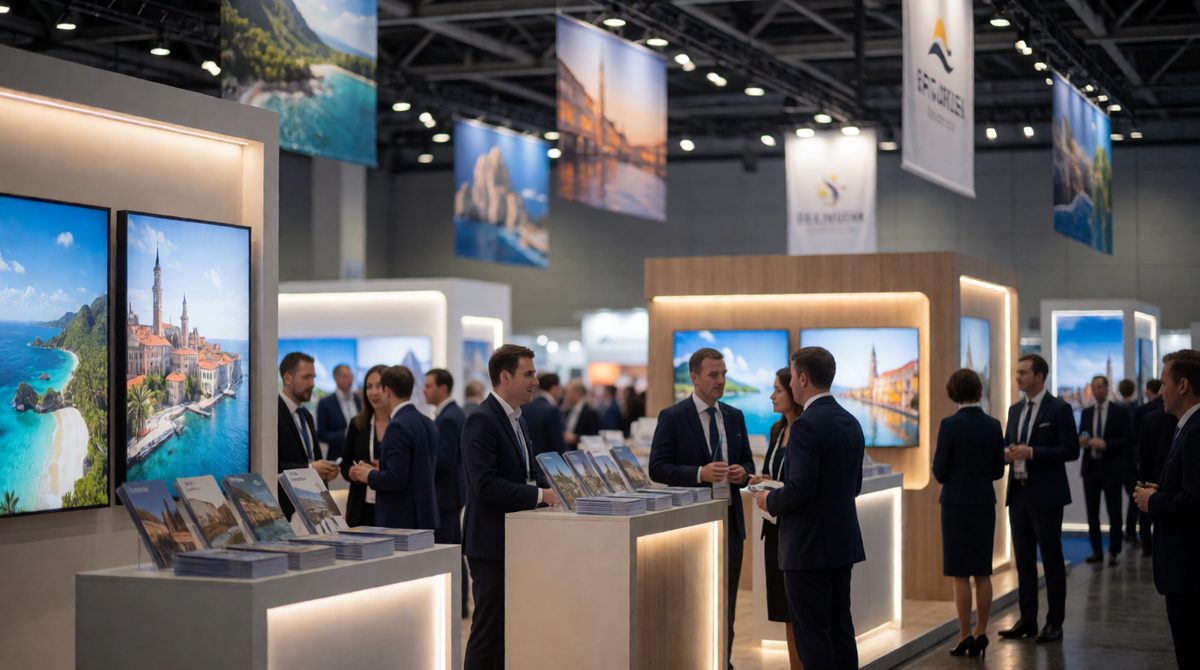
Trade promotions help sell tourism to businesses
There are several well-established methods that tourism businesses use to promote themselves to their trade partners. Each one works differently and suits different situations.
✈ 1. Familiarisation Trips (Fam Trips)
A familiarisation trip or "fam trip" is when a tourism business invites travel agents or tour operators to experience a destination or product for free (or at a heavily reduced cost). The idea is simple: if a travel agent has actually been to a resort, stayed in the hotel and eaten the food, they can sell it with genuine enthusiasm and confidence.
Fam trips are one of the most popular and effective trade promotion tools in the whole industry. They turn travel agents into brand ambassadors people who genuinely believe in what they're selling.
📋 Case Study: Emirates and Fam Trips to Dubai
Emirates airline regularly organises familiarisation trips for UK travel agents to Dubai. Agents are flown out in business class, taken on tours of Dubai's key attractions (the Burj Khalifa, desert safaris, luxury beach resorts) and given behind-the-scenes access to Emirates facilities. After the trip, agents are far more likely to recommend Emirates flights and Dubai holidays to their customers because they've experienced it themselves. Dubai Tourism reported that agents who completed fam trips sold significantly more Dubai packages in the following months compared to those who hadn't visited.
✅ Advantages of Fam Trips
- Agents sell with real knowledge and enthusiasm
- Builds strong personal relationships between businesses
- Agents can answer customer questions accurately
- Creates long-term loyalty to the brand or destination
- Word-of-mouth effect agents tell colleagues too
❌ Disadvantages of Fam Trips
- Very expensive to organise and host
- No guarantee agents will actually sell more
- Only reaches a small number of agents at a time
- Agents may enjoy the trip but still recommend competitors
- Difficult to measure return on investment (ROI)
🏫 2. Trade Fairs and Exhibitions
A trade fair is a large event where tourism businesses come together to meet, network and promote their products to each other. Unlike a consumer travel show (which is open to the public), trade fairs are exclusively for industry professionals. They are one of the most important ways that tourism businesses make new partnerships and deals.
At a trade fair, a hotel chain might have a stand where they showcase their properties to tour operators. A national tourism board might present a new destination campaign to travel agents from around the world. Airlines might negotiate new routes with travel companies. It's essentially a massive networking event for the whole industry.
📋 Case Study: World Travel Market (WTM), London
World Travel Market (WTM) is held every November at ExCeL London and is one of the biggest travel trade events in the world. In 2023, it attracted over 51,000 travel industry professionals from more than 182 countries. Countries, destinations, hotels, airlines and tourism organisations all pay for exhibition stands to promote themselves to potential trade partners. For example, the Jamaica Tourist Board uses WTM to meet UK tour operators and travel agents, show them new resort developments and negotiate deals to get Jamaica featured more prominently in UK holiday packages. WTM generates billions of pounds worth of business deals every year.
📋 Case Study: ITB Berlin
ITB Berlin (Internationale Tourismus-Börse) is another giant trade fair, held annually in Germany. It's considered the world's leading travel trade show, with around 100,000 visitors over five days. Tourism businesses from across the globe exhibit here to reach European tour operators and travel agents. It's especially important for destinations trying to break into the European market.
✅ Advantages of Trade Fairs
- Reach hundreds of trade partners in one place
- Build face-to-face relationships more personal than emails
- See what competitors are doing
- Generate media coverage and industry buzz
- Opportunity to launch new products or campaigns
❌ Disadvantages of Trade Fairs
- Very expensive stand costs, travel, staff time
- Only happens once or twice a year
- Crowded hard to stand out among thousands of exhibitors
- Results may take months to materialise
- Small businesses may struggle to afford participation
💰 3. Override Commissions and Incentive Schemes
One of the most direct ways to motivate travel agents to sell your product is to pay them more money for doing so. This is where override commissions and incentive schemes come in.
Key Definitions:
- Commission: A percentage of the sale price paid to a travel agent for booking a product on behalf of a customer. Standard commission in travel is typically 10–15%.
- Override Commission: An extra bonus commission paid to agents who sell above a certain target. For example, if an agent sells more than 50 TUI holidays in a month, they might receive an extra 3% on top of their standard commission.
- Incentive Scheme: A reward programme where agents earn prizes, bonuses or recognition for hitting sales targets. Prizes might include cash bonuses, free holidays, gift vouchers or trophies.
- Preferred Supplier: A tour operator or supplier that a travel agency officially recommends above others, often because of a special financial deal or incentive arrangement.
📋 Case Study: Thomas Cook's "Preferred Supplier" System
Before its collapse in 2019, Thomas Cook operated a preferred supplier system with independent travel agents. Agents who agreed to promote Thomas Cook holidays as their first recommendation received higher commission rates and access to exclusive deals. Thomas Cook also ran an annual "Agent Achievement Awards" programme, where top-selling agents won luxury holidays and cash prizes. This created strong loyalty among independent agents, who were financially motivated to recommend Thomas Cook over rivals like TUI or First Choice.
✅ Advantages of Override Commissions
- Directly motivates agents to prioritise your product
- Measurable easy to track sales increases
- Creates loyalty and preferred supplier relationships
- Can be targeted at specific agents or regions
❌ Disadvantages of Override Commissions
- Expensive reduces profit margins
- Agents may recommend your product even when it's not the best fit for the customer
- Competitors can simply offer higher commissions
- Can create ethical concerns about biased advice
📚 4. Trade Publications and Press
Just as consumers read travel magazines and newspaper travel supplements, people working in the tourism industry read their own specialist trade publications. Advertising in these publications is a key way to reach travel professionals.
Key trade publications in UK travel and tourism include:
- Travel Trade Gazette (TTG): One of the UK's oldest and most respected travel trade magazines, read by thousands of travel agents and tour operators.
- Travel Weekly: Another major UK trade publication covering industry news, new products and promotional features.
- Travelmole: An online trade news platform widely read by travel professionals.
- Caterer & Hotelkeeper: Aimed at hospitality professionals in hotels and restaurants.
Tourism businesses advertise new destinations, products, commission rates and special deals in these publications to reach agents and operators who might not attend trade fairs or be on their email lists.
👥 5. Sales Representatives and Trade Visits
Many larger tourism businesses employ dedicated sales representatives (reps) whose job is to visit travel agencies in person, build relationships and promote their products. This is sometimes called "road selling" or making trade calls.
A sales rep from a cruise company like P&O Cruises might visit 10–15 travel agencies in a region each week, dropping off brochures, explaining new itineraries, answering questions and sometimes bringing gifts or incentives. This personal, face-to-face approach builds trust and keeps the company's products front-of-mind for agents.
📋 Case Study: ABTA and Trade Support
ABTA (the Association of British Travel Agents) plays an important role in supporting trade relationships across the UK travel industry. ABTA runs regular training events, webinars and roadshows for travel agents, helping them learn about new destinations and products. Tourism boards and tour operators sponsor these events as a form of trade promotion by funding an ABTA training session on, say, Caribbean holidays, a destination board ensures that hundreds of agents across the UK learn about their destination in a positive, professional context. ABTA also publishes trade resources and hosts the annual ABTA Travel Convention, a major networking event for the industry.
🎓 6. Training and Educational Programmes
Another powerful form of trade promotion is offering free training to travel agents. If agents are trained and certified in selling your destination or product, they become far more effective at recommending it and they feel a sense of loyalty to the brand that trained them.
🌎 Destination Training
National tourism organisations like Tourism Australia run the "Aussie Specialist" programme a free online training course for travel agents. Agents who complete it earn a badge and access to exclusive deals.
✈ Airline Training
Emirates runs the "Emirates Airline Travel Agent Academy" an online training portal where agents learn about routes, cabin classes and booking systems. Trained agents are more confident selling Emirates.
🚢 Cruise Line Training
Royal Caribbean runs "Cruising for Excellence" a training programme for travel agents. Agents who complete it become "Certified Cruise Counsellors" and receive priority support and higher commission rates.
📈 Trade Promotions vs Consumer Promotions
It's really important for your exam that you can clearly tell the difference between trade promotions and consumer promotions. Here's a clear comparison:
👥 Trade Promotions
- Aimed at: Travel agents, tour operators, hotels, transport providers
- Goal: Get trade partners to sell or recommend your product
- Examples: Fam trips, trade fairs, override commissions, trade press advertising, sales reps
- Seen by: Industry professionals only
- Relationship: B2B (Business to Business)
👤 Consumer Promotions
- Aimed at: The general public tourists and travellers
- Goal: Persuade customers to buy your product directly
- Examples: TV adverts, social media, brochures, early booking discounts, loyalty schemes
- Seen by: The general public
- Relationship: B2C (Business to Consumer)
💡 Exam Tip: Use Both Sides
In the exam, if you're asked how a tourism business promotes itself, don't just write about TV adverts and social media. Mention trade promotions too fam trips, trade fairs, commission incentives. This shows the examiner you understand the full promotional mix and will earn you higher marks. A really strong answer will explain why a business might choose a trade promotion over a consumer promotion in a specific situation.
⚖ Evaluating Trade Promotions
Like any marketing activity, trade promotions have both strengths and weaknesses. The best approach for a tourism business is to use a mix of trade and consumer promotions together.
✅ Overall Advantages of Trade Promotions
- Targeted: Reaches the exact professionals who influence purchasing decisions
- Cost-effective reach: One travel agent who recommends your product can influence hundreds of customers
- Builds relationships: Long-term partnerships are more stable than one-off advertising campaigns
- Expertise: Trained agents sell more effectively and handle customer queries better
- Competitive advantage: Preferred supplier status can lock out competitors
❌ Overall Disadvantages of Trade Promotions
- Expensive: Fam trips, trade fairs and commission schemes all cost significant money
- Indirect: You're relying on a third party to sell your product you lose some control
- Hard to measure: It's difficult to prove that a fam trip directly caused a sales increase
- Ethical concerns: Override commissions may lead agents to recommend products that aren't best for the customer
- Less relevant for direct booking: As more tourists book directly online, the role of travel agents (and therefore trade promotions) is declining
📋 Case Study: VisitBritain and Trade Promotions
VisitBritain is the national tourism organisation responsible for promoting the UK to international visitors. A huge part of their work is trade promotion convincing overseas tour operators and travel agents to include UK destinations in their packages. VisitBritain attends trade fairs like WTM London and ITB Berlin every year. They run fam trips for overseas agents, bringing groups of American, Chinese and Australian travel professionals to the UK to experience destinations like London, Edinburgh, the Lake District and Wales. They also provide free training resources and marketing materials to overseas agents. In 2022, VisitBritain worked with over 500 overseas trade partners to promote the UK, generating an estimated £1.4 billion in visitor spending.
🌎 The Changing Role of Trade Promotions
It's worth noting that the travel industry has changed dramatically in the last 20 years. The rise of online booking platforms like Booking.com, Expedia and Airbnb means that more tourists than ever are booking directly, without going through a travel agent. This has reduced the importance of some traditional trade promotions.
However, trade promotions haven't disappeared they've evolved. Today, tourism businesses also need to promote themselves to online travel agencies (OTAs) and metasearch engines like Google Hotels and Trivago. Getting featured prominently on these platforms is a modern form of trade promotion.
For complex or luxury travel long-haul trips, cruises, adventure holidays many customers still prefer to use a specialist travel agent. This means fam trips, trade training and commission incentives remain highly relevant for these sectors.
💡 Key Exam Vocabulary
Make sure you can use these terms correctly in your exam answers:
- Familiarisation trip (fam trip) free or subsidised trip for trade partners
- Trade fair / exhibition industry event for B2B networking and promotion
- Override commission bonus payment for exceeding sales targets
- Preferred supplier a supplier given priority recommendation status
- Trade publication specialist magazine or website for industry professionals
- B2B marketing business-to-business promotion
- Distribution channel the route from producer to consumer
- Sales representative person who visits trade partners to promote products in person
📚 Summary: Key Points to Remember
- Trade promotions target other businesses in the tourism supply chain, not the end consumer
- The main types are: fam trips, trade fairs, override commissions, trade press, sales reps and training programmes
- Fam trips are one of the most effective tools agents who experience a product sell it with genuine enthusiasm
- World Travel Market and ITB Berlin are the world's leading travel trade fairs
- Override commissions motivate agents to prioritise your product, but can raise ethical concerns
- Trade promotions are B2B; consumer promotions are B2C know the difference!
- The rise of online booking has changed trade promotions, but they remain vital for complex, luxury and specialist travel
- VisitBritain is a great example of an organisation that uses trade promotions extensively to reach international markets