🏝 Resort Destinations: An Overview
Resort destinations are places specifically designed or heavily adapted to attract tourists and give them everything they need in one place. Unlike cities or rural areas where tourism is just one part of life, resorts are built around tourism. In this session, we look at four specific types: purpose-built, integrated, ski and eco-resorts.
Each type has its own character, appeal and set of challenges. Understanding the differences between them is essential for your iGCSE exam.
Key Definitions:
- Purpose-built resort: A destination created from scratch specifically for tourism, often with little or no prior settlement.
- Integrated resort: A large, self-contained complex offering accommodation, entertainment, shopping, dining and sometimes casinos all on one site.
- Ski resort: A destination in a mountainous area developed to allow visitors to ski, snowboard and enjoy winter sports.
- Eco-resort: A resort designed with minimal environmental impact, often located in or near natural areas, promoting conservation and responsible tourism.
🏗 Purpose-Built Resorts
Purpose-built resorts are planned and constructed specifically for tourism. They are usually built in areas that previously had little or no development sometimes in remote coastal or desert locations. The entire infrastructure (roads, hotels, entertainment, utilities) is created to serve tourists.
✅ Key Features
- Planned from scratch not an organic, natural growth
- High concentration of hotels, restaurants and attractions
- Often dominated by large hotel chains or tour operators
- Infrastructure built purely to support tourism
- Can feel artificial or disconnected from local culture
📍 Where Are They Found?
- Coastal areas with warm climates (e.g. Caribbean, Red Sea)
- Desert regions (e.g. Dubai, Egypt)
- Tropical islands developed for mass tourism
- Areas with good air access and attractive natural features
📍 Case Study: Cancún, Mexico
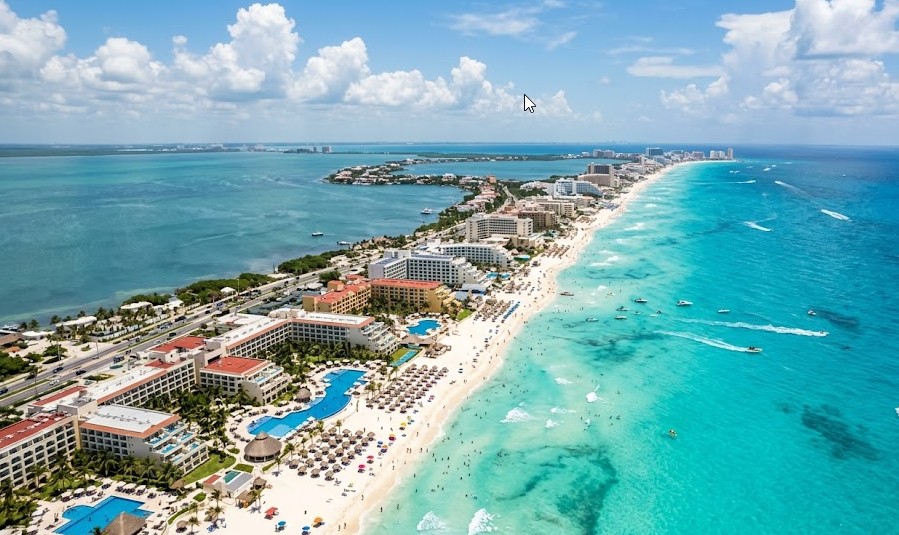
Cancún is one of the world's most famous purpose-built resorts. In 1970, it was little more than a narrow sandbar on the Caribbean coast of Mexico with a tiny fishing village. The Mexican government, working with the World Bank, identified it as the perfect location for a major tourist resort due to its white sand beaches, turquoise sea and warm climate.
By the 1980s, the "Hotel Zone" (Zona Hotelera) had been constructed a 14-mile strip of international hotels, shopping malls, nightclubs and restaurants built on the sandbar. Today, Cancún receives over 6 million tourists per year and is Mexico's top tourist earner.
📈 Economic Positives
Massive job creation, foreign currency earnings, improved infrastructure and economic development in the Yucatán region.
⚠️ Social Issues
Local Maya communities saw little benefit. Workers often live in poor conditions away from the Hotel Zone. Cultural identity has been diluted.
🌿 Environmental Issues
Coral reef damage, mangrove destruction, coastal erosion and pollution of the Caribbean Sea have all been recorded.
💡 Exam Tip: Purpose-Built vs Organic Growth
In the exam, you may be asked to compare purpose-built resorts with destinations that grew organically (like Blackpool or Barcelona). Remember: purpose-built resorts are planned, often lack authentic local culture and can suffer from economic leakage where profits go to foreign companies rather than local people.
🏛 Integrated Resorts
An integrated resort (IR) is a massive, self-contained complex where tourists can eat, sleep, shop, be entertained and relax all without leaving the site. They are sometimes called "mega-resorts" and often include casinos, convention centres, theme parks and luxury retail. The idea is that guests spend all their money within the resort.
Integrated resorts are a relatively modern concept, pioneered in Las Vegas and later developed across Asia, particularly in Singapore and Macau. They are controversial because, while they generate huge revenue, they can also encourage gambling addiction and create enclaves that are cut off from the local community.
🏢 What's Inside an Integrated Resort?
- Multiple luxury hotels (often thousands of rooms)
- Casino gaming floors
- Convention and exhibition centres (MICE tourism)
- High-end retail and designer shops
- Multiple restaurants and celebrity chef venues
- Entertainment venues, shows and theme parks
- Spas, pools and wellness facilities
💰 Why Are They Built?
- Governments use them to attract high-spending tourists
- They generate enormous tax revenues
- They create thousands of jobs
- They can transform a city's global image
- They attract business travellers and conferences (MICE)
📍 Case Study: Marina Bay Sands, Singapore
Marina Bay Sands (MBS) opened in 2010 and is one of the most iconic integrated resorts in the world. Built by Las Vegas Sands Corporation at a cost of US$8 billion, it transformed Singapore's skyline and tourism industry overnight.
The resort sits on reclaimed land in Marina Bay and features three 55-storey hotel towers connected by a famous rooftop "SkyPark" with an infinity pool. It includes a casino, the ArtScience Museum, a 2,500-seat theatre, a convention centre and over 300 shops and 80 restaurants.
📈 Tourism Impact
Singapore's tourist arrivals jumped from 9.7 million (2009) to over 15 million (2013) after MBS opened. It helped position Singapore as a top global destination.
💰 Economic Impact
MBS contributes billions to Singapore's GDP. The casino alone generates more revenue than the entire Las Vegas Strip. It employs over 10,000 people directly.
⚠️ Social Concerns
Problem gambling is a serious concern. Singapore introduced entry levies for local residents to discourage addiction. Critics argue the resort creates inequality.
🌎 Other Famous Integrated Resorts
The Venetian, Macau: The world's largest casino resort, modelled on Venice, Italy. Macau overtook Las Vegas as the world's top gambling destination in 2006.
Atlantis Paradise Island, Bahamas: A Caribbean integrated resort featuring a water park, marine habitat, casino and multiple hotels all on one island.
Resorts World Sentosa, Singapore: MBS's competitor on Sentosa Island, featuring Universal Studios Singapore, a marine life park and a casino.
⛳️ Ski Resorts
Ski resorts are destinations built in mountainous areas to allow visitors to enjoy winter sports primarily skiing and snowboarding. They depend entirely on snow (natural or artificial) and are therefore highly seasonal. Most ski resorts are found in the Alps (Europe), the Rockies (North America) and increasingly in Asia.
Ski resorts are a great example of how tourism can transform a remote, economically marginal area. Many Alpine villages that were once poor farming communities are now thriving international resorts. However, they also face serious challenges from climate change.
🏔 Key Features of Ski Resorts
- Ski lifts and gondolas to carry skiers up the mountain
- Pistes (ski runs) graded by difficulty (green, blue, red, black)
- Ski hire and ski schools for beginners and equipment rental
- Après-ski the social scene after skiing (bars, restaurants, spas)
- Accommodation from budget chalets to luxury hotels
- Snow-making machines used when natural snowfall is insufficient
📍 Case Study: Val d'Isère, France
Val d'Isère is one of Europe's most prestigious ski resorts, located in the French Alps at an altitude of 1,850 metres. It sits within the Espace Killy ski area, which it shares with neighbouring Tignes, offering over 300km of pistes. The resort hosted the 1992 Winter Olympics alpine events.
Val d'Isère attracts wealthy skiers from across Europe and beyond, with luxury chalets, Michelin-starred restaurants and high-end ski brands. The season runs from late November to early May, thanks to its high altitude.
📈 Economic Benefits
Tourism supports virtually the entire local economy. The village earns the majority of its annual income during the ski season. Property values are among the highest in France.
🌿 Environmental Issues
Deforestation for piste creation, soil erosion, water use for snow cannons and increased carbon emissions from flights and road traffic are all significant concerns.
🌡️ Climate Change Threat
Warmer winters mean less natural snow. Lower-altitude resorts are already struggling. Val d'Isère invests heavily in artificial snow-making, but this uses vast amounts of water and energy.
🌡️ Climate Change and the Future of Ski Resorts
This is a major exam topic. Studies suggest that by 2100, up to 70% of Alpine ski resorts could have insufficient natural snow to operate without artificial snowmaking. Lower-altitude resorts like those in Austria and Germany are most at risk. Some resorts are diversifying into year-round mountain tourism hiking, mountain biking and wellness to reduce their dependence on snow.
🏔 Ski Resort Seasonality
One of the biggest challenges for ski resorts is seasonality the fact that most income is earned in just a few winter months. This creates problems:
- Workers are employed seasonally and may struggle in summer
- Infrastructure (hotels, lifts) sits idle for months
- Local businesses face cash flow problems
- Investment in year-round facilities is expensive
Many ski resorts are now investing in summer tourism to extend their season. Activities like mountain biking, hiking, paragliding and summer luge runs are being promoted to attract visitors outside the ski season.
🌿 Eco-Resorts
Eco-resorts (also called eco-lodges) are a fast-growing type of resort destination. They are designed to have the lowest possible environmental impact while giving guests an authentic experience of nature. They are typically found in or near areas of outstanding natural beauty rainforests, wildlife reserves, coral reefs and remote wilderness areas.
Eco-resorts are part of the broader movement of ecotourism, which aims to conserve natural environments, support local communities and educate visitors. They are popular with a growing segment of tourists who are concerned about the environmental impact of their travel.
🌎 Key Principles of Eco-Resorts
- Minimal environmental footprint in construction and operation
- Use of renewable energy (solar, wind, hydro)
- Water conservation and recycling
- Use of local, sustainable building materials
- Employment and empowerment of local communities
- Education of guests about local ecosystems
- Active contribution to conservation projects
🔍 What Makes a True Eco-Resort?
Not every resort that calls itself "eco" really is one. Greenwashing is a real problem where resorts use eco-friendly marketing without making genuine changes. A genuine eco-resort should have third-party certification (e.g. from Rainforest Alliance or Green Globe) and be able to demonstrate measurable environmental and social benefits.
📍 Case Study: Lapa Rios Eco Lodge, Costa Rica
Lapa Rios is widely considered one of the world's best eco-resorts. It is located on the Osa Peninsula in southern Costa Rica, within a 1,000-acre private nature reserve of lowland tropical rainforest one of the most biodiverse places on Earth.
The lodge was built in 1993 by American couple John and Karen Lewis, who purchased the land specifically to protect it from logging and agricultural clearance. The resort has just 17 bungalows, all built from sustainably harvested local timber and designed to blend into the forest canopy.
⚡ Energy and Water
The resort runs on hydroelectric power generated on-site. Rainwater is collected and recycled. No single-use plastics are used. Food waste is composted.
👪 Community Benefits
Over 95% of staff are from the local village of Puerto Jiménez. The resort funds a local school and supports community health programmes. Local guides lead all wildlife tours.
🐸 Conservation
The private reserve protects scarlet macaws, tapirs, jaguars and over 300 bird species. Guests participate in wildlife monitoring. The resort has won multiple international sustainability awards.
🌎 Eco-Tourism in Costa Rica
Costa Rica is a global leader in eco-tourism. Despite being a small country, it contains 5% of the world's biodiversity. The government has protected over 25% of its land as national parks and reserves. Eco-tourism now earns Costa Rica more foreign currency than its traditional exports of bananas and coffee. This shows how eco-resorts can drive national economic development while protecting the environment.
📍 Case Study: Six Senses Zil Pasyon, Seychelles
For a contrast with Lapa Rios, Six Senses Zil Pasyon shows how luxury and sustainability can coexist. Located on the private island of Félicité in the Seychelles, this ultra-luxury eco-resort has just 30 villas, each with a private pool and butler service.
Despite its luxury positioning, Six Senses has serious environmental credentials: solar panels provide a significant portion of energy, a coral restoration programme actively rebuilds damaged reef and a resident marine biologist monitors the ecosystem. Guests can participate in conservation activities as part of their stay.
This case study illustrates the concept of high-value, low-volume tourism charging premium prices to a small number of visitors, thereby generating income while minimising environmental damage.
📊 Comparing the Four Resort Types
It is important to be able to compare these four resort types in the exam. The table below summarises the key differences:
🏗 Purpose-Built
Location: Coastal/desert
Scale: Large to very large
Visitors: Mass market
Example: Cancún, Mexico
Key issue: Economic leakage, cultural loss
🏛 Integrated
Location: Urban/coastal
Scale: Mega-scale
Visitors: High-spending, business
Example: Marina Bay Sands
Key issue: Gambling, social inequality
⛳️ Ski
Location: Mountain
Scale: Medium to large
Visitors: Affluent, seasonal
Example: Val d'Isère, France
Key issue: Seasonality, climate change
🌿 Eco-Resort Summary
Location: Remote natural areas | Scale: Small, low-density | Visitors: Environmentally aware, often affluent | Example: Lapa Rios, Costa Rica | Key issue: Greenwashing, accessibility, high cost
⚠️ Impacts and Sustainability Issues
🏗 Purpose-Built Resorts: Sustainability Challenges
Purpose-built resorts often suffer from economic leakage a major exam concept. This is where money spent by tourists flows out of the local economy to foreign-owned companies (hotel chains, airlines, tour operators). In some all-inclusive Caribbean resorts, studies suggest that as little as 20 cents in every dollar spent actually stays in the local economy.
Other sustainability issues include: overdependence on tourism (if visitor numbers drop, the whole economy suffers), cultural homogenisation (local culture is replaced by a generic tourist experience) and environmental degradation from construction and overuse.
⛳️ Ski Resorts: The Climate Change Crisis
Climate change is the single biggest long-term threat to ski resorts. The Alps have warmed by 2°C since 1900 twice the global average. Snow seasons are getting shorter and the snowline is rising. Resorts below 1,500m are already struggling to operate. Artificial snowmaking can help, but it uses enormous quantities of water (a typical ski resort may use millions of litres per day) and energy, which itself contributes to carbon emissions.
Some resorts are responding by diversifying: Verbier in Switzerland now markets itself as a year-round mountain destination. Others are investing in glacier protection covering glaciers with reflective blankets in summer to slow melting.
💡 Key Exam Concept: Economic Leakage
Economic leakage occurs when tourist spending leaves the local economy. It is particularly common in purpose-built resorts and all-inclusive hotels owned by multinational companies. To reduce leakage, destinations should: employ local staff, source food and materials locally, encourage locally owned businesses and develop community-based tourism enterprises.
📚 Key Vocabulary Revision
📚 Resort Terms
- Purpose-built resort built from scratch for tourism
- Integrated resort self-contained mega-complex
- Ski resort mountain winter sports destination
- Eco-resort low-impact, nature-based resort
💰 Economic Terms
- Economic leakage money leaving the local economy
- Seasonality uneven visitor numbers across the year
- Diversification developing new products to spread risk
- MICE tourism meetings, incentives, conferences, exhibitions
🌿 Sustainability Terms
- Greenwashing false eco-friendly marketing
- Ecotourism responsible travel to natural areas
- High-value, low-volume fewer tourists paying more
- Carbon footprint total greenhouse gas emissions
✅ Exam Technique: Resort Destination Questions
For "describe" questions: Give specific named examples and data. Don't just say "a ski resort" say "Val d'Isère in the French Alps."
For "explain" questions: Use connective words "because," "therefore," "this means that" to show cause and effect.
For "evaluate" questions: Always give both sides. For example, integrated resorts bring economic benefits BUT also cause social problems such as gambling addiction.
Top tip: Learn one detailed case study for each resort type. Examiners reward specific knowledge.