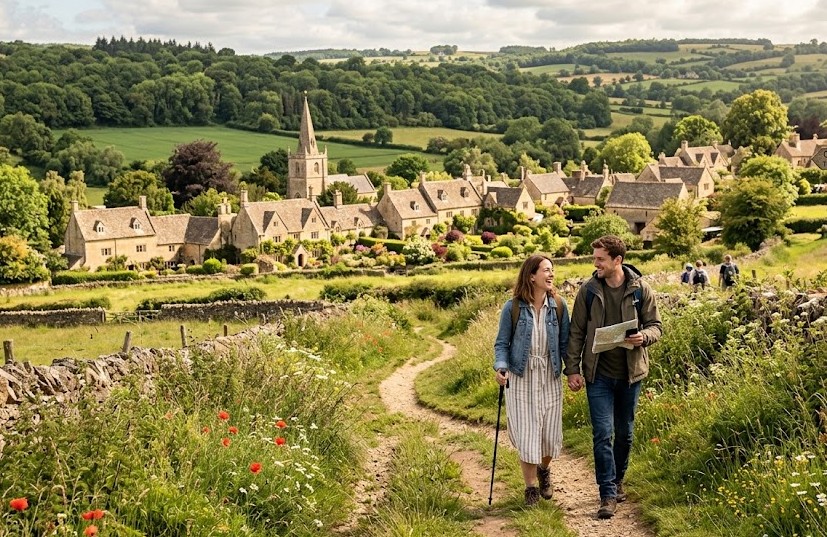
🌿 Rural Destinations: Countryside, Mountains and Lakes
Rural destinations are areas away from towns and cities where the natural landscape is the main attraction. They include rolling farmland, ancient forests, dramatic mountain ranges and peaceful lakeshores. For millions of tourists, these places offer something that cities simply cannot space, quiet and a genuine connection with nature.
Rural tourism has grown rapidly since the 1990s. People living in busy urban areas increasingly seek what geographers call a rural idyll a romanticised idea of the countryside as peaceful, clean and unspoilt. This desire drives huge visitor numbers to countryside, mountain and lake destinations worldwide.
Key Definitions:
- Rural destination: A tourism location characterised by low population density, natural landscapes and limited urban development.
- Rural idyll: An idealised image of the countryside as a perfect, peaceful escape from modern life.
- Carrying capacity: The maximum number of visitors a destination can handle before damage occurs to the environment, local community, or visitor experience.
- Agritourism: Tourism based around farms and agricultural activities, such as fruit picking, farm stays, or cheese-making tours.
- Wilderness tourism: Travel to remote, largely untouched natural areas for adventure or contemplation.
🏠 The Countryside as a Destination
Countryside destinations are typically characterised by farmland, villages, hedgerows, woodland and open fields. They attract tourists who want walking, cycling, wildlife watching and a slower pace of life. The appeal is often about authenticity experiencing local food, traditional architecture and rural culture.
😊 Why Tourists Love the Countryside
- Escape from urban stress and noise pollution
- Opportunities for walking, cycling and horse riding
- Wildlife watching birds, deer, foxes, wildflowers
- Local food and drink experiences (farm shops, country pubs)
- Historic villages, churches and stately homes
- Photography and painting scenic landscapes
- Family-friendly activities such as pick-your-own farms
⚠️ Challenges Countryside Tourism Creates
- Footpath erosion from heavy walker traffic
- Litter and fly-tipping in beauty spots
- Traffic congestion on narrow country lanes
- Second home ownership pricing out locals
- Noise disturbance to wildlife during breeding seasons
- Seasonal employment jobs only in summer months
- Pressure on small village infrastructure (car parks, toilets)
📍 Case Study: The Cotswolds, England
The Cotswolds is an Area of Outstanding Natural Beauty (AONB) covering parts of Gloucestershire, Oxfordshire and Wiltshire. It is one of England's most visited rural destinations, attracting around 38 million visitors per year and generating over £3 billion for the local economy.
The area is famous for its honey-coloured limestone villages such as Bourton-on-the-Water, Bibury and Chipping Campden. Tourists come for walking the Cotswold Way (a 164 km long-distance trail), visiting gardens, antique shops and traditional pubs.
🟢 Economic Benefits
Tourism supports thousands of local jobs in hospitality, retail and transport. Farm shops and local producers benefit directly from visitor spending. The Cotswolds brand attracts premium visitors willing to spend more per day than average UK tourists.
🔴 Environmental Problems
Bibury's Arlington Row a famous row of weavers' cottages now suffers from severe overcrowding. Visitors park illegally, trample verges and disturb residents. Some villages have introduced voluntary visitor codes and parking charges to manage pressure.
🏠 Social Tensions
House prices in Cotswolds villages are among the highest in rural England. Second homes and holiday lets have reduced the availability of affordable housing for local people. Some villages have lost their schools, post offices and shops as permanent populations shrink.
💡 Exam Tip: AONB vs National Park
Students often confuse these two designations. A National Park has the highest level of landscape protection and its own planning authority (e.g. the Peak District). An AONB protects landscape quality but has less strict planning controls and no dedicated authority. Both attract significant tourism. In exam questions, make sure you use the correct term for the correct location.
⛰️ Mountain Destinations
Mountain destinations are among the world's most dramatic and visited landscapes. They attract tourists year-round in winter for snow sports and in summer for hiking, climbing and scenery. Mountains cover about 27% of the Earth's land surface and are home to some of the most iconic tourism destinations on the planet.
Mountain tourism is not just about skiing. It includes trekking to base camps, cable car rides for non-active visitors, mountain biking, paragliding, wildlife safaris at altitude and cultural tourism in mountain communities.
🏔 What Makes Mountains Attractive to Tourists?
❄️ Winter Appeal
Skiing, snowboarding, snowshoeing and ice climbing. Mountain villages become busy resorts with après-ski culture. Reliable snowfall is essential a key vulnerability as the climate changes.
🌿 Summer Appeal
Hiking and trekking on marked trails, mountain biking on downhill tracks, wildlife watching (eagles, ibex, marmots), wildflower meadows and cooler temperatures that attract visitors escaping summer heat in lowland cities.
🏭 Cultural Appeal
Traditional mountain communities with distinct architecture, food, music and festivals. Alpine chalets, Himalayan monasteries and Andean markets all draw tourists interested in authentic cultural experiences beyond the landscape itself.
📍 Case Study: The Swiss Alps
Switzerland's Alps are one of the world's most developed and visited mountain tourism regions. Resorts such as Zermatt, Verbier, Interlaken and Grindelwald attract millions of visitors annually. Switzerland earns approximately CHF 16 billion (around £14 billion) from tourism each year, with mountain tourism forming the backbone of this income.
Zermatt is particularly notable. It sits at 1,620 metres altitude at the foot of the Matterhorn one of the most photographed mountains in the world. The town is car-free (only electric vehicles are permitted), which reduces air pollution and noise. It has over 360 km of ski runs and attracts visitors in both winter and summer.
📈 Economic Importance
- Tourism employs over 170,000 people in Swiss mountain regions
- Zermatt alone has over 120 hotels and 1,500 holiday apartments
- Summer hiking tourism now rivals winter ski revenue in many resorts
- High-spending visitors Switzerland is a premium destination
- Infrastructure investment (cable cars, tunnels, railways) funded partly by tourism taxes
🌡️ Climate Change Threat
- Alpine glaciers have lost over 60% of their volume since 1850
- The Rhône Glacier is now covered in white fleece blankets to slow melting
- Snow-reliable ski seasons are shortening lower resorts most at risk
- Artificial snowmaking uses enormous amounts of water and energy
- Some resorts are diversifying into year-round adventure tourism to reduce dependence on snow
📌 Did You Know? The Glacier Express
The Glacier Express is a famous scenic train journey through the Swiss Alps, running between Zermatt and St Moritz. It passes through 91 tunnels and over 291 bridges in around 8 hours. It is marketed as "the world's slowest express train" and is itself a major tourist attraction, demonstrating how transport infrastructure can become part of the tourism product in mountain destinations.
🏔 Mountain Tourism and the Environment
Mountains are beautiful but fragile. The thin soils, steep slopes and sensitive ecosystems mean that tourism can cause serious damage if not carefully managed.
🔴 Negative Environmental Impacts
- Soil erosion: Heavy foot traffic on mountain paths strips vegetation and causes gullying
- Deforestation: Trees cleared for ski runs and resort construction
- Water pollution: Ski resort chemicals (snowmaking additives, de-icers) enter streams
- Wildlife disturbance: Noise from helicopters and snowmobiles disturbs nesting birds and hibernating animals
- Waste: Litter left on popular trails, including on Everest base camp routes
🟢 Positive Management Strategies
- Designated paths: Channelling walkers onto reinforced trails to protect surrounding vegetation
- Visitor limits: Some peaks (e.g. Mount Fuji, Japan) now charge entry fees and cap daily visitor numbers
- Reforestation schemes: Planting native trees on degraded slopes
- Eco-certification: Resorts awarded green labels for sustainable practices
- Leave No Trace campaigns: Educating visitors about responsible behaviour
📍 Case Study Focus: Mount Fuji, Japan
Mount Fuji (3,776 m) is Japan's highest peak and a UNESCO World Heritage Site. It attracts around 300,000 climbers per year during the official climbing season (July–September). By 2024, the Yamanashi prefecture introduced a gate on the Yoshida Trail the most popular route that closes at 4pm and reopens at 3am, along with a daily cap of 4,000 climbers and a ¥2,000 (approximately £10) fee per climber. This is a direct response to "overtourism" causing litter, erosion and dangerous overcrowding. It is an excellent example of hard visitor management in a mountain destination.
🗻 Lake Destinations
Lakes offer a distinctive type of rural tourism that combines water-based activities with scenic landscapes. They can be found in mountain regions (glacial lakes), lowland areas (rift valley lakes) and volcanic regions (crater lakes). Each type has its own character and tourism appeal.
Key types of lake:
- Glacial lakes: Formed by glacial erosion or meltwater dams e.g. Lake Windermere (UK), Lake Geneva (Switzerland/France)
- Tectonic/rift valley lakes: Formed by faulting in the Earth's crust e.g. Lake Tanganyika (East Africa), Lake Baikal (Russia)
- Crater lakes: Formed in volcanic craters e.g. Crater Lake, Oregon (USA)
- Reservoir lakes: Man-made lakes created by damming rivers e.g. Lake Kariba (Zimbabwe/Zambia)
💧 What Do Lake Destinations Offer Tourists?
Lakes are incredibly versatile tourism environments. They attract a wide range of visitor types from families on holiday to serious adventure sports enthusiasts to wildlife photographers.
🌄 Water Activities
Swimming, sailing, kayaking, canoeing, windsurfing, paddleboarding, fishing and white-water rafting on rivers flowing from lakes. Some lakes (e.g. Lake Windermere) have speed restrictions to protect wildlife and other users.
📷 Scenic and Passive Tourism
Boat cruises, lakeside walking, photography, painting and simply relaxing by the water. Many lake destinations have historic towns and villages on their shores that add cultural interest to the natural scenery.
🐾 Wildlife and Nature
Lakes support rich biodiversity otters, ospreys, rare fish species and aquatic plants. Wildlife watching and nature trails are increasingly important tourism products, especially for eco-conscious visitors.
📍 Case Study: Plitvice Lakes National Park, Croatia
Plitvice Lakes is Croatia's oldest and largest national park, designated a UNESCO World Heritage Site in 1979. It consists of 16 terraced lakes connected by waterfalls, set within a forested limestone canyon. The lakes are famous for their extraordinary turquoise and emerald colours, caused by minerals, algae and bacteria in the water.
Visitor numbers grew from around 900,000 per year in the early 2000s to over 1.6 million per year by 2019 a figure that caused serious management concerns. The park has a strict set of rules: visitors must stay on wooden boardwalks, swimming is completely banned and pets are not permitted. Entry is timed and ticketed to spread visitor flow throughout the day.
🟢 What the Park Does Well
- Timed entry tickets prevent overcrowding at peak times
- Electric boats and buses reduce carbon emissions within the park
- Boardwalks protect fragile lakeside vegetation and travertine rock formations
- Revenue from entry fees funds conservation and maintenance
- Strict no-swimming rule protects the delicate water chemistry
🔴 Remaining Challenges
- Surrounding roads become severely congested in summer
- Nearby towns have seen rapid hotel and apartment development
- Pressure from tour operators to increase daily visitor caps
- Climate change is altering water temperatures and threatening the algae that give the lakes their colour
- Balancing income generation with genuine conservation
📍 Case Study Focus: Lake Baikal, Russia
Lake Baikal in Siberia is the world's deepest lake (1,642 m) and holds approximately 20% of the world's unfrozen fresh surface water. It is a UNESCO World Heritage Site and home to the Baikal seal the world's only exclusively freshwater seal. Tourism has grown rapidly, with visitor numbers exceeding 1.5 million per year. Problems include raw sewage entering the lake from tourist facilities, plastic waste on beaches and illegal construction of hotels in the protected zone. It is a powerful example of how rapid, unplanned tourism growth can threaten even the world's most extraordinary natural environments.
⚖️ Carrying Capacity in Rural Destinations
One of the most important concepts for rural tourism is carrying capacity. This refers to the maximum number of visitors a place can handle without causing unacceptable damage. There are actually several different types of carrying capacity and exam questions often require you to distinguish between them.
🌿 Physical Carrying Capacity
The maximum number of people that can physically fit in a space at one time. For example, a narrow mountain path can only accommodate a certain number of walkers before it becomes dangerous and eroded.
👤 Perceptual Carrying Capacity
The number of visitors beyond which the experience feels crowded or spoilt. This varies by visitor type a backpacker seeking wilderness may feel overcrowded with 10 people on a trail; a family day-tripper may not mind 200 people at a beauty spot.
🌎 Ecological Carrying Capacity
The number of visitors beyond which the ecosystem begins to suffer measurable damage soil erosion, species loss, water pollution. This is often the most critical limit in fragile rural environments like mountains and lakeshores.
📊 Butler's Tourism Area Life Cycle Applied to Rural Destinations
Butler's model (TALC) describes how tourist destinations develop over time through six stages: Exploration, Involvement, Development, Consolidation, Stagnation and then either Decline or Rejuvenation. Rural destinations often enter the model differently from urban or coastal ones.
- Exploration stage: A few adventurous visitors discover a remote valley or lake minimal infrastructure, authentic experience.
- Involvement stage: Local people begin offering basic accommodation and guiding services.
- Development stage: Outside investors build hotels, car parks and visitor centres. Visitor numbers rise sharply.
- Consolidation/Stagnation: The destination becomes well-known; carrying capacity may be exceeded; the original character begins to be lost.
- Rejuvenation: Sustainable management strategies are introduced to restore the destination's appeal e.g. visitor caps, rewilding, new eco-tourism products.
Many of the rural destinations in this guide the Cotswolds, Plitvice Lakes and the Swiss Alps are currently at the consolidation or stagnation stage and are actively working on rejuvenation strategies.
💡 Exam Tip: Using Specific Data
In IGCSE exam answers, using specific facts and figures always earns higher marks. Try to remember key statistics: Plitvice Lakes 1.6 million visitors per year; Cotswolds 38 million visitors per year; Mount Fuji 300,000 climbers per season; Lake Baikal 20% of world's surface fresh water. Even approximate figures show the examiner you have studied the case studies properly.
🌎 Comparing Countryside, Mountain and Lake Destinations
Although all three are types of rural destination, they each have distinct characteristics, visitor types and management challenges. The table below summarises the key differences.
📋 Key Comparisons
🌿 Countryside
- Main appeal: Scenery, walking, culture, food
- Typical visitor: Domestic day-tripper or short-break tourist
- Key issue: Second homes, traffic, erosion of rural community
- Example: The Cotswolds, England
⛰️ Mountains
- Main appeal: Skiing, hiking, dramatic scenery, adventure
- Typical visitor: Active sports tourist, international visitor
- Key issue: Climate change, erosion, deforestation for ski runs
- Example: Swiss Alps / Zermatt
🗻 Lakes
- Main appeal: Water sports, scenery, wildlife, relaxation
- Typical visitor: Families, nature lovers, photographers
- Key issue: Water quality, overcrowding on boardwalks and shores
- Example: Plitvice Lakes, Croatia
📚 Key Vocabulary Revision
- Rural idyll: The idealised image of the countryside as peaceful and perfect.
- Carrying capacity: The maximum visitor number before damage occurs.
- AONB: Area of Outstanding Natural Beauty a UK landscape protection designation.
- Overtourism: When visitor numbers exceed what a destination can sustainably manage.
- Timed entry: A visitor management strategy using pre-booked time slots to spread visitor flow.
- Ecological carrying capacity: The visitor threshold beyond which ecosystems are damaged.
- Rejuvenation: The stage in Butler's model where a destination revives through new strategies.
- Travertine: The limestone rock formations at Plitvice Lakes, shaped by water and algae over thousands of years.
- Diversification: When a destination develops new tourism products to reduce dependence on one activity (e.g. ski resorts adding summer hiking).
✅ Exam Technique: Rural Destination Questions
Common question types:
- "Describe the attractions of a named rural destination." Name your destination clearly, then describe physical AND human attractions with specific details.
- "Explain the impacts of tourism on a rural environment." Use the PEEL structure: Point, Evidence (your case study data), Explain the link, Link back to the question. Cover both positive and negative impacts.
- "Evaluate strategies used to manage tourism in a rural destination." Describe the strategy, explain why it works, then consider its limitations. Timed entry at Plitvice is a great example it works but doesn't solve road congestion outside the park.
- "How might climate change affect mountain tourism?" Shorter snow seasons, glacier retreat, need for diversification, increased summer tourism as lowlands overheat.