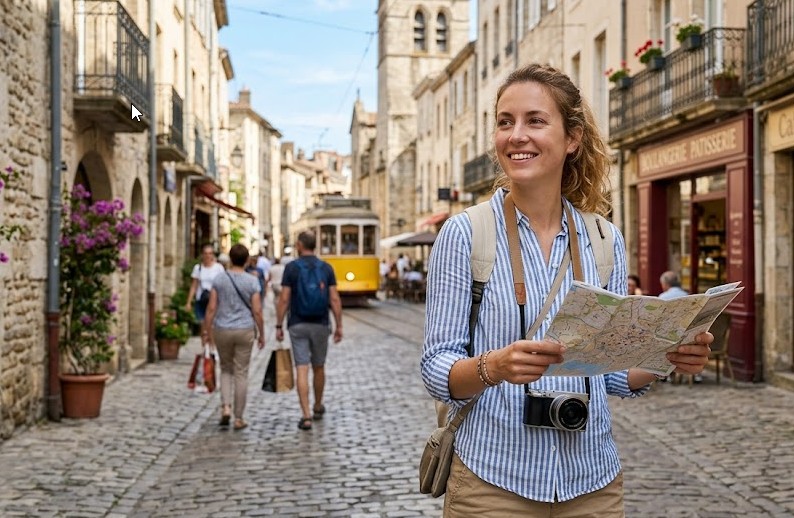
👤 Who Exactly Is a Tourist?
You might think this is obvious but the iGCSE exam uses very specific definitions. Getting these right can earn you easy marks. Let's nail them down.
Key Definitions:
- Visitor: Anyone who travels to a place outside their usual environment for less than 12 months, for any reason except employment.
- Tourist: A visitor who stays at least one night at the destination. Also called an overnight visitor.
- Same-day visitor (Excursionist): A visitor who does NOT stay overnight they arrive and leave on the same day. Cruise ship passengers are a classic example.
- International tourist: Someone who crosses a national border and stays overnight in another country.
- Domestic tourist: Someone who travels within their own country and stays overnight.
💡 Exam Watch: Tourist vs Excursionist
A cruise passenger who docks in Barcelona for 6 hours and then sails away is NOT a tourist they are a same-day visitor. They still spend money and use facilities, but they are counted differently in tourism statistics. Examiners love testing this distinction!
✈ Why Do People Travel? Purpose of Visit
The iGCSE syllabus requires you to classify tourists by their purpose of visit. This matters because different types of tourists have different needs, spend different amounts of money and affect destinations in different ways.
🌞 Leisure & Recreation
This is the largest category. It includes holidays, sightseeing, sport and relaxation. These tourists choose their destination freely and are highly influenced by marketing, price and weather. Example: A British family flying to Majorca for a beach holiday.
💼 Business & Professional
Travel for work attending meetings, conferences, trade fairs, or training. Business tourists often spend more per day than leisure tourists (hotels, restaurants, taxis). They travel year-round, not just in peak season. Example: A manager flying to Frankfurt for a conference.
👪 Visiting Friends & Relatives (VFR)
People travelling to see family or friends. VFR tourists often stay in private homes rather than hotels, so they spend less on accommodation but still use local restaurants, attractions and transport. Example: A student flying home to Lagos for Christmas.
⚒ Health, Religion & Other
Includes medical tourism (travelling abroad for treatment), religious pilgrimages and educational trips. Example: Millions of Muslims travel to Mecca, Saudi Arabia, each year for the Hajj pilgrimage one of the world's largest annual tourist movements.
🌎 Types of Tourist Destination
A tourist destination is a place that attracts visitors and has facilities to meet their needs. The iGCSE syllabus identifies several key destination types. You need to know what makes each one distinctive and be able to give real examples.
🏖 Coastal / Seaside Resorts
The most popular type of destination globally. Tourists are attracted by beaches, warm weather, water sports and relaxation. These destinations often experience seasonal demand very busy in summer, quiet in winter.
📍 Examples
Phuket (Thailand), Cancún (Mexico), Benidorm (Spain), Maldives
👑 Key Features
Hotels, beach facilities, water parks, restaurants, nightlife, souvenir shops
⚠ Key Challenge
Overcrowding in peak season, coastal erosion, pollution from sunscreen and waste
🏛 Urban / City Destinations
Cities attract tourists for their culture, history, shopping, entertainment and business facilities. City tourism tends to be year-round because there is always something to do regardless of season.
📍 Examples
Paris (France), New York (USA), Dubai (UAE), Tokyo (Japan)
👑 Key Features
Museums, galleries, theatres, shopping centres, historic buildings, business hotels
⚠ Key Challenge
Traffic congestion, pressure on housing, tourist-resident conflict (e.g. Venice, Amsterdam)
🌿 Rural & Countryside Destinations
These destinations attract tourists seeking peace, nature and outdoor activities. They are often linked to ecotourism and agritourism (farm stays). Rural destinations can be fragile environments that need careful management.
📍 Examples
Lake District (UK), Tuscany (Italy), Masai Mara (Kenya)
👑 Key Features
Walking trails, wildlife, farms, small guesthouses, local food, scenic landscapes
⚠ Key Challenge
Footpath erosion, litter, disturbance to wildlife, limited infrastructure
🏔 Mountain & Wilderness Destinations
These attract adventure tourists, skiers, hikers and those seeking dramatic scenery. They are often in remote locations with limited access, making infrastructure expensive to build and maintain.
📍 Examples & Features
The Alps (skiing, snowboarding), Himalayas (trekking, mountaineering), Patagonia (wilderness hiking). Facilities include ski lifts, mountain huts, guided tours.
⚠ Issues
Avalanche risk, environmental damage from ski runs, altitude sickness for tourists, seasonal employment only for locals.
🏭 Heritage & Cultural Destinations
Places where the main attraction is history, culture, or built heritage. These can be UNESCO World Heritage Sites, ancient ruins, or culturally significant cities. Tourists come to learn, experience and connect with the past.
Examples: Pyramids of Giza (Egypt), Angkor Wat (Cambodia), Rome (Italy), Kyoto (Japan)
🏭 Case Study: Dubai, UAE A Purpose-Built Destination
Dubai is a fascinating example of an urban destination that was largely purpose-built for tourism. In the 1970s, Dubai was a small trading port. Today it receives over 16 million international tourists per year. Key attractions include the Burj Khalifa (world's tallest building), Palm Jumeirah (artificial island), Dubai Mall and luxury beach resorts. Dubai targets high-spending leisure tourists and business travellers. It has invested billions in airports (Dubai International is one of the world's busiest), hotels and entertainment. This shows how a destination can be deliberately developed rather than growing naturally.
📌 Transit Points vs Tourist Destinations
Not every place tourists pass through is a destination. The iGCSE syllabus distinguishes between:
- Tourist destination: The main place a tourist travels to. They stay overnight and spend time there. Example: Paris.
- Transit point / stopover: A place tourists pass through on the way to their destination. Example: Singapore is both a destination AND a major transit hub for flights between Europe and Australia.
- Gateway city: A city that acts as the entry point to a wider region. Example: Nairobi is a gateway city for safari tourism in East Africa.
💡 Why Does This Distinction Matter?
Transit tourists spend less money and stay for shorter periods. Destinations need to convert transit visitors into staying tourists to maximise economic benefit. Singapore has done this brilliantly it markets itself as a destination in its own right, not just a stopover.
📈 Butler's Tourism Area Life Cycle (TALC)
This is one of the most important models in iGCSE Travel & Tourism. Richard Butler (1980) proposed that tourist destinations go through a predictable series of stages just like a product has a life cycle. Understanding this helps explain why some destinations are booming while others are declining.
The Six Stages of TALC
🚀 1. Exploration
Very few tourists visit usually adventurous travellers. Few facilities exist. The destination is largely unspoilt. Example: A remote island just being discovered by backpackers.
📈 2. Involvement
Local people begin providing basic facilities (guesthouses, guides). Tourist numbers slowly grow. The community starts to benefit economically.
🏢 3. Development
Rapid growth. Outside investors build hotels, resorts and attractions. The destination becomes well-known. Marketing increases. Local character may begin to change.
🎉 4. Consolidation
Tourist numbers are high but growth slows. The destination is established and well-marketed. Some older facilities may look dated. The local economy depends heavily on tourism.
⚠ 5. Stagnation
Visitor numbers peak and stop growing. The destination has a poor image or is seen as old-fashioned. Environmental and social problems may be serious. Example: Some traditional British seaside resorts like Blackpool.
🔄 6. Decline OR Rejuvenation
Decline: Tourists go elsewhere, facilities close, unemployment rises. Rejuvenation: New investment, new attractions, or rebranding brings tourists back. Example: Bilbao, Spain was rejuvenated by the Guggenheim Museum opening in 1997.
🏭 Case Study: Blackpool, UK Stagnation & Attempted Rejuvenation
Blackpool was Britain's most popular seaside resort in the early 20th century, attracting millions of working-class tourists from northern England. By the 1980s–1990s, it had entered the stagnation stage of Butler's model. Cheap package holidays to Spain drew tourists away. Blackpool's image became associated with cheap entertainment and decline. The local council has attempted rejuvenation investing in a new tram system, regenerating the promenade and attracting new events. However, it has not yet fully recovered. This is a classic TALC case study for your exam.
📋 Key Vocabulary: Tourist & Destination Types at a Glance
Use this table to check you know every key term. Cover the right-hand column and test yourself!
- Tourist: An overnight visitor who stays at least one night away from home.
- Excursionist (Same-day visitor): A visitor who does not stay overnight.
- Leisure tourist: Travelling for holidays, recreation, or relaxation.
- Business tourist: Travelling for work, meetings, or conferences.
- VFR tourist: Visiting friends and relatives.
- Coastal resort: A destination based around beaches and sea activities.
- Urban destination: A city attracting tourists for culture, business and entertainment.
- Heritage destination: A place attracting tourists due to its historical or cultural significance.
- Transit point: A place tourists pass through rather than stay at.
- Gateway city: A city that serves as the entry point to a wider tourist region.
- Butler's TALC: A model showing how tourist destinations develop through six stages: Exploration, Involvement, Development, Consolidation, Stagnation and Decline/Rejuvenation.
- Rejuvenation: When a declining destination is revived through new investment or rebranding.
📌 Exam Tip: Command Words Matter!
When a question says "Define" give a precise, concise definition (1–2 marks). When it says "Explain" give the definition AND say why it matters or how it works (2–4 marks). When it says "Evaluate" weigh up the positives and negatives and reach a conclusion (6–8 marks). Always use named examples in longer answers examiners reward specific places and data.
🎉 Well Done You Know Your Tourist & Destination Types!
You've covered all the key definitions and concepts for this part of Theme 1. Make sure you can recall the difference between a tourist and an excursionist, name at least one example for each destination type and describe the six stages of Butler's TALC model. Now take the quiz to test yourself!