💻 Introduction to Technological Factors Affecting Tourism Demand
Think about the last time someone in your family planned a holiday. Did they go to a travel agent on the high street? Probably not. They most likely searched online, compared prices on a website, read reviews on TripAdvisor and booked everything from their phone all in one evening. That's technology at work and it has completely changed the world of travel and tourism.
Technology is one of the most powerful forces driving changes in tourism demand. It has made travel easier, cheaper, faster and more accessible for billions of people around the world. For the iGCSE exam, you need to understand how and why specific technologies have increased (or sometimes changed the nature of) tourism demand.
Key Definitions:
- Technological factor: Any development in science, engineering, or digital systems that changes how people behave in this case, how they travel.
- Tourism demand: The total number of people who want to travel and the destinations, products and services they choose.
- E-tourism: The use of digital technology especially the internet to plan, book and manage travel.
- Low-cost carrier (LCC): An airline that keeps prices low by cutting extras like free meals and checked luggage. Examples include Ryanair and easyJet.
💡 Did You Know?
In 1994, there were fewer than 3,000 websites on the entire internet. By 2024, there are over 1.1 billion websites and thousands of them are dedicated entirely to travel. The internet has arguably done more to boost tourism than any other single invention.
🌐 The Internet and Online Booking
Before the internet, booking a holiday was a lengthy process. You had to visit a travel agent, look through brochures and trust someone else to find you the best deal. The internet changed all of that. Now, travellers can research, compare and book everything themselves often in minutes.
🔍 How Online Booking Changed Tourism
The rise of online booking platforms has had a massive effect on tourism demand. Websites like Booking.com, Expedia, Airbnb and Skyscanner allow travellers to instantly compare thousands of options for flights, hotels and holiday packages. This transparency in pricing has encouraged more people to travel because they can find deals that suit their budget.
✅ More Choice
Travellers can compare hundreds of hotels and flights in seconds, finding the best deal without needing a travel agent.
💰 Lower Prices
Competition between online platforms drives prices down, making travel affordable for more people.
🕐 24/7 Access
You can book a flight at 2am on a Sunday. There are no opening hours online, which makes spontaneous travel much easier.
🔍 Case Study: Airbnb
Airbnb was founded in 2008 and completely disrupted the accommodation sector. Instead of only being able to stay in hotels, travellers could now rent a spare room or an entire home from a local person. By 2024, Airbnb had over 7 million listings in more than 220 countries. This created entirely new tourism demand in places that had few hotels, such as rural villages, remote islands and unusual destinations. It also made longer stays more affordable, encouraging people to travel who previously couldn't afford traditional hotel prices.
✈️ Transport Technology and the Rise of Low-Cost Airlines
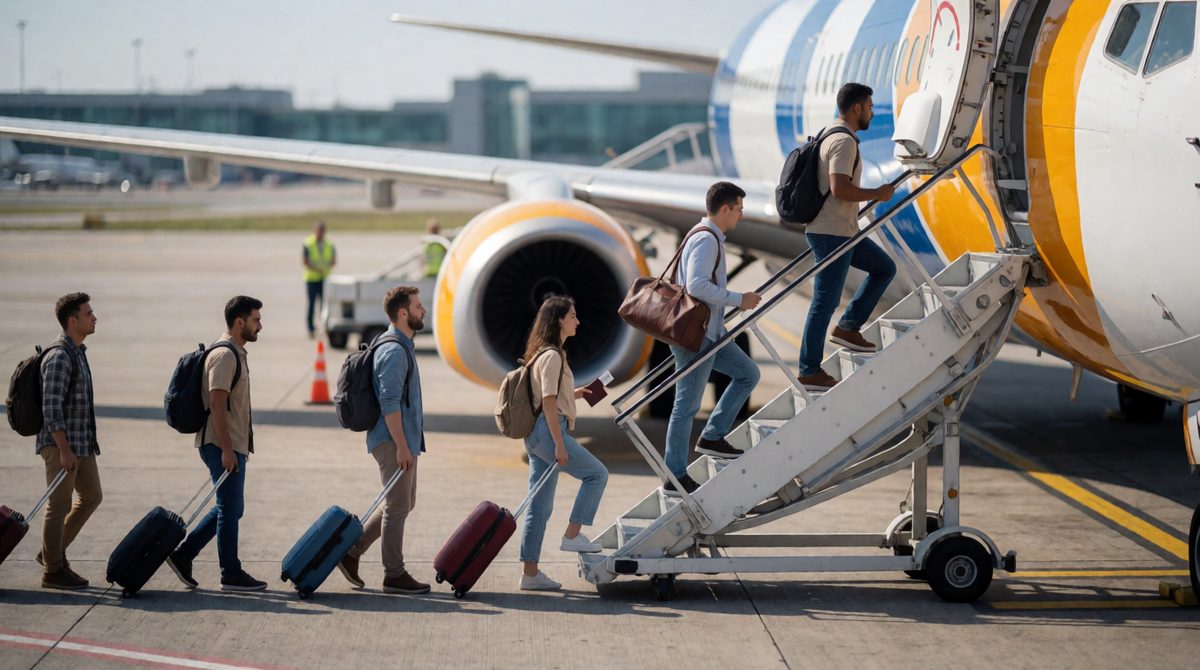
Low-cost airlines made travel affordable for millions
One of the biggest technological shifts in tourism has been in air travel. Advances in aircraft design, fuel efficiency and airline management systems have made flying dramatically cheaper over the past 30 years. The development of low-cost carriers (LCCs) airlines that strip away extras to keep ticket prices low has opened up air travel to people who could never have afforded it before.
🔍 Case Study: Ryanair and the Low-Cost Revolution
Ryanair, founded in Ireland in 1984, transformed European tourism. By using a no-frills model passengers pay for extras like hold luggage and seat selection Ryanair was able to offer flights for as little as £9.99. This made short-haul European travel accessible to millions of people on modest incomes. Cities like Krakow in Poland, Porto in Portugal and Riga in Latvia saw huge surges in tourism after Ryanair began flying there. In 2023, Ryanair carried over 183 million passengers more than any other European airline.
The key point for your exam: low-cost airlines increased tourism demand by making flying affordable for a much wider group of people.
🚀 Faster Aircraft
Modern jet aircraft like the Boeing 787 Dreamliner are far more fuel-efficient than older planes. This reduces operating costs for airlines, which can pass savings on to passengers. Long-haul flights to destinations like Australia or Japan are now within reach for ordinary travellers.
🗺 New Routes, New Destinations
As airlines open new routes, previously hard-to-reach destinations become tourist hotspots. Iceland, for example, saw tourist numbers jump from 500,000 in 2010 to over 2 million by 2018 largely because new direct flights made it easy to get there.
📱 Smartphones, Apps and the Digital Traveller
The smartphone has become the most important travel tool of the 21st century. From researching a destination to navigating a foreign city, smartphones have made travel simpler, safer and more enjoyable and this has encouraged more people to travel independently.
🔎 What Can Travellers Do With a Smartphone?
📍 Navigation
Google Maps and similar apps mean travellers no longer need to buy paper maps or hire local guides for basic navigation. This makes independent travel far less daunting.
💬 Translation
Apps like Google Translate can translate signs, menus and conversations in real time. Language barriers once a major reason people avoided certain destinations are much less of an issue.
🏭 Booking on the Go
Travellers can book last-minute hotels, tours and restaurants from anywhere. This encourages spontaneous travel and reduces the need to plan everything months in advance.
💡 Real-World Impact
A 2023 survey by Booking.com found that 70% of travellers use their smartphone as their primary travel tool. Apps like TripAdvisor, Google Hotels and Hostelworld are used by millions of people every day to make travel decisions. The ease of using these apps has directly increased tourism demand particularly among younger travellers who are comfortable with digital technology.
⭐ Online Reviews and User-Generated Content
Before the internet, you had to trust a travel brochure which was written by the company trying to sell you the holiday. Now, travellers can read thousands of honest reviews written by real people who have actually visited a destination. This has had a huge effect on tourism demand.
📋 TripAdvisor and the Review Revolution
TripAdvisor, launched in 2000, now has over 1 billion reviews and opinions on hotels, restaurants and attractions worldwide. Positive reviews can turn a small, unknown guesthouse into a fully booked success story. Negative reviews can destroy a business's reputation overnight.
For tourism demand, the key effect is increased confidence. When travellers can read genuine reviews from hundreds of previous visitors, they feel more confident booking a trip to an unfamiliar destination. This has opened up demand for destinations that might previously have been considered too risky or unknown.
👍 Positive Effect
A small eco-lodge in Costa Rica with 500 five-star reviews on TripAdvisor can attract international visitors who would never have found it through a traditional travel agent. Reviews create demand for niche and off-the-beaten-track tourism.
👎 Negative Effect
A destination that receives widespread negative reviews perhaps for poor safety, bad hygiene, or unfriendly service can see tourism demand fall rapidly. Reviews hold destinations and businesses accountable in a way that was impossible before the internet.
📷 Social Media as a Technological Factor
Social media platforms like Instagram, TikTok, YouTube and Pinterest have become powerful drivers of tourism demand. When someone posts a stunning photo of a destination, it can inspire thousands of followers to add it to their travel wish list. This is a technological factor because it relies entirely on digital platforms and internet connectivity.
🔍 Case Study: TikTok and "Set-Jetting"
A growing trend called "set-jetting" visiting locations made famous by films or TV shows has been turbocharged by TikTok. When the TV series The White Lotus (Season 2) was filmed in Sicily, Italy, TikTok videos about the filming locations went viral. Tourism to Sicily increased by over 30% in the months following the show's release. Similarly, the town of Gimmelwald in Switzerland saw a surge in visitors after travel influencers posted videos there. None of this would have been possible without social media technology.
💡 Travel Influencers
A travel influencer is someone who shares travel content on social media and has a large, engaged following. Top travel influencers can have millions of followers and earn money from tourism boards and hotels to promote destinations. When an influencer posts about a destination, it can generate enormous tourism demand almost overnight. This is a direct technological driver of tourism demand.
📈 Global Distribution Systems (GDS) and Travel Technology Infrastructure
Behind the scenes, technology also powers the systems that connect airlines, hotels and travel agents. Global Distribution Systems (GDS) like Amadeus, Sabre and Galileo are massive computer networks that allow travel agents and online platforms to access real-time information about flight availability, hotel rooms and car hire across the world.
Without GDS technology, the complex web of international travel bookings would be impossible to manage. These systems process millions of transactions every day and are the invisible backbone of modern tourism. Their development has made it possible for a single website like Expedia to offer you a flight from London to Tokyo, a hotel in Shinjuku and a car hire all booked simultaneously and confirmed instantly.
📱 Virtual Reality (VR) and Augmented Reality (AR) in Tourism
Emerging technologies like Virtual Reality (VR) and Augmented Reality (AR) are beginning to influence tourism demand in new ways. While these are still developing, they are already being used by tourism organisations to inspire travel.
👀 Virtual Reality (VR)
Some tourism boards and hotels now offer VR "taster" experiences you can put on a headset and virtually walk through a hotel room or explore a destination before booking. Tourism Australia has used VR experiences at travel expos to showcase the Great Barrier Reef. This can increase demand by giving people a taste of a destination and inspiring them to visit for real.
📷 Augmented Reality (AR)
AR overlays digital information onto the real world. Apps like Google Lens allow tourists to point their phone at a landmark and instantly receive information about it. Museums use AR to bring exhibits to life. This enhances the tourist experience and can increase demand by making destinations more engaging and educational.
📋 Summary: Key Technological Factors at a Glance
🌐 Internet & Online Booking
Made travel research and booking fast, easy and cheap. Platforms like Booking.com and Airbnb created new markets and increased demand globally.
✈️ Low-Cost Airlines
Aircraft technology and LCC business models made flying affordable for millions more people, dramatically increasing tourism demand.
📱 Smartphones & Apps
Removed barriers to independent travel through navigation, translation and instant booking tools, encouraging more people to travel more often.
⭐ Online Reviews
Gave travellers confidence to visit new destinations by providing honest, peer-written feedback. Increased demand for niche and emerging destinations.
📷 Social Media
Platforms like TikTok and Instagram inspire travel demand by showcasing destinations visually. Influencers and viral content can create tourism booms.
📈 GDS & VR/AR
Behind-the-scenes systems make complex bookings possible. VR and AR inspire travel and enhance the tourist experience.
✅ Exam Tip
In the exam, don't just say "technology has increased tourism." Be specific. Name the technology (e.g., low-cost airlines, online booking platforms, smartphones), explain how it works and say why it increases demand. Use real examples like Ryanair, Airbnb, or TripAdvisor. Examiners reward specific detail and real-world examples.
💡 Quick Revision Checklist
- ✅ I can explain how the internet and online booking platforms have increased tourism demand
- ✅ I can describe how low-cost airlines have made travel more accessible
- ✅ I can give examples of how smartphones and apps have changed travel behaviour
- ✅ I can explain the role of online reviews in building traveller confidence
- ✅ I can describe how social media and influencers drive tourism demand
- ✅ I can give at least two real-world case studies linking technology to tourism demand
- ✅ I understand what a Global Distribution System (GDS) is and why it matters
- ✅ I can explain how VR and AR are beginning to influence tourism